Followers

Showing posts with label WW2 Poland. Show all posts

Thursday, 8 May 2025

Line of Departure is Dead - Long Live Startline!

The simple WW2 rules I have been developing under the working title Line of Departure seem to be working out, and I have decided to set aside the more complex original Startline rules. The simpler rules will be the game I'll be developing going forward.

So I've decided to re-name Line of Departure as Startline, as I like the shorter name. Likely to cause confusion? Don't be so silly!


The latest version of the new Startline rules is available for download on my Facebook group:


For those not on Facebook I have added a link below to the file on my Google Drive. Let me know if you have any issues with the link. Unfortunately Google Drive alters the formatting slightly so the downloaded file has some formatting issues. You might want to try downloading the file in different formats - say, PDF rather than Word, and see if that helps. But if you download as a Word doc at least you can re-format fairly easily. The tables seem to come out OK. 

Download

'Til next time!

Saturday, 1 March 2025

A WW2 Rules Revolution (part 2)

Almost exactly 4 years ago, in February 2021, I wrote a blog post about developing my own version of the WRG 1973 World War Two rules. I've continued the work on and off for those four years, resulting in the Startline set of rules that can be found in the Files section of my Facebook page. I've had a lot of fun developing the rules and the associated data tables, and I've learned a lot. I believe I can claim that the rules as they now stand are a new and quite different set from the original booklet.

Now, don't tell me, you're waiting for the 'but'. Hmmm. But.

But, looking through them recently, I started to wonder if they hadn't grown a bit too, well, large for my current tastes. The games were easy enough to actually play, but it seemed like there was a lot of stuff to wade through for a player new to the rules. I believe the current phrase is barriers to entry. My recent use of the Age of Hannibal rules for my ancient games was a factor here - it was evidently possible to have a set of rules for a complex historical period where the actual playing rules were just eight pages. So I started to think about simplification.

I actually went right back to 1963 and Donald Featherstone's second book, Tackle Moel Soldiers This Way. At the end of the book there are 3 delightfully simple and old school rule sets, one of which is for WW2. Interestingly it includes infantry on group bases, a quite modern idea for that time which I presume Mr Featherstone picked up from Joe Morschauser.


Anyway, I knocked up a really basic set of rules on less than 2 pages of A4. They were clearly far too simple for modern sensibilities, so I made them a bit more complex. After a solo game or two, I upped the granularity a bit more. My number of armour classes, for example, had gone from three, to five, and then to six. There I stopped. I now have a set of rules that takes up 5 pages of A4, along with a two page QRS. I'm really quite pleased with them, and I've called them Line of Departure. I'm getting the feeling that they might end up replacing Startline as my main WW2 rules. 

The good thing is I can tack on all the background stuff from Startline to fill in the detail for all the various odd situations that WW2 gaming creates, and furthermore the data tables from Startline are easily adapted for Line of Departure. The turn sequence is exactly the same as for Startline - it's the mechanics which have been stripped back. Anyone who's interested can find the rules to download in the Files section of my Facebook wargaming group. Just be aware they're under development, and therefore incomplete in some areas, as well as being subject to change.

So, How Long Does a Turn Represent?
This is a question I was asked about Startline, and of course it has been a nagging question for all wargames rules for many decades. Rules writers have taken a number of stands on this question, from 'I don't really care' to something like 'exactly 30 seconds'. Personally I'm in the former category these days. One particular problem was that the guys who insisted on a 'correct' time scale had to admit that their battles only lasted for about 10 minutes or less of game time, which was a bit of a thorny issue. However, one of the best answers to this question came in the 1980 book by George Gush, A Guide to Wargaming

   "when the fighting starts [...] the model soldier [...] never rests; if not feverishly loading and firing at top speed, or hacking away in a melee, he is marching flat out for some point where he can carry out these activities, or just possibly running rapidly to the rear. He never waits for orders, hoping they will not come, or falls out to take his boots off, for a rest or some other physical need; he never smokes a cigarette, straggles or drags his feet on the march or gets lost.

His commanders, too, show an almost uncanny grasp, down to unit level, of the overall battle situation, and direct their men in the best way to achieve the general objective without requiring 'O' Groups, addresses from Caesar or whatever the contemporary method was..."

How true. And in a game, how can it really be otherwise? The guys at WRG used to get told off for saying that each turn could be considered to contain "a variable amount of delay', as this was all rather too vague for the time and distance fanatics. But in fact the WRG were right. 


This question has been brought home to me recently, as I have been reading George Bernage's Battle of the Odon (the Battle of the Odon may be more familiar to some of you as Operation Epsom, June 1944). The interesting thing about George's book is it goes right down to company, platoon and even section level, with some 'then and now' sections showing detail of where and how the various small unit actions took place. I've only just started the book, but straight away it's facinating to see how half an hour or an hour could just waste away as units lose their way, are pinned by enemy fire, or just stop when uncertain and wait for someone to tell them what to do - only to find that their leaders have all been killed or wounded. Or maybe the leaders themselves find they don't know what to do, in the confusion, fear and chaos of combat. So the unit just does nothing for a while until someone gets a grip


This kind of thing could be represented on the tabletop, I suppose, but it wouldn't really make much of a game, would it? It's interesting to reflect, in this regard, how frustrated some gamers can be when the command and control rules in use mean a particular unit does nothing for a couple of turns, or even longer. "This would never happen in real life!", they lament. Well, it seems it did. All the time. Those using a variant of the Warmaster command system (for example, in Black Powder, or Blitzkrieg Commander) will know this issue well.

So, I conclude that 'how long does a turn represent' may not be as relevant a question as some people think. In Line of Departure, I am deliberately not bothering with such things. The only relevant scales are what moves and firing distances make a company-level game work on a 6' x 4' table, and the only time-scale worth worrying about is how many turns a game lasts. Somehow, as most of you will know, the results of such an attitude have an uncanny similarity to the mechanics of those who continue to insist that time and distance scales really matter.

I'll be updating the LoD rules in the near future, so if you're interested keep an eye on the Facebook page. I hope maybe a few of you may get some value from them, or even feel able to make some constructive criticisms.

Anyway - 'til next time!

Tuesday, 23 July 2024

"Testing, Testing..."

In early May, just before my wife and I set off for our 8 week Scandinavian adventure in our motorhome, I was working on two ideas that I thought might enhance Startline. The first was a new, alternate move sequence (rather than the current IGO-UGO), and a new morale system. Both offered interesting and quite fundamental changes to the game, so on my return I was keen to try them out.
Packing up the motorhome can be time consuming.

Do IGO or do UGO?
Startline currently uses a pretty traditional IGO-UGO system - I move and fire all my stuff, then you do the same with yours. Most of you will know the various arguments as to why this can be a problem - the most common being that one player stands there doing nothing (or not much), whilst the other player has all the fun. This has never really been a problem for me, as I am a gamer who enjoys watching the battle unfold, and I am very content to watch my opponent do his (or her) thing. Some banter can always be applied to liven things up - a loud sucking of the teeth combined with a doubtful shake of the head can often tempt your opponent to change their move. If part of a multi-player side, you can also indulge in behind-the-hand whispers about what your opponent is up to, which may cause additional alarm and despondency. 

There is, of course, the very basic argument that IGO-UGO is just plain old-fashioned.

For me, a much more telling critique of IGO-UGO is that it is too predictable and is a poor representation of battlefield events. To put it simply, the actions we are trying to represent are rather more interactive and less orderly than IGO-UGO implies. Thus, some form of alternate activation has become fashionable - one of my units goes, then one of yours, etc., until everyone has 'gone'. A further step in this process is random activation, where which player goes next is decided on a die roll, or picking a counter, or turning a card. Bolt Action is the most well-known WW2 game using this mechanic, where tokens are drawn from a bag. 

I recently came across this video on YouTube which covers this subject, amongst others. The whole video is interesting but the IGO-UGO discussion commences at 6.50.

One of the commenters on the video made a point which chimed in with my own thoughts - that random activation can get just a bit too random. The feeling of creating and executing a plan disappears and one ends up just reacting. Now some may argue this is quite a good representation of WW2 combat at section/platoon/company level. But my own view is that too much random can spoil a game. Hence my aversion to the recent resurgence of the 'special event card' mechanic - for example, the Fate Cards in Valour & Fortitude. The dice make our games quite random enough, IMHO.

So, I went for alternate activation, where Side A picks a unit and fires and moves with it, then Side B, then Side A again, etc. Indirect fire and air strikes are done by both sides in an opening phase of the turn, and after activation is finished both sides check morale.

Run Away!
The morale section in Startline is also currently pretty old school. A die roll, a set of modifiers (perhaps a few too many for modern tastes), and then check the total against a results table. Here, the inspiration for something different came from an online contact with a gamer in the U.S., Tom Dye. He had been thinking about what might be wrong with morale rules in miniature wargaming, and I took away two ideas from his thoughts - first, that more than just 3 morale categories (in my rules, hesitant, regular or determined) might be preferable, and that morale during the course of an action would go up and down, in particular as a result of the leadership qualities and interventions of the unit command, and this should be tracked in a game on a turn-by-turn basis. 

Now, hardly ground breaking you might think, but these ideas helped me see the way to a different morale system. Basically, each unit would start the game with a number between 6 and 12, which would be its Morale Value. Events through the game (mainly casualties) would reduce this, but the Morale Value can also be recovered through a rally rule. There is a still a results table that tells what the Morale Value of a unit means in terms of behaviour in the game - basically either OK, no advance, fall back, or run away. The upsides here were a system that looked a bit more original, and a significant reduction in the number of modifiers during morale tests.

Test Game 1
So, I embarked on a couple of test games to check out if the new rules were viable. I went for just a 4' x 4' table which would enable a quick set up. The terrain was adapted from the 'Cristot' scenario in the Dave Brown 'O'Group rule book. The first game was an attack-defence scenario with a German recce group attempting to seize and hold a Polish village during the 1939 campaign. Forces were of the same points, according to my points system:

German - Force HQ + 2cm AA on half track
Heavy Armoured Car platoon - 3 x Sdkfz231 
Light Armoured Car platoon - 2 x Sdkfz221, 2 x Sdkfz222
Motorcycle Infantry platoon
Truck-mounted Infantry platoon
75mm IG75 section - 2 guns

Polish - Force HQ
Infantry platoon x 2 (each with 37mm Bofors anti-tank gun attached)
TKS platoon - 3 x TKS mg, 1 x TKS 20mm
Tank platoon - 3 x Vickers 47mm, 2 x Vickers mg
Mortar section - 2 x 8cm mortars off-table with MFO on-table

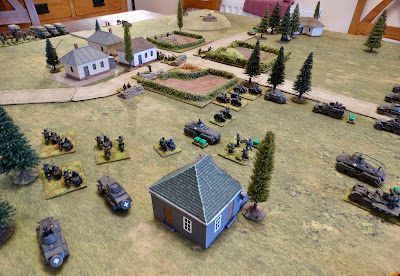
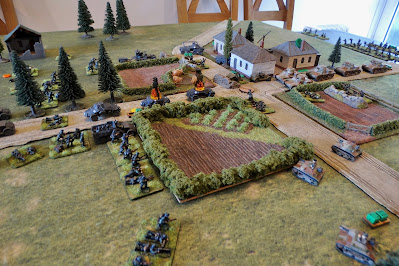
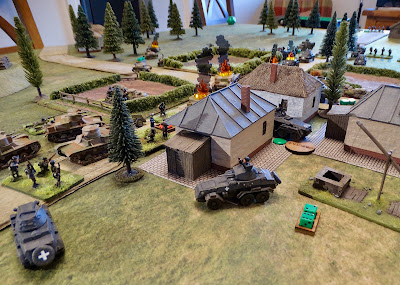
A few photos just to give you an idea:
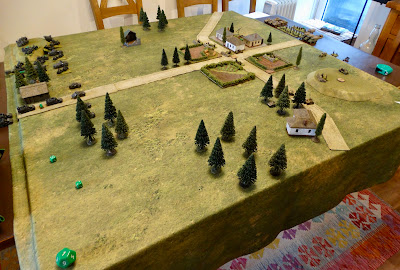
Set-up. Germans attacking from left.
Half the Polish force started off-table in reserve.

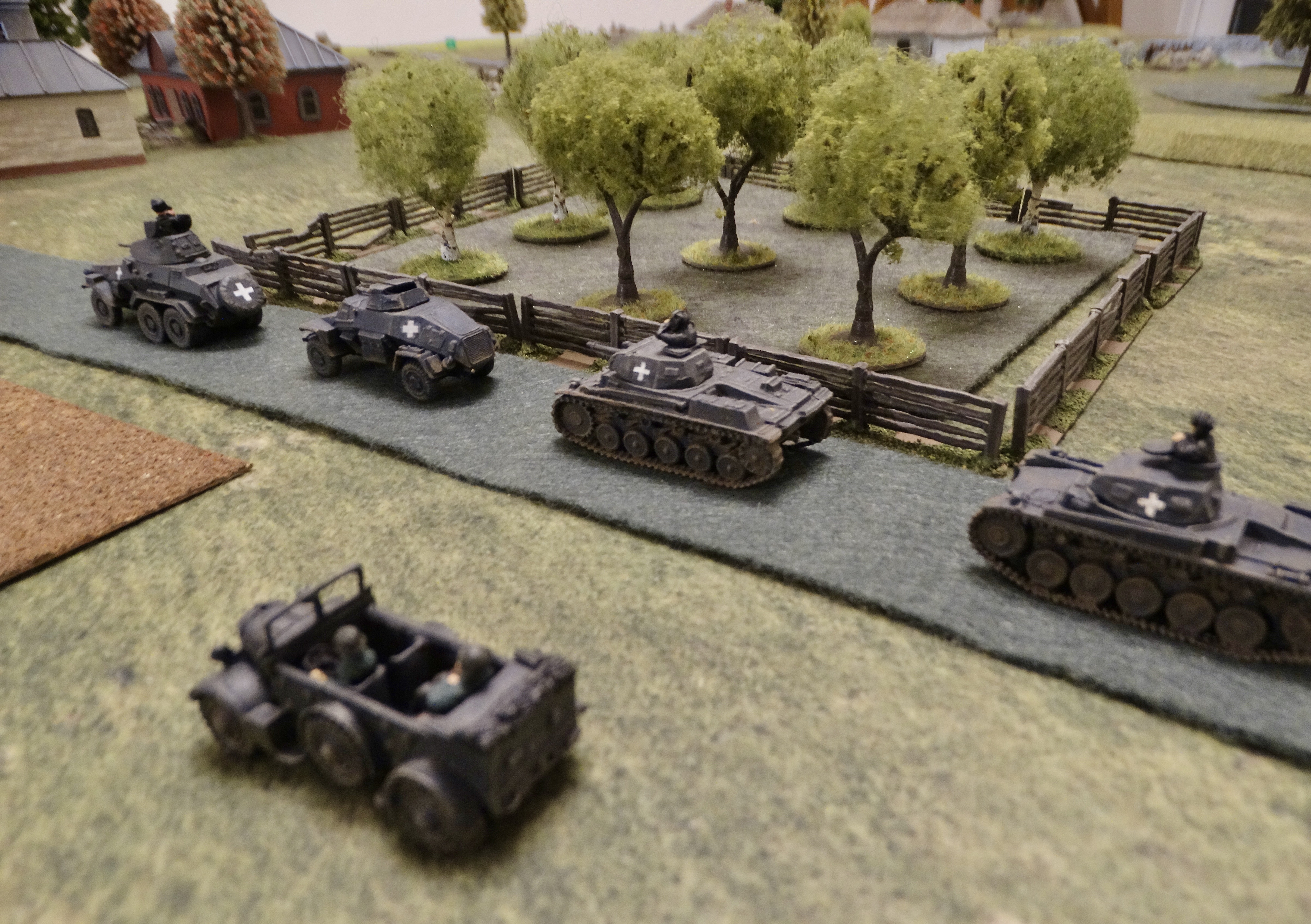
German armoured cars and motorcyle infantry making good progress...

...until the Vickers tanks arrive and things get messy.


The German heavy armoured cars managed to penetrate into the rear of the village.
You can see that their Morale Value is 8.

This first game was a bit confusing as I got used to the new ideas. To be honest, I wasn't convinced things were going to work out with the new rules. For the record, the Germans lost despite their bold advance, as they didn't manage to claim the required 2 objectives in 8 turns.

Test Game 2
For this game I decided that simpler forces and a simpler set up would enable me to concentrate on how the new rules were functioning. So I tweaked the terrain slightly and went for a tank-heavy encounter engagement:

Germans - Force HQ
Medium Tank platoon x 2 - each 5 x Pz38t
Light Tank platoon - 5 x PzIIc
Motorcycle platoon 

Polish - Force HQ
Light Tank platoon x 2 - each 5 x 7tp
Medium Tank platoon - 4 x Renault R-35
Truck-mounted Infantry platoon

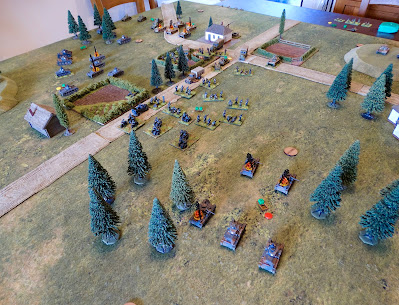
Points values between the 2 forces were once again just about equal. Some more photos:

Set-up. Germans to the left once more.

Half-way point. Tanks casualties high on both sides.


Polish infantry retreating from the crossroads area.

In this game the Germans won by claimng one objective, whilst the Poles could claim none. A much more positive game where I could see the wood for the trees, or to put it another way, I could see the new rules working rather better.

So, overall, I'll be sticking with the new rules for future games - but there is a way to go yet. I might end up dumping either or both of them, or more likely adopting them in an amended form. We'll see. Should be a fun process!

To check out the new rules, visit the Startline io group, and look in the Files section. If you're not a member, it takes a couple of minutes to join. Free rules - what's not to like?

'Til next time!

Wednesday, 10 April 2024

A 'Startline' Wargame - Poland 1939

It was good over a recent weekend to have the opportunity to set up a Startline scenario and play the game through, first solo, then with a live opponent in the shape of my long-time friend and wargaming opponent Paul. I only have the one WW2 collection, so as usual this fictional engagement was set during the 1939 Polish campaign. 

To create a suitable scenario, I turned to a resource I have been using for a few months now, the latest list of Flames of War missions. These are available for free download online (you can also get a printer-friendly version without the fancy background). Thanks to FoW for making this available. The scenarios suit Startline very well, as my rules are set at exactly the same company level as FoW, and the basing is pretty much identical as well. 

As you will see if you check the link, the scenarios don't give specific terrain, but do give everything else you need - type of scenario (i.e. attack-defence, encounter), the details of deployment, victory conditions, and any special rules needed. So it's easy to replay any scenario several times by just changing the terrain, the period, or the forces used. Each scenario uses equal points forces on both sides - attack-defence set-ups work by having only around half the defenders on table to start with and the rest arriving as reserves. This gives the attackers a decent chance to win. Many of the scenario deployments are quite unusual and original, and give an excellent alternative to just setting up on opposite sides of the table.

One such is 'Hold the Pocket', which was the scenario I chose to play. You can check the details of this scenario on the download, but essentially the attacker deploys down each short table edge, whilst the defender holds a box centred on one of the long table edges. The defender is thus being attacked from both sides. The photos below show the terrain and forces for the second game, with the deployment areas outlined with green dice.


As you can see, the terrain was flat, with a settlement and crossroads within the defender's box, or 'pocket'. On one flank, a stream ran between the pocket and the attacker's deployment area. This was crossable, but a bridge was also available. I chose the simplest possible victory conditions - one objective marker was placed on the crossroads, and the attacker had to claim this to win. If he did so in 6 moves, that was that. If not, an extra two moves were allowed. If the defender still retained the objective, the defender had won.

Naturally the Germans were attacking. The forces were:

German
Battlegroup HQ.
Panzer company with CO:
Medium platoon: 2 x PzIV, 2 x PzII. Medium platoon: 2 x PzIII, 3 x PzII. Light platoon: 1 x PzII, 4 PzI.
Infantry company with CO:
3 x infantry platoons. One platoon is motorised with a Pak 36 attached.
AA section: 2 x 2cm Flak 30.
Off-table artillery: 2 x 10.5cm batteries, each 4 guns.
AFO, and an airborne AOP (Hs-126) also available.

Polish - on table
Force HQ.
2 x infantry platoons, each with 1 x MMG and 1 x Bofors 37mm attached. 
1 x 75mm wz.1897 (attached to one of the infantry platoons).
AA section: 1 x 40mm Bofors, 1 x AAMG.
MFO.
AFO.
6 x 4" square minefields (to be combined as required).

Polish - off table
Recce platoon: 3 x Wz.34 armoured cars
Tank platoon: 3 x Renault FT-17.
Off-table mortar section: 2 x 8cm mortars.
Off-table artillery: 2 x 75mm wz.1897 batteries, each 4 guns.

I had decided to keep the Poles as a basically infantry force. To make up the points against all those German tanks, the minefields were just the thing. As the Polish commander, I marked their location on a map, leaving Paul to guess their location until one of his elements entered and had to roll for destruction. This makes for a nice bit of gameplay, and is simple to set up. Paul had the advantage of an AOP to spot for his artillery, and the use of a pre-game barrage, which also added a bit of extra flavour to the game. I used the normal FoW reserves rules for the entry of the Polish recce and tank platoons.

In the first game, other commitments meant I only had time to play out 4 moves. In the second game, Paul failed to gain the objective in 6 moves. We had to call the game there, but it looked like playing an extra 2 moves would have put victory in his grasp.

So, nothing remains but to show a few photos of the games in progress. I would strongly recommend any WW2 gamer to check out those FoW missions, if you aren't already aware of them. Very useful.

Solo Game:

The settlement after the pre-game barrage.
The Polish AFO copped it, a serious set-back.

German motorised infantry cross the bridge.

The brown counters mark a minefield.
Note the two Panzer Is overunning a Polish trench.

The motorised infantry make progress.

Heavy pressure on the Polish right flank -
but the Poles are fighting back.

A punishing airstrike by German Hs-123s.

German tanks are at the gates of the village near the Polish baseline.
But the red marker shows they have been forced to retreat following
the destruction of the acompanying Company Command tank.

Game with Paul:

One of the Polish platoons is falling back following artillery and airstrikes.
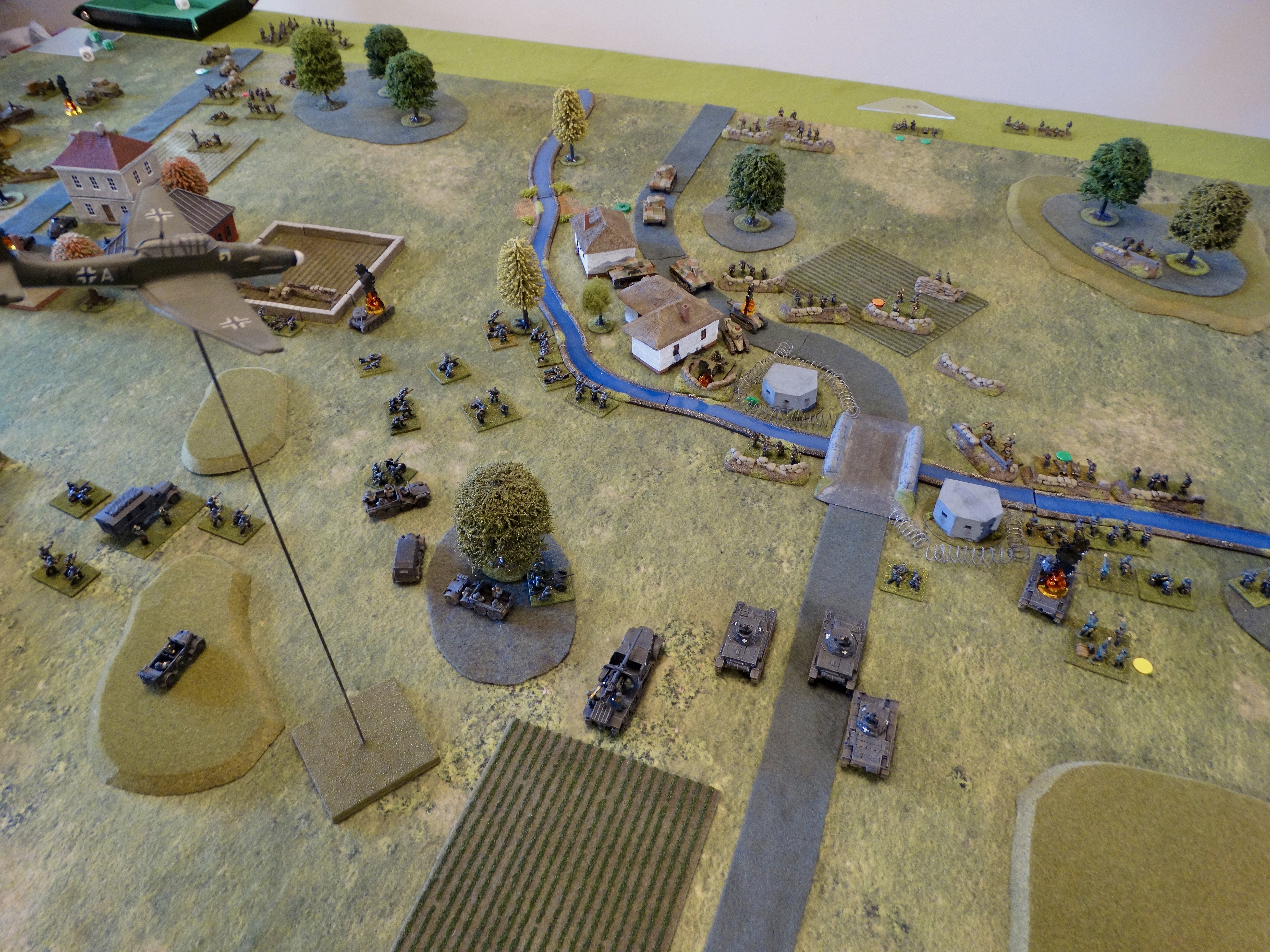
Note the orange marker and the Stuka over the table.

The main German attack makes progress...

...but the German diversionary attack is easily halted. 
The yellow markers show morale is wavering.

Close, but not close enough.
The village is still in Polish hands (just) after 6 moves

Movement Rates
One issue I've been dealing with in Startline is movement distances. How to get the game moving faster without making move distances unrealistically large? I've already been using my usual solution - allow for increased moves (and sometime decreased moves) on a die roll related to unit quality, with the presence of company commanders making larger moves more likely. Following these two games, I've also added what I call 'march moves', which add 50% to movement when out of contact with your opponent. Most of you will be familiar with the concept - increased moves as long are you are not too close to the enemy, sometimes called 'reserve moves'. I use this kind of thing in Shadow of the Eagles. In FoW, Battlefront introduced what they call 'dash moves' in version 4 to achieve the same thing. I guess we'll see how things go.

Thanks for visiting. 'Til next time!

Sunday, 28 January 2024

Ah Yes...Facebook

I have never really thought Facebook was a good place for wargaming sites. The Facebook pages or groups I visited seemed to lack focus and looked to me like a jumble of messages and posts with little order or organisation. So I set up 'proper' websites for Honours of War and Shadow of the Eagles, with forums, download sections, author content etc. 

Well, the Honours of War site has worked pretty well for about 9 years, but activity is now limited to a few stalwart members. These guys post some great content, but for a set of rules published in 2015 a website was beginning to look like a luxury I couldn't afford.

The Shadow of the Eagles site had some interest at first, but this has faded recently and there is currently very little activity. The simple fact is that SotE sold less copies than HoW. This is pretty easy to explain - the Napoleonic rules market is much more competitive than the SYW one, and Osprey have a much higher profile than Partizan Press - particularly with their 'Blue Books'. With the annual renewal of the site coming up, at much increased cost, renewal just didn't seem worth it for a site generating almost zero posts on the forum. (As an aside, check out the Little Wars TV review of the Blue Book series HERE).

On the other hand, people kept telling me Facebook and Instagram were the places to be if one wanted to generate interest in your rules. Once you joined Facebook and your page or group got going, you became part of a significant online conversation, where people joined and posted on your little group, and you joined and posted on their groups. Interest might therefore flourish. This is the problem for small-time rules authors - once the initial publicity has faded, there is the danger that your rules will just sink without trace amongst all the other rule sets.

So there we are - I want to keep interest in my rules alive, and Facebook seems to be a good place to help that along. At least, that's the case according to my kids - and my wife. And a number of fellow gamers. And Dave Ryan at Partizan Press, who always wanted me to have a Facebook page. And recently, well-known military historian and Osprey author Angus Konstam also encouraged me along this route.

So, in a month or so, I will be saying goodbye to the HoW and SotE sites. To anyone who ever posted on those sites, or just joined to download free stuff, my sincere appreciation and thanks. I learned a lot from the questions asked and comments made, and this resulted in some rule amendments and errata corrections. All the errata and new or amended rules will continue to be available on Facebook, free to download. 

The Facebook group is set up, and you can apply to join via the group page:


As for Startline, the discussion group on groups.io will continue (see the Startline Discussion Group). After all, this group has only just started and I want to keep the momentum going. Anyone interested in Startline should keep an eye on both groups. 

For the record, where Startline is going remains uncertain, but I'm enjoying working on the rules immensely. I'll just keep plugging away and time will provide an answer as to what to do with them. The secret to success (as the Buddhists and mindfulness experts tell us) is to love the process, not crave an outcome. That works for me!

So, I hope to see you on the new platform. 'Til next time!

Monday, 6 November 2023

STARTLINE - Wargaming World War Two

I have mentioned previously on this blog my work on a set of company-level WW2 rules inspired by the WRG 1973 set 'Armour and Infantry'. I have spent many pleasant hours working on these rules recently, and thought it was now time to open up the content to my fellow gamers.


The changes to the original rules have increased to the extent that I now consider the rules to be a new and separate set, which I have called Startline. You can go to the group via the link below, and join up if you wish:

All interested wargamers are welcome to join. If you have not received a specific invitation, membership is subject to approval, to keep out spammers. 

You can download the present version of the rules and a few other files I have included for background. At the moment a QRS is not available, mainly because creating one is a bit of an issue. Startline covers the whole of WW2, but each wargamer will only want the details relating to the part of WW2 he or she is gaming. So I'm still working on a useable format.

Those of you on the CWD mailing list should have received an invitation email - if not, one will arrive in the next day ot two. Apologies if this represents unwanted junk mail - just ignore it and it will go away! Wargamers who have expressed an interest in my ongoing work via this site should also receive an invite - but if you want to just go straight to the group and sign up, that's fine.

Finally, this is a just a hobby project at the moment. The group is there for individual gamers to download a set of rules, game with them if they wish, and post any comments or suggestions they have. In other words, we are just exchanging ideas on a personal set of rules. 

I hope to hear from you via the comments on this post, or via the group. 
 

Friday, 31 March 2023

Clear The Woods September 1939

Here we go with another WW2 scenario, played using my WRG 1973 revised rules. This time I was fortunate to have a live opponent - many thanks to Steve for coming over and helping out. If anyone finds the title and map of this scenario ringing some bells, both belong to a Napoleonic skirmish scenario laid out in WSS magazine a year or two ago. The original magazine is, alas, long lost, so I can't refer readers to the source.

Suffice to say that the Germans are attacking from the west, entering the table on move 1 along the two roads (sectors A and B on the map). Force A is based around a Combat Engineer platoon, force B is based around a Kradschutzen platoon. Their overall objective is to clear the wooded terrain of the enemy, and make a clear path for the tank units following them up. The Poles are there to delay them as long as possible. The four specific objectives are indicated by the red dots on the map, and as indicated in the scenario details the Germans have to take at least 3 of them to win. Game duration would be as long as we decided it was worthwhile - this was, after all, basically a test game.

As usual, the table was 6' x 4'. If anyone needs reminding, the models are 15mm or 1/100th scale. The Poles were free to dig-in as required.


Forces

How It Played
Due to the rules requiring elements of a platoon to stay within 200m of their command element, or 50m from each other, the Poles would need to deploy the cavalry platoon guarding one road, whilst the recce sections guarded the other. Thanks to Steve, I was able to see how my 'dummy counters' rules worked to disguise the details of the Polish deployment (quite well, as it turned out). 

As so often with a new scenario, it turned out to be a little unbalanced, and the Germans had a tough time making progress without proper armoured support. Hence the recommended addition of an under-strength panzer platoon along each road. This should create a more mobile and equal game. You could try more armoured cars if you prefer, giving the Germans a full armoured car platoon of 4 or 5 vehicles down each road to give the Germans a proper chance of punching through the Polish defences.

Overview of the table, with dummy counters in place.

The Germans made reasonable progress on the southern road.

Things were a bit slower on the northern route, due to a nicely
placed artillery strike which caused casualties and disruption.

As dummy counters were revealed, it became necessary to
winkle out Polish opposition.

The leading armoured cars from the southern column reach the ford.

The Polish 'strategic reserve', as Steve called them, take some
mortar fire at the crossroads. Polish AFO seen behind.

The Poles are making a stand at the northern roadblock.

A German airstrike appears, but as so often the effect is limited.

After 7 moves it was time for Steve to head home.
German progress had been halted - it seemed they
needed more mobile firepower to make a breakthrough.

De-Brief
The Poles had won, but it seemed obvious the Germans needed a bit more 'oomph' to make a game of it - unless of course the Polish forces were reduced. So I think adding about 3 German tanks up each road should do the trick - the Germans will be able to overcome the initial Polish defences, giving them time to dismantle or go around the roadblocks before taking on the FT-17s.

This was Steve's first try at these rules, and he seemed to settle into them without too much trouble. He commented on their 'old school' feel, which is hardly surprising considering their vintage. Will he be abandoning Blitzkrieg Commander, his favourite rules of many years? I doubt it, but it seems we have an altenative set of rules with a different figure scale to add variety to our WW2 engagements.

To see Steve's report and his comments on the rules, go over to his excellent blog:


"Til next time!

Wednesday, 8 March 2023

The Action at Rudnik - Poland 1939

For the moment, my main project continues to be developing my variant of the WRG 1973 Armour and Infantry rules. Tweaking the morale rules (or 'reaction' as the rules call it) had been causing me some trouble, but I thought I now had it figured out.

I decided to test things out using a full-blooded attack-defence game with a battalion-sized German Kampfgruppe attacking a Polish position. I hope any readers gaming WW2 will find the scenario of interest, regardless of the rules you are using.

The terrain map (6' x 4' table) is shown below. 


The Germans are coming from the south, and are looking to open up the routes to the north. They need to capture Rudnik and force a crossing of the bridge. 

All the hills are classed as 'low', which means that they are just representing folds in the ground or low rises which block line-of-sight but have no other effect on the game. The narrow river is crossable by infantry, but vehicles will roll as they wade: a 1 or 2 and they are stuck. The pillboxes hold an MMG each. The defenders can dig-in as required. Polish reinforcements dice from move 2, needing a 5+ to arrive. If they fail, they try again next turn on a 4+, and so on. Arrivals dice 50-50 to see which road they will arrive on.

The forces were:

German - 'Kampfgruppe Meyer' (attacking from the south)
Kampfgruppe HQ - Command group in radio truck

Panzer Company HQ - 1 x panzer I command tank
2 x light panzer platoons - 3 panzer II, 2 panzer I
1 x heavy panzer platoon - 2 x panzer II, 2 x panzer IV, 1 x bunkerflak (attached)

Infantry company HQ - 1 x light truck with radio
3 x infantry platoons each - 1 x platoon command group, 3 x rifle group, 3 x rifle/lmg group, 1 x 5cm mortar group, 1 x anti-tank rifle group, 1 x MMG group

Recce section - 1 x sdkfz 231 (6 rad), 1 x sdkfz 222

Anti-tank section - 1 x light truck with command group, 2 x towed pak 36

Off table mortars - 6 x 8cm mortars with on-table MFO
Off table artillery - 4 x 10.5cm howitzers with on-table AFO

Polish (defending. Placed up to 700m/28" from north table edge)
HQ - Company command group in truck with field telephone

2 x infantry platoons each - 1 x platoon command group, 6 x rifle group, 3 x rifle/lmg group, 1 x 46mm mortar group, 1 x anti-tank rifle group, 1 x 37mm anti-tank gun with tow. Right flank platoon also has a towed 75mm field gun attached.

MMG section (attached to left flank platoon) - 2 x MMG group

Attached tank platoon - 4 x Renault FT-17

Reinforcing tank platoon - 4 x 7tp

Reinforcing recce section - 2 x Wz-34 armoured cars

On-table mortar section - 2 x 8cm mortars with command group and MFO (telephone only)
Off table artillery - 4 x 75mm field guns with on-table AFO


Photos of the Battle

A Polish 75mm field gun waits in Rudnik

The Polish positions in Rudnik.
Many infantry bases were inside the houses.

Polish positions around the bridge.

Overall shot before game start. 

The pre-game barrage fell on Rudnik and was deadly.
Many infantry elements were knocked out and the platoon fell back.

German armour races forward past the orchard.

Polish artillery claims a truck on the German left flank.

Tank platoon with infantry on the German right.

As the Poles fall back, German armoured cars enter Rudnik.

The Germans edge forward towards the bridge.
The pillboxes are pounded with suppressive fire.

Polish reinforcements (the 7tp platoon) enter the table,
passing by the Polish mortar position.

Overview in mid-game.

The Germans press forward to the bridge, firing as they go.

Polish casualties around the bridge include
a 37mm anti-tank gun and an FT-17.

At last the German infantry close up to the stream, 
only to be bracketed by Polish mortar fire.

The Poles evicted from Rudnik manage to fight back.
German armour burns in the village square.

A Stuka strike arrives over the bridge area.

The Poles at the bridge are under pressure but holding...

...They have the support of both tank units.

After 6 moves I stopped the game. Rudnik is in German hands,
with Polish armoured cars acting as rearguard for the retreating infantry.

Conclusions
Even playing solo it had been a fun game, with the rules nicely tested out. The reaction rules seem to be fixed, and most other issues were minor. 

Usually I show knocked out tanks and guns with grey-dyed soft toy stuffing. For this game I used my new Litko 'flaming wreckage markers'. I like the way they catch the light and give the illusion of flames.

The Germans had taken Rudnik, and after a struggle the Poles at the bridge were finally beginning to crack, with the infantry platoon falling back. But the FT-17s and 7tps would doubtless make the Germans pay if they tried to rush the bridge. However, the bridge position was now outflanked to the west and I decided the Poles would pull out to avoid being trapped. A German victory.

'Til next time!