Followers

Showing posts with label Ancients. Show all posts

Thursday, 26 June 2025

Age of Hannibal - The Battle of Trimsos

My recent hobby activity has mostly involved a fair bit of research and writing for Startline, along with a welcome addition of actual wargaming thanks to the Cirencester club, who have mostly been playing Napoleonic 28mm games using Lasalle

However, I realised my intention of progressing further with my latest choice of ancients rules (Age of Hannibal) had been rather neglected. What better way could there be of furthering this little project than inviting round an old wargaming buddy and having a game? And so a few days ago my old friend Paul came around to see what he thought of the rules.

For a scenario, I once again turned to Donald Featherstone's classic, the Battle of Trimsos. I do have one particular issue with this scenario - dividing the battlefield diagonally with an uncrossable river does cramp things a bit, with the two bridges being rather too easy to defend. So for this game, the river became a crossable stream ('rough ground', in AoH terms), the bridges disappeared, and the famous stone wall became a cultivated area supposedly irrigated by the stream. This area would also be rough ground. And that was about it. The interesting thing about this simple terrain was that the centre of the battlefield was dominated by the three hills, which is unusual for an ancient engagement. Unusual situations are often good tests for a set of rules.


I picked two armies of about 1200-1300 points each from my fictional adversaries of Paphlagonia and Latium. We deployed using the simple procedure from the basic rules - the winner of a die roll deploys first, then the other player does the same. Both had the usual deployment zone of up to 12" from their baseline.

As you will see from the photos, I was using 28mm figures on 80mm/3" wide bases, so the moves were doubled as suggested in the rules. Missile ranges were increased by 50%, as even with 28mm figures, a javelin range (for example) of 8" seemed a bit excessive. This all worked perfectly for a 6' x 4' table. And so we set to.

The Game in Pictures

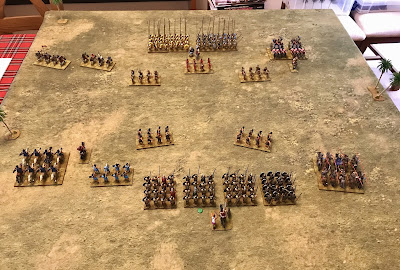
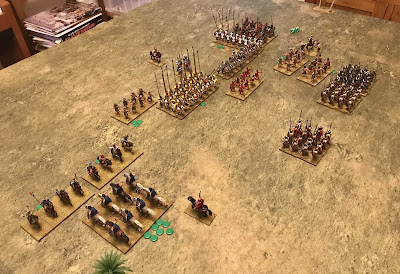
The terrain and the troops. Deployment has not yet taken place.

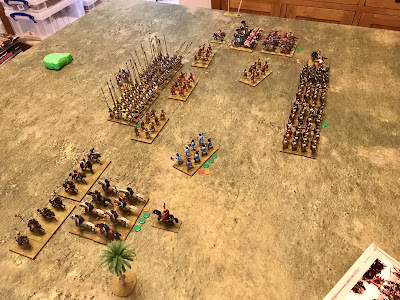
The game commences. I commanded the forces of Latium in the foreground.
Paul begins his first turn.

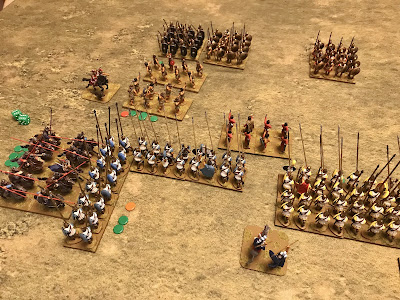
Elephants vs. chariots? I thought my left flank had it made!

 
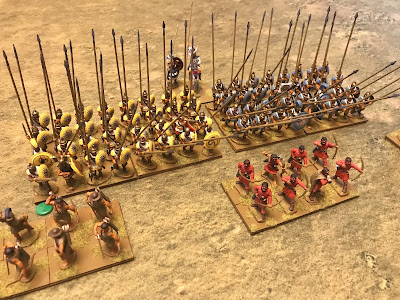
Persian Immortals of the Paphlagonian right-centre. I have a house rule allowing overhead archery,
so the horse archers behind them are a good tactic

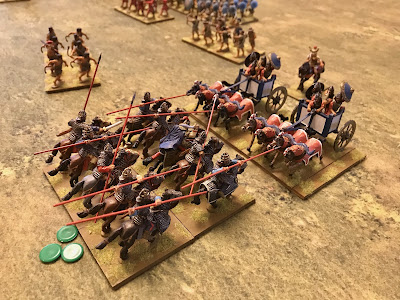
Cavalry melee on the eastern flank. Arch enemies the Latium Cataphracts
and the Paphlagonian Companion Cavalry are hotly engaged.
 
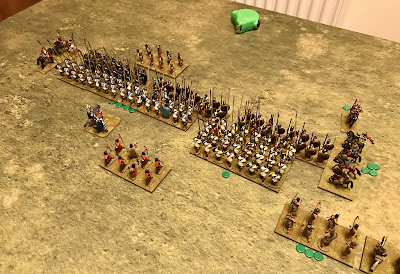
The crucial clash in the centre on Rat Hill. My money was on the Paphlagonian pikemen,
to be honest, but I was determined to make a fight of it.

Confused and bloody fighting took place on River Ridge.

Well I never. The Paphlagonian pikes are besieged on Rat Hill,
with the Latium hoplites refusing to be overawed.

Fierce fighting all along the line. Paul considers his options.

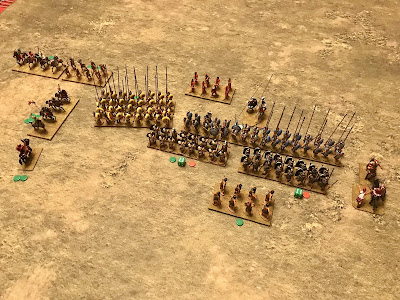
The Pikes of the Yellow Shields have triumphed for Paphlagonia on River Ridge (background).
But nearer the camera, the cataphracts have trounced the Paphlagonian Companions
 and turn inwards to cause more mischief.

My elephants never had the opportunity to engage. Paul wisely held back his chariots,
and by the time the right flank of the elephants was secure, it was time to call it a night.

Comments and Questions
An enjoyable evening's wargaming. Paul, being the gentleman he is, reckoned that had we had more time Latium would have triumphed. His forces had lost 9 units whilst I had lost only 5. On the other hand , his morale clock was at 7 whilst mine was down to 6. There was still a lot of life in the game - doubtless we would have made more progress if we were more familiar with the rules.

AoH is easy to learn, and seems to re-create most of the factors one would want in an ancients game. Whether it would please those gamers who are deeper into the ancients period than myself or Paul, I wouldn't like to say, but I am enjoying the playing experience. 

There are one or two puzzling features - neither of us could understand why only infantry can provide flank support in melee, for example. In addition, I thought the 'Panic' rule was an obvious one to use for elephants, but on closer inspection it means that as soon as an elephant unit receives a DMZ (basically, a single effective hit), it automatically panics and runs off in a random direction. This is surely a bit over the top - I have amended this so that 2 DMZs are needed to trigger the rule (3 DMZs = destroyed), and even then panic only ensues if a rally test is failed.

The move away from the more manoeuvre-based tactics of the WW2 and Napoleonic periods to the more close-combat based ancient period was really interesting. It took a while for me to remember that ancients games are often all about the big infantry punch-ups, and one has to focus on these in order to win.

What I need now is a game or two set in an historical period, rather than an imginary one, in order to really judge how well the rules cope. Fortunately I am not short of gaming friends who know the ancient period well and have armies for me to borrow. Lucky me!

'Til next time!

Tuesday, 14 January 2025

'Age of Hannibal' Ancient Wargaming Rules

In my previous post, I wrote about my adoption of the 'Three Ages of Rome' rulebook by Philip Garton. Over the Christmas period I had the chance to play a game with my eldest son using these rules, and this went rather well. 

Father in 'head down' mode.
A 4' x 4' table worked fine, and was easy to set up.

But wargamers can be fickle. Whilst checking out the latest on the Little Wars TV website, I was brought to remember that they had a set of ancients rules available, which were designed to be simple and straightforward to play. I delved a little deeper and was quickly hooked.


I have a high regard for the rules that various members of LWTV have developed - they tend to be simple and to the point, emphasising quickness of learning, but also quite clever in capturing the historical character of their period. I had already been impressed by their 'Live Free or Die' rules, written for the AWI but perfectly applicable to the SYW and other mid-18th century European wars - you can check out my playtest here. Gregg Wagman was the main man on 'Live Free or Die', and was also the main author for 'Age of Hannibal', so I had high hopes. The printed AoH rulebook is a bit pricey at around £30 in the UK, but fortunately a PDF version can be acquired for about £13.50, so I went for that. 

I immediately had the feeling that these might be for me. The actual rules are just 8 pages (including examples of play), although the whole book extends to 44 pages, with additional rules for seige warfare, three historical scenarios, and various other stuff such as terrain and strategem cards to print for use in setting up the game.

The first thing to say is that, like 'Three Ages of Rome', these rules are suitable for most periods of ancient warfare, not just the Punic Wars. Data for all the troop types you need are included in the book. Maybe 'Age of Hannibal' wasn't the best choice of title if LWTV wanted to maximise sales, but that's just my opinion. I won't go into the details of how the rules work as there is a rules review video available to watch which gives a pretty good overview. 

The rules are designed for big battles (i.e. Cannae) using small (6mm/10mm) figures, with units on 40mm x 40mm bases representing about 750 infantry or 500 cavalry. Not a good start, you might think, for someone using 28mm figures, but in fact the rules say double all measurements for this size of figures. This made sense straight away as my 28mm units are mostly on 80mm wide bases. Doubling the distances is not really an issue, as moves, for example, are quite short in the basic rules, just 4" for formed infantry and 8" for light cavalry. Doubling these actually equates quite closely to the normal movement in 'Three Ages of Rome', so a 6' x 4' table is quite big enough for most games. Missile ranges in AoH are a bit longer than in 'Three Ages of Rome', but again this was no problem. If you wanted to do Cannae in 28mm, a table at least 8' x 6' would be needed, maybe bigger, but this was not my ambition.

Anyway, why the switch, if 'Three Ages' was working fine? I'll list my reasons:

1. To make 'Three Ages' work for me, I had to do quite a bit of alteration to the original rules. This was interesting to do but a bit frustrating. 'Age of Hannibal' felt like only the odd tweak would be needed. The rules are in their 2nd edition, so most of any problems have already been ironed out.

2. Support for 'Three Ages' is non-existent. My Facebook page had attracted some members but not much was going on - in fact, as far as I could see, none of the members were actually current players of the rules. 'Age of Hannibal' has the various useful bits and pieces on the LWTV site, and also has an existing Facebook Page which is reasonably active, and provided somewhere to ask rules questions.

3. AoH are even simpler and easier to grasp than 'Three Ages'. One particular example of this is that 'Three Ages' is quite table heavy, with lots of modifiers. AoH is very different. Modifiers are kept to very low numbers, and the only stuff that is occasionally tricky to remember are the troop characteristics, or 'traits', that you need to apply, mainly in close combat.

4. I was also attracted by the terrain set-up method in AoH, which uses the terrain cards system mentioned above. LWTV have a tutorial video on this if you are interested. Something a bit different. 

Terrain card examples. I needed to buy the little plastic sleeves, 
which you can find HERE, for example.

5. No re-basing needed. The rulebook says any base sizes are OK, provided both sides are the same. This is not strictly true, as square bases work best with the rules as written, but only the odd tweak and bit of common sense is needed if your bases (like mine) are rectangles.

So, here we go again. This is the fifth set of ancients rules I have seriously tried. Previously I have used my own rules (abandoned years ago),  DBA, 'Kings of War Historical', and 'Three Ages of Rome', quite apart from dipping into various other rulebooks along the way: 

Dipping into 'Armati' with friends Roy and Keith.
A most interesting set, but just not to my taste.

So let's not get too excited. But I'm looking forward to more solo learning games, and then trying them out on gaming friends. Should be an enjoyable journey.

'Til next time! 

Sunday, 3 November 2024

Three Ages of Rome and The Battle of Piranthus

There is considerable potential for complication in Ancient wargaming, resulting from the long time period to be covered, and the resulting plethora of troop types and combat styles. It takes a bit of talent to boil all these down into a workable game, but Philip Garton appears to have achieved this in his 160 page, softback rulebook, Three Ages of Rome, published by Helion. 


I first encountered these rules at the Cirencester Waragmes Club. I was impressed by the way they included all the period character I wanted, in a set that was very playable. I finally bought my own copy at the Colours show at Newbury Racecourse. I needed a solo game to get me back up to speed, and then I invited my old pal Paul up from Bristol to get a proper game in.


As you can see, basic terrain and the most basic scenario possible - line 'em up and have at it. Each side had three 'commands' plus an army general. You can see Paul shuffling the playing cards which we used for the random activation of both side's commands, as per the rules. This works nicely.

I'm not going to give a full description of how the rules function, but as a comparison, I was reminded of Valour and Fortitude when playing these rules, particularly in that they give the game a proper story as commands, and then the whole army, slowly fall apart during the game. There should be no doubt about who won and who lost in most games.

Those willing to go back to older posts in the Ancients section of this blog will see that my previous set of rules was Mantic's Kings of War Historical. These are an interesting and original set, but I quickly found Three Ages of Rome seemed a more natural fit for the ancient period. Most notably, they were written specifically for this peiod, rather than being adapted from a fantasy set, as Kings of War are. One interesting difference is that KoW is a true 'bucket of dice' game, whereas 3oaR needs no more than a couple of dice for most of the game.

I have to admit that a further attraction was that the rules were going for £15 at the Colours show, a very reasonable price indeed. Well done to Paul Meekins for their usual well-stocked and well laid-out stall, and the variety of good deals on offer. Normal price is £20 from Helion & Co. Time for a few more photos.


It was good to get the ancients stuff out again. They haven't seen much action in the last couple of years. For those not familiar, it's no use trying to work out what period the armies shown above have come from. They are from my imaginary nations of Latium and Paphlagonia, invented so that I can collect whatever ancients figures I wish and mash them together in composite armies. The 'Battle of Piranthus' is thus entirely fictional.

No mountain of re-basing was required to swap to these rules. Sensibly, the author specifies basing in multiples of 40mm, easily the most common basing style out there. The rules were apparently written for figure sizes between 6mm and 15mm. The author states that those using 28mm figures will need to increase game distances by 50%, and gives larger base measurements for these bigger figures. 

In fact, I found the rules worked fine with my 28mm troops using the normal measurements. I use 8 infantry figures on an 80mm wide base in two rows of 4, or 4 formed cavalry figures in a single row on the same base width. Playing with 50% bigger measurements would, I think, be an issue as the rules would outgrow a 6' x 4' table, particularly as the moves are quite generous. Plus the 'multiples of 40mm' thing breaks down a bit when using the larger base sizes recommended for 28mm.

Each of those 80mm wide bases forms a 'unit', by the way. A unit of 'massed infantry' (e.g. a hoplite or legionary unit) is supposed to represent 900-1200 men. A unit of 'massed cavalry' (meaning most medium and heavy cavalry) represents 400-600 men. Although technically you can use units individually, forming them into larger base-to-base groupings seems natural, as my photos show and as the photos and examples in the rulebook also demonstrate. It makes no difference to how the rules themselves play, although of course it makes a considerable difference to the tactics one might use. Historical formations would seem to work the best.

I should add that the scenarios section is good, providing details for six small, real battles, each featuring about 10,000 to 15,000 troops in the original actions. Of course, the actual size of the real battles may be somewhat in doubt, but the author does his best. As you can see, these scenarios are quite small, most involving less units than the game I set up with Paul, so they are good for introducing you to the rules but won't accomodate medium or large collections. The separate army lists are commendably simple and easy to understand - a clever piece of work, IMHO, but note they are also configured for small, club-night style actions.

There Has To Be A Downside?
Of course there is. Well, a few fairly minor drawbacks. Most notably, the rules writing lacks clarity in a number of sections. For example, the author shows an unnerving desire to call the same thing by different names as a paragraph or section proceeds. The worst example is that the names of the troop types carefully described in the rules differ from the abbreviations given in the army lists. This had to be fixed by a free download on the Helion sales site, providing the appropriate translation. I won't labour this point - the lack of clarity is irritating, but a full and careful reading of the rules makes just about everything clear in the end.

The rules are also rather table-heavy, but the tables are where a lot of the period flavour resides, so this seems to me to be reasonable. 

Something to look out for is that Paul and I did find the play rather indecisive. We managed 7 moves in about 2.5 hours, at which point only a couple of units had routed and none had actually been lost. I played out 3 more moves solo the next day, and losses did start to mount, but the rules for 'command confidence' and 'Army General's Will' had only just started to kick in. 

This was noticed at the Cirencester Club where I first encountered these rules. Changes to the 'reform' rules (i.e. the rally rules) were made pretty quickly, as reforming seemed much too easy. Personally, I also found that flank and rear attacks were not generating enough damage, and I have tweaked the rules for these. We all know how dangerous such attacks were supposed to be, for pike and hoplite formations in particular. I have also imposed the same rule I used in Honours of War, that melees must continue until some sort of decision is reached in the current turn, rather than carrying over into the next turn. I'm hoping this sort of thing will  make my games crack on at a faster pace.

Overall, these rules deserve a wider audience. I found no online support, official or otherwise, which is a shame. Therefore I have just started a Facebook group which you can find here:


And that's about it. 'Til next time!

Wednesday, 21 September 2022

In Which I Actually Play A Couple Of Games

Yes comrades, a lot of my time recently has been spent in front of my laptop trying to develop an updated version of the 1973 WRG Armour and Infantry rules. These efforts are now bearing some wothwhile fruit, but it was good last week to be able to indulge in two real wargames with real opponents. We all have our own individual ways of enjoying our hobby, and for me in the last few months this has meant too much time researching and writing, and insufficient time actually wargaming. I needed to remind myself why all this research and writing was taking place.

Game 1 - The Battle of... erm... Roy's Wargaming Room.
It was way past time for me to return the remaining figures that Roy had lent me for my Waterloo game in early August. So it made sense to arrange a game at the same time. Eager for a change of scene from WW2, I took up Roy's suggestion of a game of Armati, one of Roy's favourite ancients rule sets and one in which he is well practised. We used Armati 2, an update of the original rules dating from 2004, and although to gamers of my age this seems like a fairly recent publication date, in the rapidly changing world of wargaming rules Armati 2 is out of print and quite hard to get hold of.

This is a shame, as the games I have played under Roy's guidance have revealed a basically straightforward set which requires players to use historical tactics and which plays quite briskly. This particular battle pitted late Romans against a Goth army in the mid-4th century C.E. This was a battle quickly set up 'on the hoof', and I'm afraid I can't give details of all the units in use, but the Gothic army was, of course, larger, a bit lower in quality, and had lots of cavalry. The figures used were 20mm in size and mostly Newline Designs - a very impressive collection indeed.

We each set up behind a blind lowered across the centre of the table (a lovely old school touch which is part of Roy's very fancy wargames room). We found we needed a table extending to 8 feet wide to fit in the armies in use (particularly the Goths), with their very linear deployments, but depth was kept to 4 feet. The terrain was simple, but a sketch map is given below. Two gentle hills, two woods, and a road that was basically decorative:


A close-up of a Goth infantry base, just to demonstrate the quality of Roy's figures.

The Goth's (under my uncertain control) charged down off their hill.

The long, thin Goth 'divisions' made manoeuvre awkward - as doubtless it was in real life.

Goth left wing cavalry meets Roman right wing cavalry.

Roy niftily detached some light cavalry and caught me in the flank.

The infantry slogging match gets underway.

You can see that the Goths had a second line of infantry, but under the standard Armati victory conditions my army buckled before they could be engaged. So, I lost the battle but had a couple of very entertaining hours gaming. I am currently wondering whether some of the approach of these rules (mostly regarding movement restrictions) should be incorporated into house rules for Kings of War Historical, the ancient set I am currently using. KoWH is good on playability, but its roots in fantasy gaming mean that historical flavour is sometimes lacking. 

Game 2 - Poland, early September 1939
Game 1 was Monday, and Friday saw me heading up to Birmingham for a WW2 game with Paul. It was time to test out the latest version of my WRG amendments. 

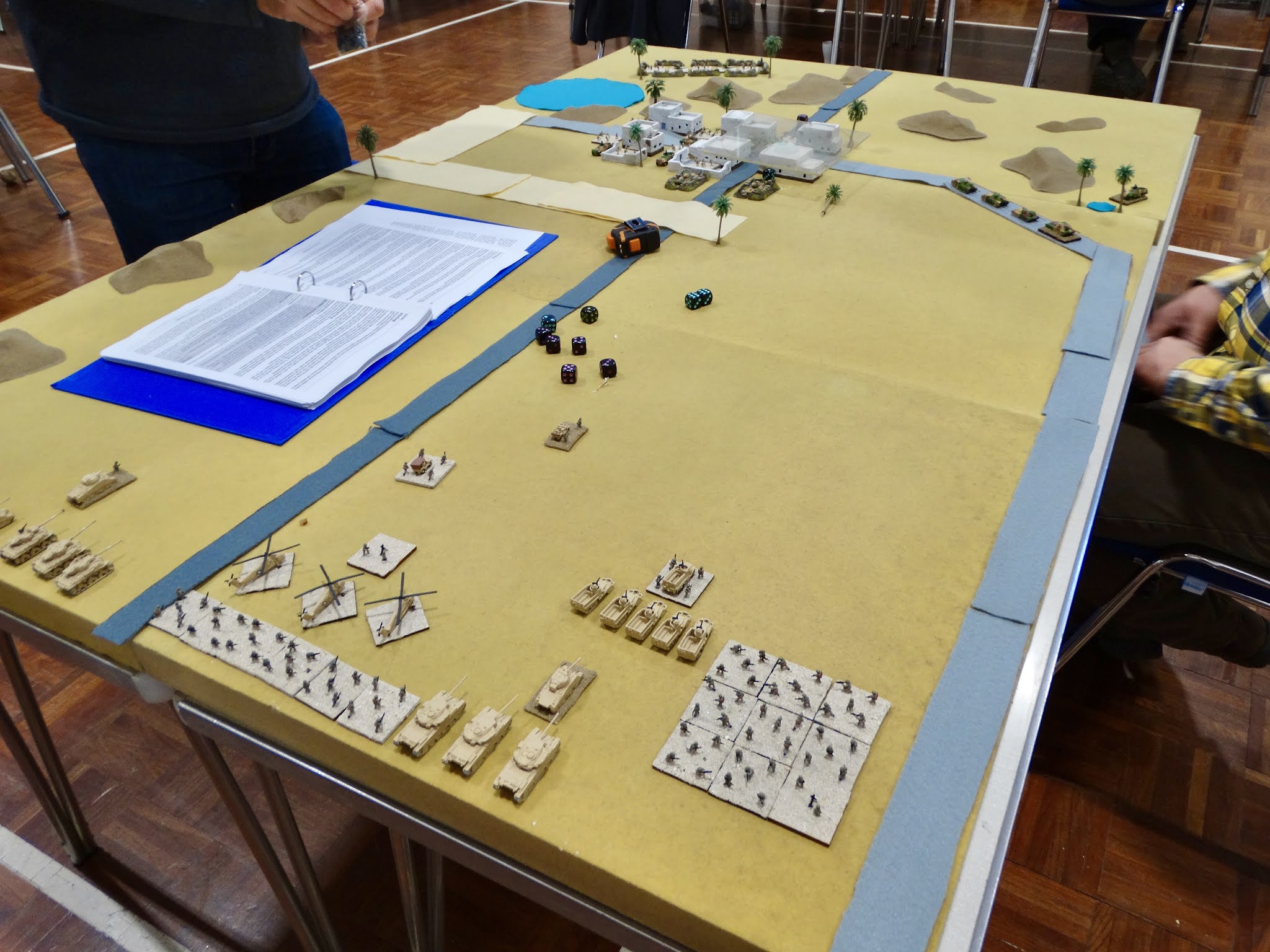
I chose to use a scenario from the Battlegroup Blitzkrieg rule book, entitled 'Forward The Uhlans'. This pits Poles from the 10th Mechanised Brigade against Germans from the 2nd Panzer Division. The terrain was as per the book, whilst the OOB was amended for the WRG rules - basically, this was an encounter battle with each side having 2 platoons of motorised infantry, 2 platoons of tanks, and some fairly light off-table fire support. Oh, and a couple of recce units out in front for the first couple of moves before the main forces entered the table. For a change, the baselines are the short edges of a 6' x 4' table. I brought over my 15mm Poles, whilst Paul provided (and commanded) the Germans.

Table set-up. Objectives were the church on the left,
the road junction, and the farm seen on the right.

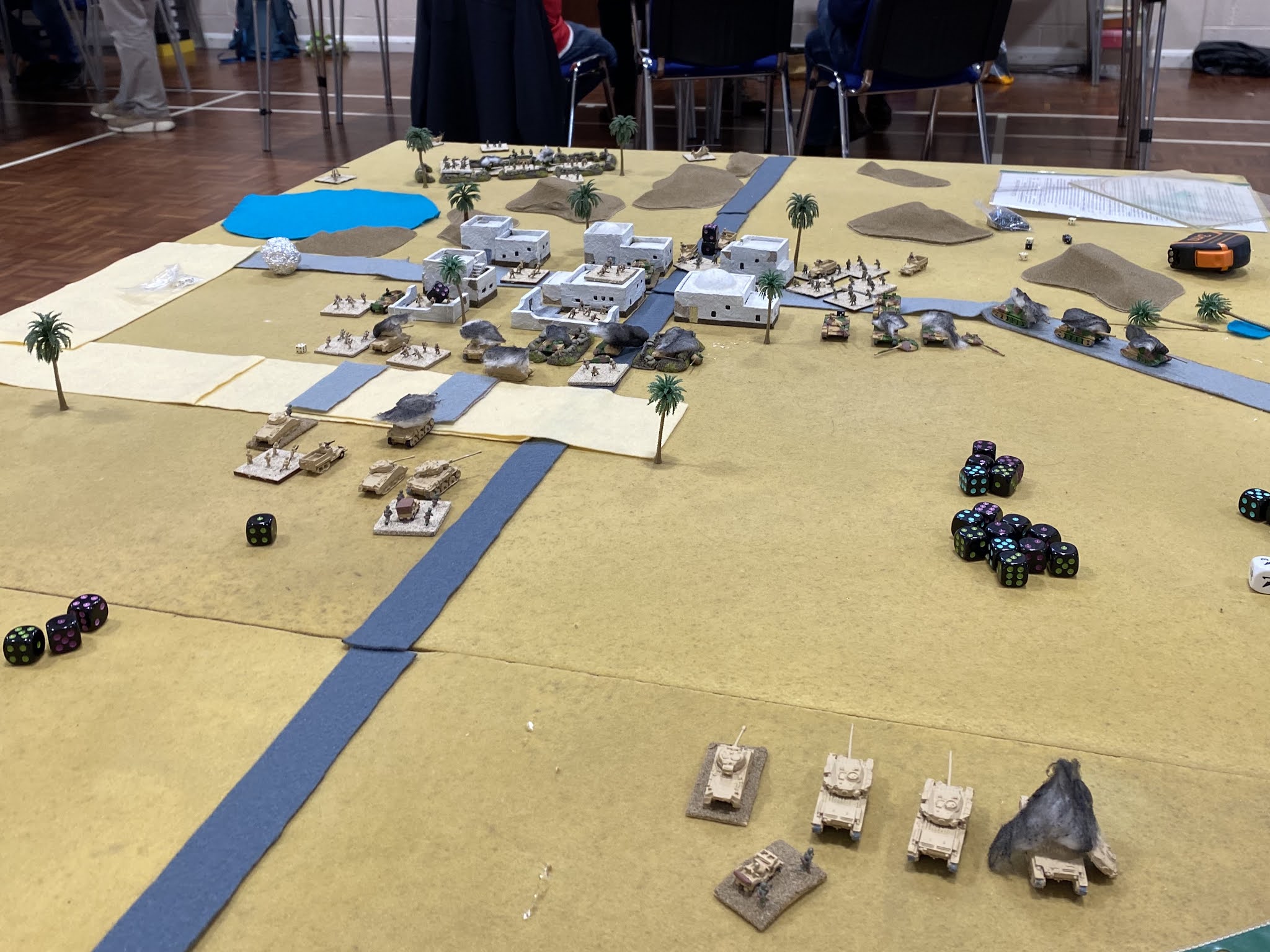
Well into the game, and the Poles have gained the junction and farm.
The church is firmly in German hands.

Polish tanks and infantry around the village and road junction.

The German right flank battlegroup sets up to attack the farm.

In the village, both sides struggled to advance across open ground.
A fierce firefight ensued with tanks supporting infantry sheltering in the houses.

Tankettes and infantry advance in the Polish centre, attempting to
threaten the impending German advance against the farm.

The Polish left flank tank platoon takes casualties at the farm.

German light tanks providing fire support in the village.

In the end, the engagement turned into a bit of a slugging match, particularly in the village, which the Germans won. The German attack against the farm succeeded, with many Polish tanks lost. Both Polish tank platoons ended up under half strength, whilst their German opponents only lost a couple of vehicles. It was time for me to head home, and I had no choice but to concede to Paul.

This was a very valuable playtest, which showed up issues in the amended morale rules and in one or two other areas. But the basic moving and fighting rules seemed solid enough, and work quickly and simply - a tribute to Mr Barker's original work.

Gaming is Good
As usual, it was good to get playing again. Sometimes I find it strangely easy to lose sight of the fact that playing games is the core of the hobby! I was fortunate to have two excellent opponents, both knowledgeable but relaxed in their approach. Just what I needed.

Well, the Cotswold Wargaming Day beckons on Sunday next. Should be a blast - a report will surely follow in the not-too-distant future.

'Til then comrades!

Saturday, 5 March 2022

Solo Rules Testing - 3

So, the old 4' x 4' table came out again for my last planned rules test. This time I wanted to remind myself of the ancients rules I'm currently using, Mantic Games' Kings of War Historical. Well, I say 'Mantic Games' but they don't actually sell or support these rules anymore! As usual I'm well behind the times and using old, long forgotten rule sets. But you can check the background to this decision at the posts linked below:

Post: Kings of War Historical

Post: Playing and Discussing KoWH

You can still get copies of the rules if you search around the net, from ebay and other sources. But it's worth pointing out that they differ very little from the original Kings of War fantasy rules, and these are still going strong and in their third edition. Even better, you can download the basic rules for free from the Mantic Games website. This really is the spirit of the hobby and Mantic should get a big thumbs up for this kind of offer. 

In fact, the free download gives you most of what you need to play - as far as I can tell the playing rules are all there, it's only the army lists and various bits of fluff that are absent, and as these are fantasy rules you don't need any of that. However, what turns the fantasy rules into a playable ancients set are the stats and special rules which give the various periods and units their flavour. For this a copy of Historical is really needed, unless you are feeling really creative and are ready for a bit of serious work.

The Game
Anyway, a few captioned photos of the playtest. Sorry for the quality, but I snapped these in haste with an iPhone 7. Those are 28mm figures in use. You don't need a sketch map as the terrain was just a flat board with a terrain mat over it. The small forces involved are from my imagi-nations, the countries of Latium and Paphlagonia, and so you will see various units of hoplites, legionaries, cataphracts and chariots (and others) mixed up in both armies. Sadly my lovely Celts missed the cut.

End of the first move. Forces of Latium in the foreground.

The flanking cavalry come together whilst skirmishers and bowmen
on both sides try to weaken their opponents.

The Blue and Yellow Shields phalanx units of Paphlagonia.

Cataphracts of Latium vs. Paphlagonian heavy chariots.
The chariots lost!

The cataphracts wheel around into the Blue Shields (top).
A gap in the Latium main line has been created by the Paphlagonian bowmen.

The cataphracts crash in but this was a melee too far for them,
resulting in their destruction by long pointy things.

And finally the main lines come together...

...resulting in a Paphlagonian victory. Latium's left flank hoplite unit is destroyed
(helped by a flank attack from light cavalry), and the red markers show the
remaining two are 'wavering'. Game over.

Conclusion
This was a fun little action which reminded me how much I like these rules. They provide a fast moving game, and with a few tweaks they have all the period flavour I want. A great shame they never really seem to have taken off. Perhaps Mantic should try again. If you're listening guys...

This and the previous games in this series have also proved to me that a 4' x 4' table is no real barrier to having nice games, even in 28mm, without having to try those silly skirmish games that are all the rage these days. Skirmish games? Don Featherstone must be turning in his grave!

It feels like I've been through a period of preparation since Christmas, looking at new rules and rules not used for a while, and dusting off my model armies. I reckon I'm ready to go with some 'proper' gaming. Time to phone some friends and re-start the banter and dice rolling.

'Til next time!

Tuesday, 5 October 2021

Cotswold Wargaming Day - Full Story and Pictures

So the day finally came, two years after the last event. 

Thanks to the very co-operative caretaker of the hall, I had been able to get all the tables set up the evening before, and so arriving at the hall around 08.15 to make the finishing touches was much less stressful. By about 10.30 we had 29 people in the hall, and there were two or three visitors who popped in later, so overall numbers were the same as in 2019. 

There were 8 games, 6 in the main hall and 2 in the side room. It was interesting to have 4 big games present, all using 12 foot long tables. There was still room for a couple of extra games of average size, so there is room to expand the event in 2022. Unfortunately, three games were cancelled before the event (all for very good reasons), so we could have had an even busier day this year. However, I also concluded that expansion beyond about 10 games and maybe 40 people would make things too crowded and intense.

Overall, the day couldn't have gone any better. Everyone seemed to be relaxed and enjoying their gaming, and everyone found time to chat to old friends and new acquaintances. It was a lovely atmosphere and I thank all the participants for coming, especially during a fuel shortage! 

The Scene
Evidently I was getting a bit over-excited, as my photos weren't really up to scratch. Particular apologies for the photos of prize winners which look like they were taken on a 1970s Instamatic (if you remember those). We can start with a basic trip around the hall.

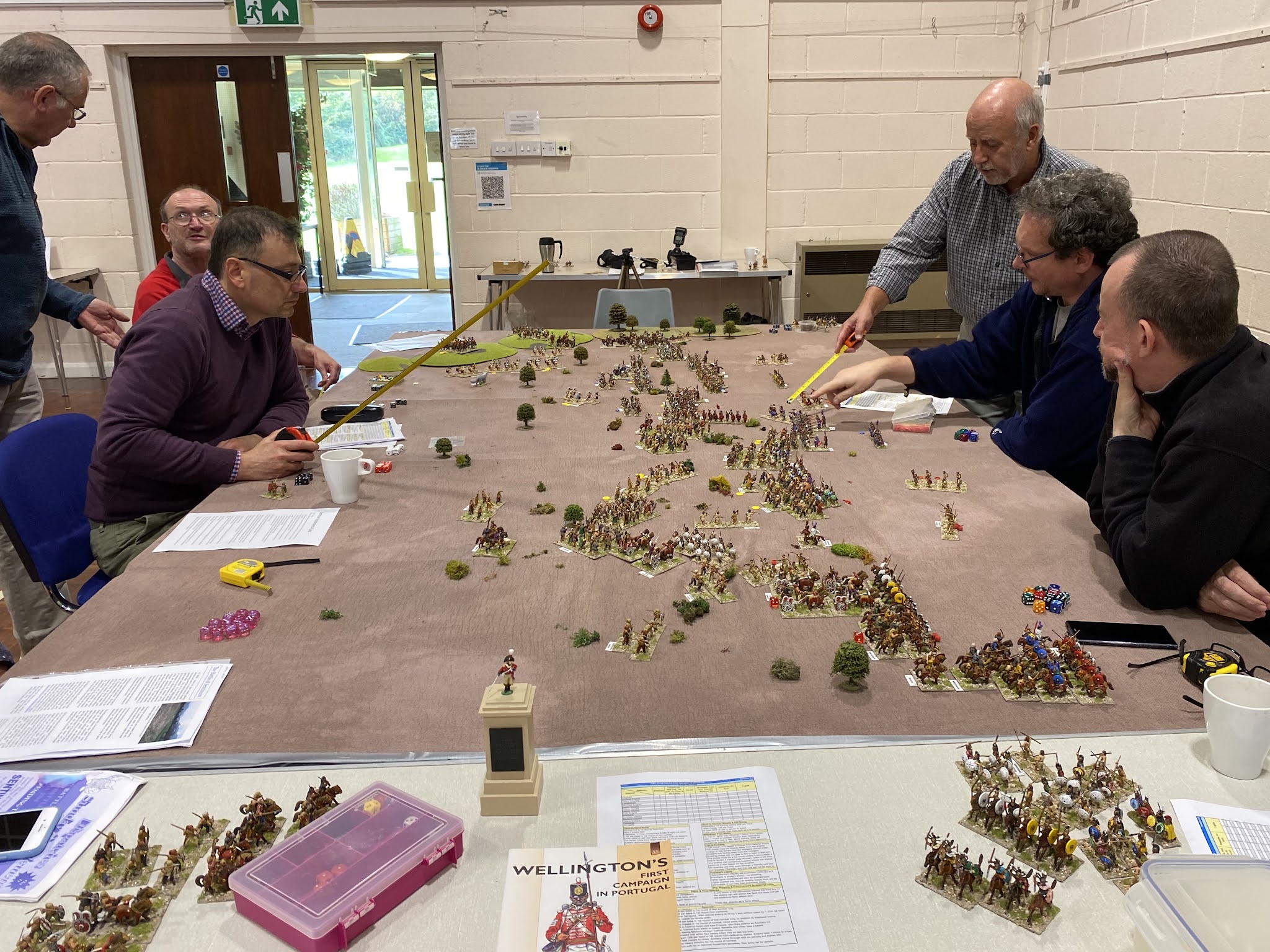
Tim Cull and members of the Farnborough Wargames Club presented The Battle of Sentium (295 BCE). 12' x 6' table with 6 well-briefed players.

At the other end of the scale was Steve Johnson's Napoleonic battle,
using a scenario from Grant and Asquith's Scenarios For All Ages. 3' x 2' table.

Stuart C and the Cirencester Wargames Club brought a Renaissance game,
with Poles against an Ottoman army. 12' x 4' table

This is JP's great-looking Napoleonic game, The Battle of Dollitz, using General d'Armee.
Another biggie on a 12' x 6' table.

Equally lovely was this ACW game led by Keith McWilliam.
Another 12' x 4' game. 

Couldn't miss out the train. Nice!

My old buddy Paul put together a Cold War Commander game
featuring a battle from the 1967 'Six Day War'. 

No wargames show would be complete without someone using a plastic beaten zone.

In the side room Dave Kenyon and friends had set up a 6' x 4' table
with a Sharp Practice game set in the French-Indian War.

Game 8 was Jon Billington's WW2 game using the old
Battlegroup Panzergrenadier rules from 2002.

The Winners
I think everyone was a winner on the day, but I like to have a light-hearted prize giving to say thanks to those who take so much trouble to put on games. I have kept in touch with Stuart Asquith's son Tom, and was delighted when he agreed to come along and present the prizes, as his father had done 2 years ago. Tom also judged the prizes in conjunction with myself and Jon Billington. Thank you so much Tom.

Best Game and the Stuart Asquith Trophy went to Tim Cull. An impressive game,
with a lot of effort put into historical background and player briefing.
Plus some very high quality figures.

Best Figures - Steve Johnson. Tom was very taken by the 10mm MDF figures
Steve was using, and felt Stuart would have loved them.

Best terrain went to JP. A really attractive game which drew you in with its visual appeal.

Honourable mentions to the other 5 gamers who braved the fuel shortage
to put on games we could all enjoy. Thank you gentlemen.

Eye Candy
Pictures of rather better quality are available at a couple of other blogs, Wargaming Addict and Battlefields and Warriors. Below are a few close ups of some of the action, and pictures of gamers enjoying themselves. Which is always good.

Cavalry clash at the Battle of Dollwitz.

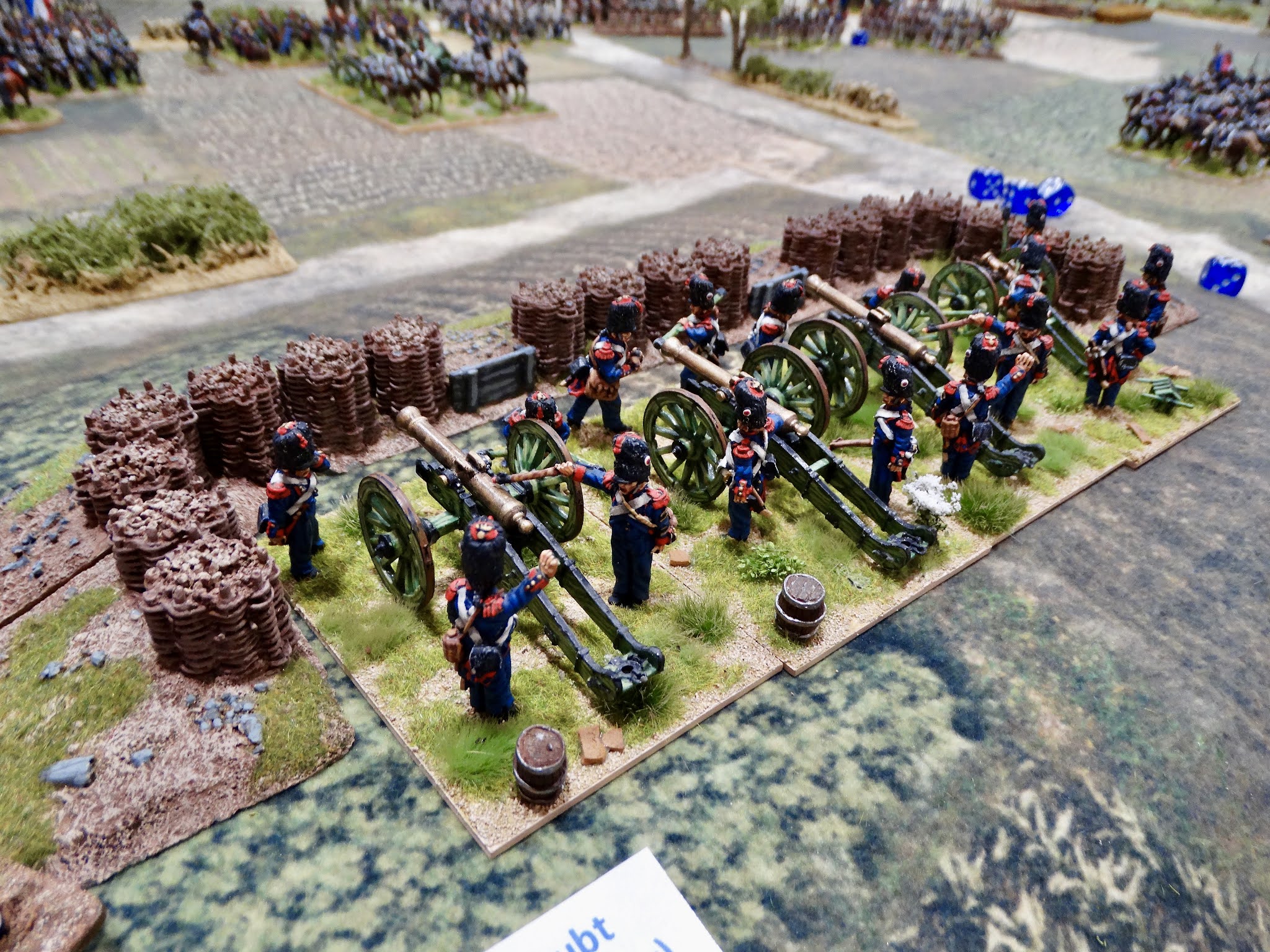
Crazy-good figures and models.

Dollwitz again. A fine spectacle.

The ACW game gets going.

Steve's now-famous MDF figures are from Commision Figurines.

More terrific figures in Dave's FIW game.

Gamers having fun. 

The Arab-Israeli game from the Israeli side.

More gamers having fun.

Did I mention the terrific figures?

'Best Game'. 

Oh, for goodness sake stop enjoying yourselves.

Jon's game used the 'Pont de la Croix' scenario from
Gavin Lyall's 1976 classic, Operation Warboard. Very high nostalgia value.

A man and his game. Dave Kenyon with his FIW skirmish set up.

The day flew by, and I loved every minute. So many people came up to me to say thanks and what a great day it had been that it started to get embarrassing. I think this is something clubs and groups of gamers all over the country should consider - hire a hall and invite local gamers to showcase what they're doing. It makes a great halfway house between everyday gaming and the big shows. 

Partizan on Sunday. Phew! Hope to see you there!