Followers

Showing posts with label Airfix. Show all posts

Friday, 8 May 2026

Airfix Nostalgia - The Story Continues

My Airfix nostalgia project started almost exactly 6 years ago. When I created my first post on the subject, I indicated the project was just about complete! And now here we are 6 years later.

Yes, the original idea was "five kits only". Now I have 24 completed, and 4 waiting to be made. The motivation comes and goes, but this looks very much like a project that will be ongoing - until my eyesight goes, or the motor skills in my hands fail. What has not changed about the project is the pleasure I am getting from buying and making these kits. There have been frustrations and the odd loss of temper, but overall this quiet, solitary branch of my hobby activity continues to deliver; supplying moments of peace and tranquility, nostalgia, childhood memories and a sense of achievment.

My favourite 'makes' are the original kits from the 1960s, in their original packaging. The Me-262 and Bf-110 shown below are good examples. It's worth saying that I generally paint these old kits as recommended in the original instructions, ignoring the fact that the paint schemes suggested were often inaccurate. It's all part of the nostalgia.


I try and go for the classic Roy Cross artwork, but sometimes I can't resist a kit from before the Roy Cross era, like the Me-262 above with its very early packaging, probably from the early 60s. I love the old-school instructions, from before the days of wordless instruction sheets designed for international sales. The main issue is the old decals, which are sometimes unusable. But remarkably, in the majority of cases, I have been able to use all or most of the c.60 year old decals, which gives me great pleasure. My friends here have been bottles of Microset and Microsol, which are indispensable companions of the 'classic kit' builder. 

I have not restricted myself just to old Airfix kits. Below you can see a P-47 by Academy, and an Airfix P-51 from their current range. I enjoyed making them, but modern kits for me generally have too much detail (particularly too much cockpit detail), which results in too many fiddly little parts that you often can't even see on the finished model. I have also found that using modern kits sometimes doesn't even solve the decal issue - the decals on the P-47 were frankly crap, and I had to buy a new set from a specialist decal supplier. It appears that Academy decals are well known to be troublesome.


I am mostly sticking to 1/72nd, but my eldest son gifted me a 1/48th kit for Christmas 2024 which gave the 'project' a nice boost. It took me a while, and the expected 'fiddly' parts were there, but I persevered through bouts of swearing and cussing to produce what I think is a very nice model - the floatplane version of the Japanese 'Zero' fighter.


Recently, I have gone back to my original inspiration of classic Airfix 1/72nd. A real little gem was the old Airfix Tiger Moth. I originally bought the current Airfix Tiger Moth kit from a model shop, but this was a sad mistake. The 'fiddly parts' and the super thin wing struts defeated me, and the whole thing ended up in the bin. So I got hold of the gloriously yellow original and it went together like a dream. One of my favourites in the collection, with all-original decals.


My most recent completion has been a Boulton-Paul Defiant, another fond memory from childhood days. Again, a wonderful, straightforward build with parts that fitted nicely. The decals were a bit of an issue, as they started to break up and split as I applied them, but an unexpected bout of patience (of which I generally have a rather short supply) came to my rescue. After some touching-up with acrylic paints, the kit was rescued.


Now then. Not all my kits are of aircraft - there has been some military vehicle nostalgia as well. All of those shown below are from the Vintage Classics range. In this range, you get the old kits as they were, with the Roy Cross artwork and nice new decals. On the downside, the instruction sheets aren't 'classic' - we're back to those modern exploded views full of symbols but no words. Still, this range is a nice compromise between obtaining the old models through online dealers, tired decals and all, and buying models from the current range. In the end, I have found the latter really don't do it for me.


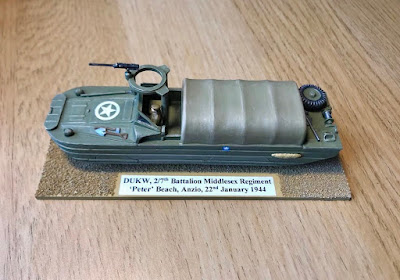
The model of the DUKW represents a double wammy of nostalgia - I remember building the original, and the caption relates to my Dad who drove one up the beach at Anzio, back in January 1944. For the Stug III I weakened and gave it a vaguely genuine paint scheme appropriate to the Eastern Front, rather than the plain dark green featured on the box art. I dare say Roy Cross is turning in his grave.

And finally, my current project, which is a Tamiya 1/35th Panther A. It looks like a modern kit, but dates right back to the 60s when it was brought out as a motorised novelty toy. It's been re-issued many times over the years, with the motorisation bits now deleted. It is much vilified for inaccuracy by present-day modellers, but it's half the price of Tamiya's more recent Panther kits - and guess what, the number of the infamous fiddly parts is about half as well. The moulds are obviously in good nick as all parts are crisply presented and the kit goes together pretty well. I think it will look pretty classy. Good fun.


And that's about it. There's a modern Airfix Vampire kit waiting to be made up, a lovely old 1960s Beaufighter likewise (so old it's bagged rather than boxed), and a Vintage Classics P-61 Black Widow also on the shelf in the 'study'. I'm looking forward to plenty of relaxing modelling for the rest of the year. And I've avoided buying loads of tempting kits and creating the well-known 'pile of shame'!

That's All Folks! 'Til next time.

Wednesday, 14 June 2023

Airfix Nostalgia - Redux

Well, it seems I just can't get away from those old Airfix kits. My original Airfix nostalgia project was supposed to be all over in 2020, but it seems the itch still needs scratching. So this is a short post recording a couple of recent bits of kit building. 

The first kit was one of those 'Vintage Classics' that Airfix currently have an extensive range of. So you can buy one of the models you remember from your youth, with the old school artwork, but the decals and instructions will all be bang up to date. Personally I'd prefer to have a facsimile of the old style instructions, but you can't have everything. Quality of the kits is generally very good. 

I picked the DUKW kit for two reasons - I remembered having fun building it and playing with it from when I was about 10, and it was also a vehicle that my dad told me he had driven in the war. In particular, he drove one up the beach at Anzio in 1944 (whilst the beach was still under fire), serving in a machine-gun battalion of the Middlesex regiment. So there it was, on a shelf at my favourite model shop, the Cheltenham Model Centre. No brainer!


The second is a genuine late 60s kit of a Ju-87 Stuka. This was another kit I distinctly remember building, at a time when I didn't even bother to paint my models, just glueing them together and then impatiently waiting for the glue to dry so that I could fly them round the house. Sad old fool that I am, getting my hands on one of those old bagged kits was once again a real thrill. 

Back in the day, the model would have been put together in an hour at most, but a combination of other things to do and a desire to savour the full nostalgic experience meant making this particular Stuka took a couple of months of short spells of activity. One positive surprise was that the decals, over 50 years old, still functioned, and so all I needed to add was a tail swastika from a modern decal company. Such things weren't allowed back in the late 60s, at least if you wanted to sell your kits in Europe.

Maybe those decals neeeded a couple of extra coats of Microsol!

It seems this project is now open-ended. I have a genuine 50+ years-old boxed Me-110 kit waiting on the shelf, and my eldest son bought me a trio of 'Vintage Classics' for Christmas, so that will keep me going for a while. I find making up these old kits at my current slow pace to be so relaxing, and the nostalgia is great for promoting peaceful and pleasant reminiscences. Retirement is good!

'Til next time.

Tuesday, 7 July 2020

Airfix Nostalgia Project - The Italian Job

This is the third and final post in this series, just to let readers see how I got on with the last model made, the Macchi MC.202 Folgore. That makes 7 fighters in all, from 6 nations.


The Folgore was just as much fun to make as all the others. The only problem was the old decals, which slid off the backing easily but then crinkled up badly when applied. I gave up and sourced some Italian decals from Print Scale, which were excellent.

This project started well before lockdown, but turned out to be an excellent way to pass the time and relax during my furlough. I honestly didn't expect to find the whole thing so satisfying. Great nostalgia and very absorbing.

Proper wargaming in the next post, I promise!

Wednesday, 10 June 2020

Airfix Nostalgia Project - Part 2

WARNING: This post contains no information or photos relevant to Airfix kits.

Well, that's got the disclaimer out of the way. Despite the absence of Airfix kits in this post, I thought I would include an update on the closing stages of this enjoyable project. Part 1 of the posts regarding this project ended with a photo of my unmade Revell kit of a Vought Corsair. I am happy to report that this model is now made and the original 5 models are now finished. 


I'm afraid the Light Tank Mk.VI that I mentioned has been binned - making it was fun, but then I got to all the fiddly transfers and kind of gave up. The vehicle wasn't really part of the project and I didn't want another model needing to be dusted and taking up shelf space.

There has, however, been a further significant development. Some of you may have noticed the comment on the previous Airfix post from Steve-The-Wargamer, in which the absence of an Italian WW2 fighter was pointed out. This made good sense to me, and I have been investigating the Airfix G.50bis model, especially one in 'bagged' form. Unfortunately these seem to be about £25-30, mostly on ebay, and I felt I couldn't justify this at a time when my wife and I are trying to save money following my furloughing from work. But then, what did I come across online but a model of a much better Italian fighter - the Macchi C.202 Folgore.

Even better, this was a 1970s boxed kit from FROG. Ah, FROG - that name got my nostalgia meter swinging towards the red. Cost? Fifteen quid including postage from the fine people at Kingkit. It seemed an excellent way to finish up the project - I had pretty good memories of making the old FROG kits, as they often tackled the more esoteric aircraft subjects. I still fondly remember making their 'Gloster Whittle' kit, which lingered in my collection long after many others had been disposed of.

So the order went off, and as soon as I received it and opened the parcel I was very glad I'd made the investment. Here was more nostalgia, in spades. Anyone remember that the old FROG boxes opened out into a 'working tray'? I kept my modelling stuff in one for years when I was a lad.


What impressed me in particular was the high quality of the model itself - lovely moulding, no flash, good fit of parts. Good service as usual from Kingkit - I recommend these guys if you yourself fancy a bit of plastic kit nostalgia. A nice website, reasonable prices and every kit checked for completeness.

Can't wait to get started!

Friday, 10 April 2020

Airfix Nostalgia Project

I wonder how many wargamers of a certain age started off with Airfix figures, and at the same time built their modelling skills with Airfix construction kits? Well, that was certainly me. In the late 60s (I was 10 in 1967) I was obsessed with building Airfix kits. The new releases were a constant source of delight and making them took up a lot of my time. My standards of finishing were generally low, and improved only slowly. It's hard to say when the obsession tailed off, but let's say by about 1974 it was mostly over. By then I had started to discover wargaming.

These days I don't do much painting or modelling. I've got the armies I want, and building up more (particularly, for example, building some sort of Napoleonic collection) is far too daunting in money and time to even consider. But about a year ago I got the itch to go back in time and build an Airfix kit or two. After some lightweight reflection I agreed with myself what the project would entail:
  • I would concentrate on WW2 fighters. They would be economical on shelf space (always an issue for the model kit builder), and they had formed the heart of my old obsession back in the 1960s.
  • Five kits only. One from each of the 5 major nations - Britain, the U.S., Germany, Russia and Japan. See 'shelf space' above.
  • The kits would be bought from model shops. This was a great idea - supporting local businesses, and re-visiting the old feeling of wondering what would be in stock, and not always finding exactly what you wanted.
  • Airfix preferred, but other companies not excluded.
  • Don't overdo the standard of finish. Aim for fairly rapid completion to link with my style of work as a kid.
And so it began. Visiting local model and toy shops in Gloucester, Stroud and Witney produced the first 3 kits, all modern Airfix. The actual first was a Curtiss Tomahawk, filling the role of British fighter. Here were the project rules in action - the plane is of course American in origin, but the British version was on offer in the shop and I chose it over the obvious alternatives of Spitfire and Hurricane just because, at that moment, it took my fancy. Just like a 10 year old. The other 2, bought in different shops at different times, were a Bf-109 and a Zero.


I was knocked out by the quality of the kits. They went together like a dream, with hardly any cleaning up of parts and certainly no filling of joints needed. The transfers (should that be decals?) also went on beautifully. A coat of matt varnish finished these guys off nicely. I was a happy modeller.

Time for more enjoyable browsing in real model shops, this time Cirencester and Bourton-on-the-Water. By coincidence, the Russian and U.S. slots were both filled by Revell kits, both once again purchased on the principle of what was on the shelves and took my fancy. The Yak-3 was definitely a small kit in a big box, but again a pleasure to build:


 The Vought Corsair was my other choice:


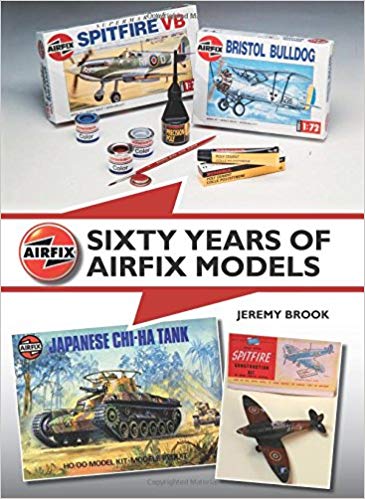
Yes, one of those crazy new-fangled starter sets. My challenge is to finish it using the paints and crappy brush provided. But those of you still awake will see the Corsair remains unbuilt. This was due to the project taking a crazy, left field direction before it was finished. I decided the project would not be complete without an original kit from my glory days, from the period known among modellers as the Airfix 'Golden Age' - which according to my Airfix book was 1952-1981. 


Obtaining a kit from the late 60s/early 70s would of course mean going online, but what the hell. The choice of old kits is pretty good and prices are mostly reasonable. I settled in the end for a model of the Westland Whirlwind which I remembered fondly from childhood days. I was genuinely thrilled to handle one of the old-fashioned 'bagged' kits again. What a nerd! I'll let the photos tell the story:


I was certain the transfers (OK, decals) would be useless after about 50 years in the bag, but actually they worked OK with careful handling (and about 4 coats of Microsol). And once again I refused to enhance the kit or even use filler. Just build it and paint it. And keep the packaging of course. There was no way those instructions or even the plastic bag were going in the bin.

Apart from the kits, this was a cheap project. I didn't buy any new paints or tools, and any paint colours I didn't have were mixed from what I did have, just like the old days. Although I was using Vallejo acrylics rather than Airfix or Humbrol enamels.

So there we are. Another project conceived, planned and executed - they call me Mr Finisher round these parts. And all tremendous fun. It really was as satisfying and relaxing a project as I had hoped it would be

Well, there is the Corsair to build. And I inherited an Airfix kit of a Mk.VI Light Tank from Stuart Asquith, which he was giving away to a good home at the last Cotswold Wargaming Day. That's under construction at the moment. I also have a terrible desire to order another 1960s kit or two - maybe a bomber like a Heinkel 111 or a Wellington. But it's time to resist - money and shelf space are limited.

Good Luck everyone. 'Til next time!