Followers

Thursday, 27 October 2016

The Battle Of Aufeld

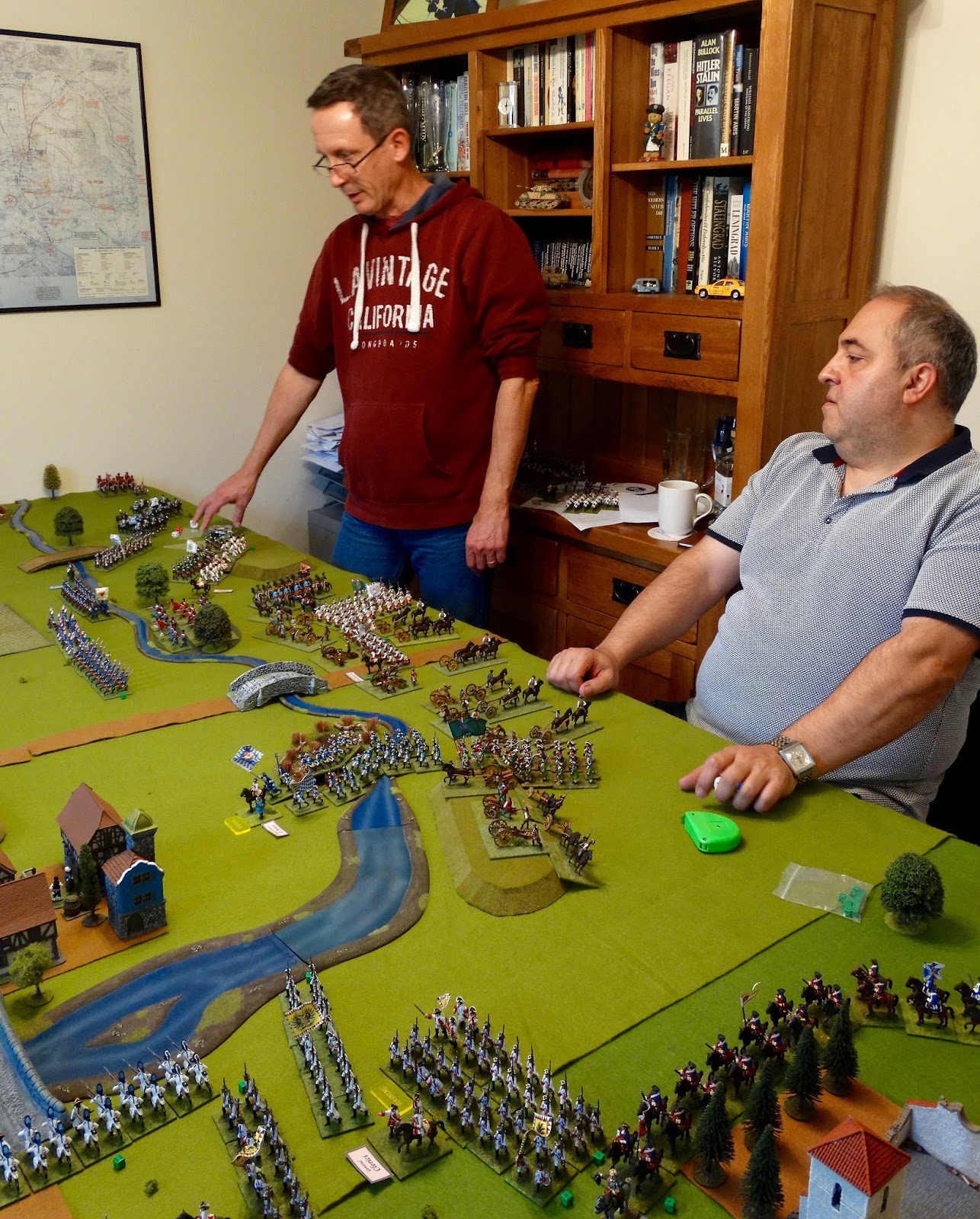
And so, last Saturday, it was time for another large Honours of War bash. This would be the largest HoW game I had yet attempted, so it was going to be interesting to see whether the rules would continue to cope, and whether we would have the time to play the scenario to a reasonable conclusion. 

Thanks to Steve, Jon, Adam and Paul for making the effort to come over and get involved. Stuart, nice to see you as well - it was good to show you some of the figures you have gifted me in action. And then there was my eldest son Sam, who kept the teas and coffees coming, helped with lunch and then took over from Steve for the final couple of moves, when duty called Mr Johnson away.

The scenario was borrowed from Wargames Illustrated 286 (August 2011). The original article was In This Sign Conquer, by Ray Lucas, and was a fictional scenario set during the War of the Spanish Succession in Italy. So I changed the names and forces around, but kept essentially the same map. My version of the terrain is seen below.

The Battle of Aufeld. 10' x 6' table, each square 1' x 1'.
Some areas of terrain are labelled as a map key.
Situation
This was to be a fairly standard attack-defence game, with the Austrians attacking the Prussians in Saxony during 1761. The Austrians would get a decent advantage in numbers, but to further offset the usual Prussian advantage the Prussians would use the '1760 onwards' National Table, and the Austrians would have a 'dashing' commanding general.

Austrian deployment would be south of the red dashed line on the map, with Prussian deployment north and east of the blue dashed line. Despite the game size, I decided to allow the players to set out the available troops as they wished, rather than presenting them with troops already deployed. The latter saves time, but of course reduces player involvement. The Prussian players had to set out 3 brigades before the Austrians started their deployment. Then alternate brigades from each side would be deployed, which would leave the Austrians with the advantage of setting out their last few brigades in full knowledge of where the Prussians were. As umpire, I held back a brigade from each side to spring a minor surprise during the game, as well as a battalion of Prussian jaeger which would appear in the ruined monastery.

The only points to note about the terrain are that all hills are gentle, the 2 main towns are classed as 'urban', the ruined monastery is classed as 'rustic', and that due south of Aufeld the Sulzbach changes from a stream (to the east) into an impassable river (to the west).

Forces
I won't burden the reader with a full OOB of each side. Suffice to say that in total, the forces were:

Austria: 22 infantry battalions, 8 cavalry regiments, 9 artillery batteries.

Prussia: 15 infantry battalions, 6 cavalry regiments, 8 artillery batteries.

For anyone not familiar with my armies, infantry battalions are 20 figures, cavalry regiments 8 figures (a few had 12), and a single gun model forms a 'battery'.

The Game
It was of course impossible, given time and space considerations, to test this scenario in advance. As it was, most of Friday ended up being used to get everything set up and all the paperwork completed. But the game ended up being pretty well balanced, leading in the end to a minor Austrian victory. The number of moves completed wasn't recorded (the game was far too involving for that!), but I think we did about 7. I added on one move played solo after everyone had gone home, which merely confirmed the result. 

The Prussians were driven out of Aufeld twice, and the town was obviously untenable under the pressure of constant Austrian artillery fire, although the Austrian infantry attacks had themselves been driven off. The Prussians were nearly at their Army Break Point (half their number of units), and so were forced to retire. The Austrians were still short of their Break Point, but had taken one third casualties in units Done For, so I considered they were sufficiently damaged to be unable to claim a major victory. This had been a bloody infantry and artillery slogging match, with the Prussians predictably aggressive (with Paul in command), and the cavalry on both sides reduced to a secondary role.

The Pictures
Not the best set of photos I've ever taken, but they give a flavour of the game.

The night before the battle.
The troops are laid out in review awaiting the whims of their respective commanders.
The game commences. The Prussians move forward on their left flank, whilst the Austrians are refusing their right and going all-out on their left. I had my doubts about those Napoleonic-style infantry columns, but kept my thoughts to myself.
The heart of the Prussian position. Their main batteries are seen on the Aufeldsberg in the background, protected to their front by the cream of the army, the grenadiers. The less steady troops in the foreground are deployed in the shelter of Aufeld town.
The unexpected battalion of jaeger in the monastery are assaulted by Austrian infantry and dismounted dragoons. They were of course soon overcome, but had delayed and diverted the Austrian attackers from their main task.
The Prussians on the Aufeldsberg. There were strong batteries on both sides, and artillery fire was exchanged mercilessly throughout the game, focussing on enemy infantry formations. The 'grazing fire' rule saw extensive service, especially against those Austrian columns...
Austrian artillery positions south of Aufeld. Prussian jaeger have pushed forward in a delaying action, but were to be quickly dispersed once canister from the Austrian guns got their range.
Austrian grenadiers in column of battalions advance, with Aufeld across the river to their right.

The stirring sight of the Prussian grenadiers on the Aufeldsberg. They would soon be committed to a spoiling attack on the Austrians, which would cost them dear.
Austrian artillery fire has cleared Aufeld temporarily.
The poor quality Freikorps and allied units in this area huddle in its shelter trying to sort themselves out.

The Prussian grenadiers advance off the Aufeldsberg, with the Prussian left flank pushing forward into the empty space on the Austrian right. It appears the Prussians expected Austrian reinforcements to appear to fill this gap, but instead a brigade previously unseen in dead ground on the Austrian left centre has commenced a dangerous looking attack (foreground left). Damn that marsh!
Aufeld, blasted by artillery, is vacant and the Austrian infantry finally closes in.
The pressure appears to be telling on the Austrian commanders. The Prussian determination to play the game in the Austrian half of the table is creating a serious situation on the Prussian right.
The Austrian cuirassiers were sent around the extreme western flank, but they were under a 'dithering' commander and their advance was sluggish. Unfortunately, the umpire turned out to be similarly dithering and forgot to allow re-rolls of failed command dice, allowed when a dashing overall commander is in charge. Sorry guys!
The Austrian grenadiers have been thrown back, but their supporting German infantry storm over the bridge in a desperate last gasp attack. Bavarian troops are beginning to free themselves from the marsh in the top right of the photo and are also closing in on Aufeld. But predictably, the gun at the bridge blasted the attacking column back with devastating canister fire.
As the game drew to a close, the Prussian left flank cavalry galloped round onto the enemy baseline to try and break in behind the Austrian lines. They defeated the defending hussars, but the cost was high and supporting Austrian artillery (just seen at the left of the photo) saw them off in the next move.
And they think it's all over! It was. Time had run out. Sadly Steve missed the final team photo - we'll get you next time my friend. On the table, it can just be seen that Aufeld is re-occupied by the Prussians, but the order to retire is on its way. Prussian casualties, increased by their aggressive defence, have been too high.

Punditry
Well, everyone stated they enjoyed the game and it had been a pleasure to watch things unfold, with some competitive gaming leavened by good-natured banter. The scenario turned out to be a good one, and the rules coped well, although the first couple of moves were a little slow as everyone found their feet. Had the 'dashing commanding general' rule been properly applied, an even more exciting game might well have taken place. Damn my useless memory!

Two things occurred to me. First, I didn't put specific command allocations in place. This resulted in some occasionally lengthy discussions between commanders sharing the decisions. This might have been avoided if players had specific troops allocated to them.

Secondly, there was an interesting domination of the game by artillery. This has considerable historical support, especially in the latter part of the SYW. However, it was interesting to note that counter-battery fire was ignored by both sides, so that the guns continued to pound the enemy unabated as the turns progressed. This also has history on its side to a certain extent, but there may be a hole in the rules here. The particular problem is that hits are fairly easily rallied off when the enemy are outside 30cm, a common situation with counter-battery fire. So getting to the point where enemy guns are seriously affected is well-nigh impossible in some situations. But historically, it is clear that counter-battery fire could sometimes be effective.

My current idea is to take into account the fact that hits on artillery might not only affect the crews and supporting staff, but might result in actual destruction of the guns themselves. This material destruction obviously couldn't be rallied off. So, for every hit on an artillery battery, roll a D6. If you get a 5 or 6, an actual gun has been put out of action and this hit cannot be rallied off. Mark such hits with a different coloured die. In this way, long-distance pounding of your opponent's artillery may a be a bit more worthwhile.

And Finally...
Once again gentlemen, thank you one and all for a great day's gaming.

'Til the next time!

Saturday, 8 October 2016

Gaming Models Kfz.13 and Munitionspanzer I

Another good reason for buying Wargames, Soldiers & Strategy 86 (see previous post) was the discovery of Gaming Models, a small-scale manufacturer in the U.S. doing 15mm resin models of WW2 vehicles. To my delight, they did a model of the Kfz.13 armoured car, which I have been pining for for some time as the final vehicle I really wanted to add to my Poland 1939 collection.

For a company I had never heard of, Gaming Models do a surprisingly extensive range, often including vehicles not available elsewhere. The models can be purchased unpainted, undercoated, or 'table ready' with a basic paint job. The cost per model is a standard $5.00. The models are very much 'wargames standard', and probably wouldn't please a dedicated modeller, but I found they were fine for the wargames table. To be honest, the painting standard of the 'painted' models was a bit basic even by my standards, so I opted for undercoated vehicles which I finished off myself. I bought a couple of Kfz.13s, a Kfz.14 radio vehicle and two Munitionspanzer Is, the latter being the kind of thing that can be very useful when playing Battlegroup Blitzkrieg, and which are also not available elsewhere in 15mm (to my knowledge).

The photos below will tell you most of what you need to know about the models themselves. Generally casting is good, although the detail in the models can lack the crispness most of us have come to expect these days. One of the Munitionspanzers had a bit of a problem with pinholes in the resin - I managed to fill some of them but doing so is fiddly and at wargames ranges you probably won't notice those that remain. You will also have to find your own crew figures - I managed to dig out some old metal and plastic figures that could be squeezed in with a little surgery. 


The munitionspanzers compared to Skytrex Pz.Is and Pz.IIs.
They fit in very well. 

Whilst on the Gaming Models sight I found something else I couldn't resist - they do a wargamers' periscope for just $15. I have wanted one of these since I first heard The Lionel Tarr Periscope described in Donald Featherstone's War Games, but making one myself always seemed likely to end in tears. 

Mr Tarr recommended using a cardboard tube 9-12 inches in length, and I am happy to say that the Gaming Models 'terrain scope' is 11 inches high, and made from a solid plastic square-section tube which comes in a nice shade of olive/khaki. This is just the kind of whimsical accessory that perfectly suits our hobby, and will be fun to wield during games with friends. Who knows, it might even come in useful occasionally! The odd LOS dispute does come up in my Battlegroup Blitzkrieg games. I should also add that Craig from Gaming Models let me have the periscope for free, as a kind of 'welcome to Gaming Models' gift. Thank you Craig, that was very generous.


Target in sight! The view through the periscope.

Service from Craig is exceptional and very friendly. I had my items from the U.S. in two weeks, and paid $16 postage and packing on a $25 order, which I thought was reasonable. All in all, if you're gaming WW2 in 15mm the Gaming Models site is very worthy of your attention. 

Thursday, 22 September 2016

Books, Books, Books...and a Magazine

I seem to be having a literary interlude in my wargaming at the moment. My painting and making projects are minor and don't have much priority for the time being. And so I've been settling down to read some recent purchases. Prepare yourself for a long post with no pictures of toy soldiers...

Tabletop Wargames: A Designers' & Writers' Handbook, Rick Priestley and John Lambshead 
(Pen & Sword, 2016, 157 pages)


This title has just been published, and retails for £14.99. Probably the most straightforward thing to say about the book is that it does exactly what it says on the tin - it provides a guide to designing and writing rules for wargames using miniatures, although it should be emphasised that naval wargaming hardly features and air wargaming is not mentioned at all. The fact that it is authored by Rick Priestley pretty much guarantees a good and informative read - if (like me) the name John Lambshead means nothing to you, he is a pretty prolific current rules author himself, working for Osprey and Warlord Games on many well-known sets.
There is plenty of solid information here - data on probability and how to calculate it, some basic technical concepts around rules design, a discussion on scales, and sound advice about the process of writing and layout. Self-opinionated waffle is largely absent. Even if you don't really want to write rules in any serious way, this book represents a sound guide to the factors influencing the rules you buy and use, and will give you some objective guidance for telling a good set from a bad set. It will also shed some light on the reasons why you might like one ruleset and not another. The book is a well-produced softback with colour photos of various wargames figures for those who don't like stories without pictures.
I found only one section I disagreed with (strongly and with considerable justification, as you will see), when the chapter on dice and probability summarily dismissed average dice as 'pretty well obsolete'. Pah! To add insult to injury, the text continues 'no doubt somewhere there is an extant rule set utilising them but offhand we can't think of one'. Yeah, and screw you too, guys. For a final twist of the knife, the 'Warhammer' series is presented as an example of the 'more elegant' solution of rolling more D6s to 'smooth potential outcomes'. I myself had the misfortune of playing several games of Warhammer 40K before my 2 sons grew out of it (around the age of 12), and I found the rules clunky and old-fashioned. If 40K is more elegant a rule system than Honours of War, then I'm a Dutchman. Nevertheless, I feel I should set aside my feelings of bitter personal antagonism. Enough!
I read this book with considerable pleasure, and it was quickly apparent that it will come in very handy for any future rule writing ventures. One of the best wargaming books of recent years.

Tackle Model Soldiers This Way, Donald Featherstone (Stanley Paul, 1963, 128 pages)


I got this one from Abe Books for £17.99 including postage. Tackle Model Soldiers This Way was written after the seminal War Games of 1962, for the same publisher, and is a book I have not bothered with up to now as it is really about making, painting and collecting model soldiers rather than wargaming. However, when Stuart came up with some ideas for our ancient rules project that he had drawn from the book, I became aware that there was some wargaming content within. From there it was a short step to feeling the need to add it to my collection.

I'm glad I did. I don't think it's too much to say that the book will have little or no relevance to most modern-day wargamers, but I read this work from cover to cover with immense pleasure. It takes you back to the days when our hobby was just getting established and the whole business of creating an army and the terrain to play a game over was just so much more demanding. The author's enthusiasm for the whole process of making, painting and collecting model soldiers, whether or not one ends up wargaming with them, shines through and produces a charming read. 

The wargaming content is basically in one chapter, which includes about the briefest and simplest sets of rules for ancients, horse and musket and WW2 you are likely ever to encounter. Nevertheless, it was surprising and interesting to find that the WW2 rules were based on 'sections' of infantry mounted 3 to a base, a thoroughly modern concept which one suspects Mr Featherstone found in Joseph Morschauser's 1962 book How To Play Wargames In Miniature. Certainly it was fascinating to discover the cross-over in influence between the two authors. In fact, this little set of WW2 rules, set over 5 small pages, had me itching to try a game with them.

I wouldn't necessarily recommend this work unless you reckon you share my attachment to old wargaming books and the need to have a collection of them on your shelves. But if you do, don't overlook this volume.

Battle Notes For Wargamers, Donald Featherstone (David and Charles, 1973, 174 pages)


This volume will probably be much more familiar to readers, and has formed a gap in my old school book collection for quite a while. I found a copy in practically new condition on Amazon for the ridiculous price of £0.83p plus the usual £2.80 p&p.

Following a fairly substantial, but admittedly rather dated, introduction covering the various wargames concepts involved in re-creating historical battles, the book examines 15 well chosen and interesting actions from ancient times to the Korean war. Each has worthwhile analytic sections on such subjects as rating of commanders and terrain, and has both an historical and wargaming map. I thought the content stood up very well for a book that is over 40 years old, and the book remains a useful source of historical wargaming scenarios and ideas for bringing them to the tabletop.

Certainly, for this price, a no-brainer.

Wargames, Soldiers and Strategy Magazine, Issue 86 (Karwansaray Publishing, 82 pages)


With Miniature Wargames apparently destined to become a sci-fi/fantasy/steampunk magazine with the sad departure of Henry Hyde, WSS will definitely be a magazine to keep your eye on. I bought this one because my recent reading of War and Peace, and my subsequent interest in Napoleonic wargaming, made the theme of Napoleon's campaign in Russia a tempting one. And I almost always find the columnists have something interesting to say, which is hardly surprising considering they include Rick Priestley and Richard Clarke.

As for the themed content, it was fine, although as so often in WSS the articles on historical battles were let down by poor maps, which featured some muddy graphic design, insufficient detail and were often presented in a ridiculously small size. But my main reason for writing about this issue was the column from Colin Philips.

He was rebutting a column from a previous issue which had apparently claimed historical wargaming was inherently superior to sci-fi/fantasy/steam punk. Now, although privately and personally I agree completely with this conclusion, it has little justification outside the world of personal prejudice. Colin accordingly produced a well written, polite, and sensible article demonstrating the untenable nature of the previous opinion. However, a few of his statements caught my attention as things I was uncomfortable with.

First off, he writes, "all those little metal miniatures represent men who have died, but we use metal miniatures and rules to provide a level of abstraction to make it a game [...]. We are, in effect, playing toy soldiers." Well Colin, I reckon we aren't 'in effect' playing toy soldiers; we are just simply 'playing toy soldiers'. Playing toy soldiers is what we do and that's it and all about it. Anything else and we are just weird blood-thirsty warmongers. I should say here I reject the view that we are likely to learn anything about warfare from playing wargames, apart of course from when the hobby makes us read proper history.

Colin develops his point by noting games he has played with his grandfathers, both war veterans, and also noting that the occasionally expressed distaste for fighting wars that are still on-going or very recent doesn't seem to be shared by those involved. He mentions Afghanistan veterans with whom he has played his own Skirmish Sangin game. All I want to say here is that, at a personal level, I find this a little odd. Why anyone who has actually experienced war would want to take part in a game about it beats me, especially a game about a war they had actually been involved in. But of course, such a person was Donald Featherstone. This is just a conundrum I am going to have to live with, I reckon. It is an interesting point that Colin is right to bring forward.

However, Colin does succeed in conclusively shooting himself in the foot towards the end of his article, unwittingly giving ammunition to those who favour historical wargaming. Arguing that the the previous writer "has the cart before the horse", he goes on to say, regarding historical gaming, "I'd argue people don't need to know about the history when they play a game, but it'll spark an interest which generally makes them learn more about the period. History is not the requisite to having fun playing a game, but it will fire the imagination and enhance your enjoyment".

I reckon it's pretty obvious that Colin is the guy with the horse and cart the wrong way round. Playing a game in an historical period of which you have no knowledge must ultimately be pretty pointless - you cannot really understand what is going on and why, and furthermore you can have no idea as to whether the rules you are playing are any good or not. History does indeed 'fire the imagination and and enhance your enjoyment' when playing historical games, which is why you need to do your research first. Knowing the period must precede buying rules and figures, and not bothering with the history is one of the reasons old buggers like me decry the 'spoonfeeding' approach of the more developed commercial companies, with their one-stop shops of figures and rules. You cannot get history from a rulebook. Hence it might be possible to argue that historical wargamers occupy the higher intellectual ground, as other gamers have no history to refer to. However, this I do not actually believe.

Thanks for a fine and thought-provoking column Colin.

Having got that off my chest I'll conclude by wishing WSS the very best. The fate of Henry Hyde, as well as that of my new found friend Stuart Asquith and his experience with Practical Wargaming back in the 90s, has confirmed for me what a cut-throat and heartless business the world of magazine publishing can be, even in the supposedly gentlemanly world of wargaming. I don't envy Guy Bowers in the slightest, but he produces a pretty good magazine.

Thanks for reading. 'Till the next time!

Monday, 19 September 2016

'The Battle Of Trimsos'

When I write 'The Battle of Trimsos', I somehow feel I should add © Donald Featherstone, or maybe ® Tony Bath. For me this is a trademark of early wargaming, and very much a classic encounter. As Mr Featherstone's War Games (1962) was the first wargaming book I ever read, and Trimsos is the first battle described in that book, it follows that this was the first wargaming battle report I ever read. As such it holds a special place in my heart. So when Stuart revealed he had a collection of ancient figures and suggested a re-fight of the Battle of Trimsos, using the original rules, I answered 'yes' immediately.

On arrival at Stuart's, he first showed me a couple of flats which he was given a while back, and which he believes belonged to Tony Bath. Quite something to have.


The map below, scanned from the book, shows the original battle setup. Stuart's dining table is 6' x 3', and so exactly matches the dimensions of the table as used in the book.


And below we see how Stuart had set up the game. The figures are basically 20mm plastics, mainly Airfix and HaT, whilst the horse archers are Tradition 25mm and the generals are Hinchliffe figures. The river is from Pegasus Hobbies, with 'New Bridge' being a Bellona model and 'Old Bridge' a find in a garden centre, originally destined for a fish tank! The wall is a bit of Britain's terrain. The elephants are adapted, in true Old School fashion, from Schleich 'baby elephant' models. The palm trees are from Poundland - another typical Stuart find. The hills are home-made MDF shapes.


The keen eyed reader will see that the units are a bit under strength - 12 figures in the infantry units, only 4 in the cavalry units. And here our problems began. To cut a long story short, we found ourselves discovering that not quite enough figures meant that the original rules didn't work properly, and so we embarked on an 'in game' adaption of the rules that quickly meant we spent more time pontificating than playing. Thus the game was not the nostalgic success we had hoped, but did set us off on the path of developing a set of simple old-style ancient wargaming rules, which promises to be an interesting project. Anyway, a few photos can't do any harm...

The Hyrkanian war elephants thunder over Rat Hill. Hang on a minute - could that be
Roman legionaries co-operating with Ancient Britons in the foreground? Sacrilege!
The 2nd Imperial Archers prepare to defend the New Bridge.
General view of the action after 3 moves.
A close up of the Imperial Archers.

Stuart and I share a high regard for the inspiration that Old School wargaming provides, regardless of any nostalgia value. One great thing about this project will be that it will be designed for the use of any ancients one might have - in fact, being able to mix favourite units from any part of the ancient world into one's army is part of the attraction. So I guess you might call this an imagi-nations project, along the lines of Tony Bath's original Hyperborea and Hyrkania. Our basis will be the rules from War Games, as well as the even more basic rules in The Don's Tackle Model Soldiers This Way (1963). Sounds good to me...

Wednesday, 31 August 2016

Long Expected Reinforcements

I have been trying some larger SYW games over the last year, with a small group of wargaming friends attending for some daytime gaming which gives us a bit more time. Most recently I have found that I can squeeze a 10' x 6' table into my dining room, and as this room doesn't see much use, the set up can be left in place for 2 or 3 days to make the whole process of setting up and clearing away much more relaxing.

As a result of this slightly more ambitious series of games, I have felt the need for a few extra units. Some of you may remember this post, where I expressed the view that my collection was more or less complete. Ah well, never say never, especially when it comes to wargamers purchasing more stuff. 

These days I limit my painting of SYW kit to the odd general or wagon, as I find painting whole units just too time consuming and tedious. A bit of lightweight painting is enjoyable and relaxing, but for me the production-line stuff is just a chore. So I ordered my new units from the current producers of my favourite RSM95 figures, namely the Dayton Painting Consortium in the U.S.A. 

In this case I had to wait a few months for the figures to turn up, which I was warned about beforehand, but they have finally arrived. Using the DPC means the figures don't have to be bought separately and sent to the figure painter of your choice, and prices are excellent. Generally, one pays about £3 - £3.50 for a painted infantry figure (depending on the exchange rate), which includes buying the unpainted figure, painting, flags, and shipping to the UK. A definite bargain. I base the figures myself as this makes shipping easier with less chance of damage to the figures. The painting style is exactly what I want - basic block painting to a good wargames standard. None of this 5 levels of shading, £5-a-figure just for the painting nonsense. 

Two battalions of Hungarian line infantry plus a regiment of Prussian dragoons were in the current tranche, with a further 2 battalions of Prussian infantry and some Saxon chevauxlegers to follow in a few weeks. Along with the unexpected free units acquired recently, I should be able to fill my table nicely when needed. 

The 2 battalions of IR53 Simbschen. The mounted general was part of the order as well -
the Bavarian officer on foot having an argument is my own work.
Prussian DR6 Schorlemmer, the famous 'porcelain regiment'. Just 8 figures in my HoW cavalry regiments, making it easier to build an army quickly. You can of course use bigger units if you wish.
A close up of the quality. Not good enough for some, I'll admit, but I buy and paint my figures for wargaming,
not for close-up shots on blogs, rulebooks or glossy magazines.

My basing work is pretty basic, as you can see. The bases are made from 2mm thick plastic card or MDF. Paint them grass green, a coat of PVA glue, then sprinkle on the grass flock. Done. I don't think there's much chance of a modelling article in Wargames Illustrated from me in the near future. Not quite enough content to please most gamers!

'Til next time!

Thursday, 4 August 2016

The Battle Of McHook's Farm

For anyone unaware of the significance of The Battle Of Hook's Farm, see this link. H.G.Wells' original map is shown below.


McHook's? Well, I'm working on a project at the moment to adapt Honours of War for the Jacobite Rebellions of the 18th century in general, and the '45 in particular. It turns out Stuart has a fine collection of 30mm figures for this period, of both sides, so we are now working on things together. For this purpose, Stuart had set up a terrain based on Hook's Farm on his dining table (6' x 3') so we could have a little play test of the ideas I have produced so far.

I only took a few snaps of very average quality, so I can't show you an overview of the table. The Government forces (Stuart) were 2 regular battalions, 1 battalion of inferior militia, a regiment of dragoons and 2 light guns. They were set up on the northern table edge. To the south, the Jacobites (myself) were set up with 6 small Highland units, 2 small cavalry units, and 1 light gun. Only 2 of the Jacobite units were given muskets, and these (the ones on the right and left of the first line) were allowed to be superior, although their firing would be classed as inferior. 

The battle turned out to be something of a re-run of Prestonpans. If I may say so, Stuart made the mistake of advancing forward with his regular battalions, temporarily isolating them from the support of his artillery and militia. When the inevitable Highland charge occurred (surging forward either side of The Hovel Public House), all 6 Scots units were concentrated against the regulars, with 3 attacking each battalion, led of course by the musket wielding superior clansmen. The Government fire was not as effective as it might have been, and in the melee that followed both Government battalions, well..., ran away.  My current rules allow the Highlanders a significant charge bonus, and when added to the modifiers for supporting units, the redcoats were simply overwhelmed.

Stuart, gentleman wargamer that he is, pronounced himself pleased with how things had worked. The 2 regular battalions were outnumbered and had fired poorly, and the result seemed fair. The main trick I need to accomplish is to balance the ferocity of the Highland charge against the defensive capabilities of the British line units, so that, as quality and numbers on both sides are varied, a series of plausible results occur. Then maybe we can re-fight some actual battles and see how they work out.

Below are a few snaps, with a little commentary on how things progressed.

The Highlanders crash into the Government left flank infantry.
(And yes, those redcoats are vintage Spencer Smith plastics. Handle with care!)
HoW dictates that in this situation, one unit melees hand-to-hand whilst the other 2 act as support.
2 moves have been played, and both Government battalions are in flight,
overwhelmed by both numbers and the aggression of the Highland charge.
A bit of black-and-white old school flavour for you.
One of the Government guns is feeling rather exposed as the supporting infantry disappears.
The 3rd and final move saw a unit of Jacobite cavalry (Bagot's Hussars) move rapidly round the
Government right flank and charge the hapless militia. 'The Cottage' is seen top right.
The Government Dragoons try the same thing on the opposite end of the table. They find themselves faced by blue-bonneted  Jacobite cavalry supported by the Jacobite light gun. This encounter could have gone either way, but we left it there as the game was effectively over at this point. Firefly Kirk in the background.

Although brief, this was an instructive engagement that supported some of my adaptions so far, and also showed up areas where I had not thought through all the possibilities (for example, the question of Highlanders pursuing following a successful melee). A great pleasure as well to have Stuart's lovely figures to use.

The project has now grown another branch, as Stuart is working on adapting Young and Lawford's Charge! rules for the same period. Plus he has promised to set up a proper re-run of Hook's Farm, complete with wooden building-block houses, Britain's figures and appropriate vintage guns. Oh yes, and then there's the re-fight of The Ancient Battle of Trimsos, from Donald Featherstone's original book, using the original rules. So many games, so little time...

Monday, 1 August 2016

Unexpected Reinforcements

As any wargamer knows, the best kind of reinforcements are the ones that come as a surprise. I was certainly surprised recently when my wargaming friend in Northleach, Stuart Asquith, offered me a whole drawer-full of tricorn-wearing figures entirely for free. Stuart is in the process of thinning out some of his current collection, and has sold many of them, but decided this lot would be a gift. I was bowled over by this act of generosity from someone I have only known for few months - thank you Stuart.

As the pictures below indicate, this is not a collection of battle-scarred veterans from way-back. These are beautifully painted 25mm figures in mint condition, mostly organised in units of 18 figures, which suits Honours of War perfectly. What was particularly intriguing is that Stuart had forgotten which manufacturer's figures they were (both plastic and metal figures are present), and he had painted them in various fictional uniform schemes just for the pleasure of creating colourful units. Immediately, the idea of developing a group of units that were fictional but fitted into a believable SYW narrative was born.

Stuart finishes all his troops in gloss varnish, and the units were based to allow single casualty removal à la Charge! rules. I had the briefest of notions to give the figures a coat of matt varnish to match my own figures, and prise off the individual castings to rebase them. Such sacrilegious thoughts were soon abandoned. The figures look wonderful in their glossy coats, and they wouldn't be Stuart's figures if given a flat finish. As for the basing, this had been done so well that re-basing would be an equal mistake. Stuart had given each figure a 20mm x 20mm space, which fits my basing scheme exactly. Some thin plastic card is already ordered, and the current bases can be glued onto 40mm x 40mm squares of this material to bring them together.

With that decided, an extremely pleasurable afternoon was spent inventing a set of suitable backgrounds for the new units. Some of them received new flags as a result, but that was about the limit of my 'conversions'. The results are described below.

Here we have the 2 battalions of the Royal Lomdardy regiment, allied, of course, with Austria. In gratitude for their service, the Empress Maria Theresa has given permission for them to retain their green uniforms and the flags of their home country. The command figure was a further gift from Stuart, just so that my new units wouldn't lack officers! Wonderful. Plastic figures to the rear, metal in front.
The Fusiliers Francaise. This volunteer unit of Frenchmen resident in the Habsburg lands has adopted the white
Austrian uniform, but again they retain their own national flag by special permission. Plastic figures.
The magnificent blue-coated men of the Polish-Lithuanian regiment Zamoyski. This mercenary unit of exiles are for hire to the highest bidder. Note the grenadier company on the left. More plastic figures.
These imaginary units are designated as originating from the real Prussian ally of Hesse-Kassel. In the rear are the men of the regular regiment von Gräffendorff, and in front the two smaller Freikorps battalions of Haller and Bischausen are seen. The mounted command figure was another gift from Stuart. All these are metal figures.
There was also a group of about a dozen dismounted hussar figures. These close-ups reveal the quality of the painting they had received. They will be re-based as light troops for HoW, providing a very valuable resource of dismounted men for either Prussian or Austrian armies. Metal figures.

So there we are - 8 new units for the table, ready in an afternoon. Can't wait to get these guys into action. Thank you so much Stuart, this was a much appreciated act of kindness.