Followers

Friday, 8 August 2014

Down At The Club (2)

Club wargaming has never been a big part of my hobby. In the past I have been happy to do most of my gaming at home or at other people's homes, within a small circle of wargaming friends. But I appreciate club gaming can add a lot to what one gets out of the hobby - it's just a question of finding a club that suits you and is within a reasonable distance.

In the Bristol area, I was lucky to be steered towards the Portbury Knights club, which at the time I joined was a thriving club with both boardgaming/fantasy and historical players hard at it during most meetings. Such a meeting was the subject of my original Down At The Club post from 2010. Unfortunately the club seems to have fallen on hard times, having zero web presence now as far as I can tell. Rumour has it that historical gaming has more or less stopped. 

On moving to the Oxford area, joining a club was an obvious way to meet new wargamers, so I ended up at the Oxford Wargames Society one Monday evening not long ago. I was lucky in that club members focus mainly on historical wargaming, and I found I was quickly welcomed and invited to join in. A particularly refreshing aspect of the club was that a number of members focus on developing their own rules and trying these out at club meetings.

Anyway, for my third evening at the society I was asked to put on a Blitzkrieg Commander game for some interested players. This I managed to do, using an adaption of my Race To The Vistula scenario from a good few years ago. I am not much used to acting as an umpire, so my guidance tended to be a little lacking in timeliness and accuracy as the evening progressed. Parts of the rules ended up being forgotten or badly explained, but a hectic game ensued with everyone seeming to enjoy themselves. A few photos are shown below:

The initial Polish defenders were set up east of the river,
allowing the Germans to make rapid progress across the table.

"AFVs may not close assault other AFVs".
No point in trying to ram that Panzer I with the armoured train then.

Despite the various random arrivals being mainly Polish, and some of the German command rolls being rather unfortunate, it was obvious by the end of the game that the Germans were going to get enough armoured units off the far side of the table to win.

Umpiring? It's a mug's game if you ask me.
Oh the endless questions, the pressure to get things right, the constant banter.
But on the other hand, with four nice guys like these fellows...

So What's The Point?
Club gaming? Of course, you have to be able to find a club that suits you, that covers your interests and has like-minded people attending. But in my limited experience, club gaming can offer a great deal. On a practical level, it gives you a physical space much greater than any normal home environment, so those big games are a possibility. It also offers an environment away from the pressures of home - you can concentrate on the gaming without interruption. And if you find the right club, those big club projects can become a reality, whether you join in with what's already going on or maybe start your own.

But, as was pointed out to me by one of the members of the OWS, the most significant difference from home wargaming is the social aspect. You encounter new wargamers and are exposed to new ideas and new perspectives. And club games tend to have a different character, especially if more than two of you are involved. Of course, one could just do what one does at home but do it at the club. However, this might be missing the point. The game of BKC I played at the OWS was very different from the game as I would play it at home. The poring over the rulebook, the quiet, concentrated effort to make sure the game correctly included every rule aspect, was replaced by a much more rough and ready approach where what mattered was keeping the game moving as rapidly as possible. Both approaches provide enjoyable wargaming: experiencing both is well worthwhile.

Plus, of course, if you pick the right club you can go down the pub afterwards. No photos of the latter event are available.

Many thanks to the chaps at OWS for making me welcome. Soon it will be time to get them playtesting Honours of War. I just hope they'll be gentle with me...


Sunday, 29 June 2014

New House, Old Magazines

With the closure of Filton Airport in Bristol, this particular Air traffic Controller had to find a new job, and the brief search ended at Oxford Airport. I've been there nearly 18 months, waiting for my daughter to complete her 'A' Level course, but with exams over the new house is chosen and I've moved in, camping out solo until wife and daughter join me at the end of July.

It's time for some country livin' in the really rather nice village of Ascott-under-Wychwood, in the Cotswold Hills. But the important thing is that whilst I'm there on my own, there's plenty of room for wargaming. Oh yes, the toy soldiers were the priority items on the moving list. Even when I'm en famille, the new dining room will be less of a family room than the old one, so there will be the chance of setting up games and leaving them there for a few days. Or such is my fond hope.

Clearing out the cupboards in the old house revealed a stack of old wargames magazines, which of course I will be keeping. I find I am the owner of the first ever Miniature Wargames and the first ever Wargames Illustrated.


Flipping through these old magazines, some of them going back to the 1970s, raises some interesting comparisons with today's products. Generally, the conclusion is that magazines these days are a lot better - better articles, better photos, better everything. The old issues of Miniature Wargames that I have, edited by Duncan Mcfarlane, are really surprisingly dull in many cases, and Wargames Illustrated isn't much better. Some of the articles hardly seem to be about wargaming at all. An honourable exception are the half dozen or so issues of Battle magazine I still have. These are actually most enjoyable to re-read, and have many interesting articles by well known wargamers, notably Charles Grant and Terry Wise. The 'editorial director' is one R. G. Moulton, who I've never heard of. Anybody? He certainly knew his stuff. 

One thing that struck me is that the covers regularly featured actual human beings playing wargames. The two below are my favourites, especially the one on the left. A classic club game in progress, including cigar smoking, and after all these years I'm still itching to join in. Still, at least these days I do have my own windmill.


You know what, maybe I'll check out ebay. There might be more of these old Battle mags out there.

One thing I found out straight away is that the tension between historical gamers and sci-fi/fantasy/board gamers is an old one. The letters page of Battle in particular is full of good old fashioned, bad tempered sniping. And issues like complex rules vs. simple are also apparently as old as the hills. Nothing much new in this hobby after all.


Three Fords

With all the wargaming stuff now shifted to the new house, it was time to christen the Wargames Room (rather quaintly referred to by my wife as the Dining Room). My old chum Paul decided a nosey round the new place and a wargame in secluded surroundings would make for a good Saturday night expedition to the Cotswolds, so it only remained to decide a scenario. My new rules badly needed some homegrown playtesting after the hiatus of the move, so it had to be Seven Years War. By good fortune, I had just purchased Miniature Wargames 374 and an excellent scenario was provided within - on a plate, as it were.

Map © Henry Hyde and Miniature Wargames magazine. Thanks Henry!

Steve Jones of the Newark Irregulars had written the latest in the 'Command Challenge' series, and the article immediately caught my eye. Entitled 'Three Fords, Three Ways', it was basically the story of a fighting retreat, based on a real action in the American War of Independence. Supply wagons and the vital units of the Main Body had to be saved before the attackers overran the position. The table was dominated by a river crossable only at three fords, and force details were given for each of three periods (hence the title). Conforming with the Biffy Theory of classic wargaming, these periods were of course the Ancient (alright, Dark Ages), Horse and Musket and Modern periods. Horse and Musket for me, then.

The map (very kindly provided by Henry Hyde via email) tells the story. The Blue Force baggage and main body stand ready to exit the table from the designated exit point at the north east corner. A rearguard backed by cavalry holds a wooded ridge against the advancing Red enemy. A modest Red flanking force adds further interest. 

Overall, I thought Steve had produced an article in the finest traditions of Charles Grant's much-loved Table Top Teasers: presenting it for three different periods was a fine piece of added value. 

Now this was not to say that some tweaking wouldn't be required. The baggage position shown on the map was obviously (to my mind, and for my rules)) too close to the exit point. To give the attackers a chance, the wagons would need to be re-located nearer the centre of the table. I also had my doubts about the tiny flanking force (a single small unit of elite troops), but I stuck with the idea for my game with Paul. I was able to run through the game twice, first with Paul and then, taking advantage of my current solo existence and the temporary facility of a dedicated wargames room, a solo run through a week later without having to take everything down and set it up again. Luxury!

Unfortunately the first game went unrecorded by the camera, but it was generally a successful and enjoyable game, with the defenders winning. It was also an incredibly useful workout for the rules, as such slightly off-the-wall scenarios usually are. However, I did find my suspicions about the flanking force were confirmed, and I increased it for the solo game. So, my forces and special rules for the second battle were:

Prussians (Red, attacking)

Flanking Force (dependable commander)
1 grenadier battalion.
1 Hussar regiment.
Main Body
Advance Guard (dashing commander)
 1 large dragoon regiment (6 bases), 1 jaeger battalion (small, 3 bases)
Infantry Brigade (dependable commander)
2 grenadier battalions, 2 line infantry battalions, 1 medium battery.

9 units, Army Break Point = 4.

Austrians (Blue, retreating)

Rearguard (dependable commander)
2 Grenz battalions.
Cavalry (dependable commander)
2 dragoon regiments.
Main Body (dependable commander)
1 German line battalion, 1 Bavarian line battalion, 1 militia battalion (small, 3 bases)
Wagons (dithering commander)
4 wagons

11 units, Army Break Point = 5.

 Victory Conditions
The Austrians are trying to save their wagons and the regular units of their main body. If they retreat at least 4 of these 6 units off the table via the exit point before their force is broken, they have won. The wagons must exit first, before the units of the main body.
The Prussians win if they prevent this.
As normal, either side wins if they break the enemy before any victory conditions have been achieved.

Special Rules
Visibility in open woods is 30cm. Units may fire out or in through the edge of the woods provided they are within this distance.
The Austrian commanding general will not take charge of the wagons.

Those of you who have the magazine will note that the victory conditions are much simplified, to suit my rules. The rule about the Austrian commanding general not helping with the wagons is designed to make sure the uncertainties of having a dithering wagon-master are maintained. I figured the general would be concentrating on leading his fighting units.


The Battle In Pictures
(Sorry about the quality, my best camera had to be lent out to the female section of the family).

I reckoned the small size of the forces would be fine on my 'standard' 6' x 5' table, rather than the 8' x 6' Steve used.
After a fair amount of juggling of the available river sections, I managed a reasonable representation of the original map. Setup of the defending forces is shown, with the Prussian advance guard just entering the table on the right.

The Grenzers on the ridge prepare to sell themselves dear.
Operating in the wooded terrain, they did very well, seeing off the advance guard in a brief skirmish with some accurate fire. But the main body of the attackers were not to be so easily deterred, and the advance of the Prussian grenadiers was remorseless. 
Here the grenz infantry have been pushed off the ridge. What could the Austrian dragoons do to delay the enemy?
Not much, was the answer. The Prussian grenadiers cooly advanced to close musket range, conclusively seeing off a desperate charge by one of the dragoon regiments, which lost the Austrian commander his first unit destroyed.
The other dragoon regiment was also driven back, the grenzers falling back as well. The wagons have managed to creak slowly towards the ford and are slowly crossing.
The Prussian flanking force deploys onto the Austrian side of the river. One battalion (the Bavarians) of the Austrian main body has already been sent to the rear whilst the German infantry and the militia seek to buy time. The commanding general is present to give them some backbone.
Meanwhile, at the main ford, chaos reigns. Failed command rolls, some stinging long range musket fire and some shots from the Prussian gun battery bring panic and disorder as everyone tries to cross at once.
Overview as the game reaches its climax. The Prussian flanking force prepares to push forward, the Prussian main force also prepares for its final advance to the main ford, whilst the Bavarians (left) are forced to wait for the Austrian wagons to cross the ford and precede them off the table
The remaining units of the Austrian main body fall back, trying to avoid getting too involved with the Prussian flanking force.
But the vagaries of the command rolls spoil Austrian plans. The Prussian flanking force gets a double move, and the grenadiers charge and destroy the whitecoated infantry battalion facing them. The low quality militia unit is of little help, and is a sitting duck for the Black Hussars who will surely sweep them up next turn.
In the end, there was no next turn. The steady musketry of the Prussian main body destroyed three more Austrian units as they were held up at the crowded ford, and the Austrians had reached their break point. Only 3 wagons, a damaged grenz battalion, the unengaged Bavarians and the near useless militia unit remained. The Prussians had lost no units, though their supposed 'advance guard' was left shamefully in the rear for most of the game after the early set back.

This is a very interesting scenario to play, with lots of different situations possible. I still don't understand the placing of the baggage on the original map - maybe there was some kind of misprint, or maybe I'm missing something. Issue 374 of MW is thoroughly recommended, by the way.

Wednesday, 11 June 2014

Good Riddance

And so it's done. I have painted my last unit of wargames figures ever. A modest enough effort: just 8 30mm cavalry figures of the Prussian Black Hussars.

Hussar Regiment no.5, The Black Hussars ('The Death Hussars').

The history of their production explains why there will be no more. I started them so long ago I can't remember when it was; maybe a year, maybe 18 months. I have painted other bits and pieces during that period: some guns and their crews, the odd general, a building or two, a tank or two, some aircraft. The hussars themselves I ground out two at a time, sometimes pausing for weeks halfway through completing each lonely pair, sometimes pausing for months between painting one pair and the next. It was the usual story: lack of motivation, lack of interest, other things to do and think about, sheer laziness. But at last the final two are finished and I have decided: I'm not going through that again. I turn my back, and walk away with no regrets. I do not expect or want a renaissance of interest.

Hitting some kind of 'painting wall' is the common currency of any number of blog posts. On the well known Grand Duchy of Stollen blog, the grandly named Heinz-Ulrich von Boffke announced recently he was recovering from what he memorably called his 'painting funk'. I have had many of these and I don't want to experience any more. On the other hand, one can only look on in slack-jawed amazement at the output of some wargamers. Prominent amongst these is the painting force-of-nature known as Olicanalad (James Roach), whose recent efforts preparing for his Zorndorf demonstration game were astonishing in both quantity and quality. This is terrific stuff, but I no longer have the desire to emulate it. In fact, these days I find such efforts rather frightening.

I admit it hasn't all been bad. Like any wargamer, I've done a fair amount of painting in my time, and in the past there were many relaxing hours of peaceful endeavour, as I mentioned in this post from 2010. And of course there was always the pleasure of completion: it was satisfying to contemplate the finished article when it had turned out as good or better than you had hoped for. But in the last couple of years painting has just become a chore. Apart from being fiddly and awkward and time consuming, painting full units is, above all, just so repetitive.

My lead pile is modest enough, and my Poland 1939 and SYW armies are now as big as I want them to be (once the most recent painted reinforcements arrive from the Dayton Painting Consortium). So that's it, apart from the odd bit of dabbling to create one or two new artillery pieces for the SYW, and maybe a German 15cm infantry gun for my 1939 games.

There will be more units, in more periods, I expect; but others will paint them, either financed out of my wages or by selling off a current collection to finance the next. I feel a burden lifting from my shoulders. No longer will half finished units and unpainted figures ruin my peace of mind, making me feel guilty for each evening spent watching the telly or reading in the armchair. I think fellow wargamers will recognise such feelings. They might seem daft to those who are not hobbyists themselves; but never underestimate the significance and consuming nature of a proper hobby. And sometimes one needs to acknowledge that the obsession to perform is not healthy.

And this is where the multi-faceted nature of our hobby shows its advantages. Putting aside any painting ambitions leaves me more time (mentally and physically) for my own preferences: reading about my historical periods, writing rules, improving my terrain, and most of all, getting more games in. It's all good.

The hobby is yours: make of it what you will.

Saturday, 17 May 2014

The Last Argument Of Kings

Ah yes. It was nearly three years ago that I wrote a 'jaundiced and curmudgeonly' post regarding this supplement to the Blackpowder rules. It was the first such supplement to come out and I did not welcome it, arguing in particular that the useful material (excluding the pretty pictures and fluff) should have been in the original rules. I also said I wasn't going to buy it.

Well, here I am in 2014, and the book has recently been bought and digested. Mostly, I wanted it because I am desperately consuming anything I can get hold of on the Seven Years War, what with Honours of War coming out next year (fingers crossed). So it seemed appropriate to post a modest review here. My blog statistics clearly show that my old posts on Blackpowder continue to be regularly visited, so some of you out there may find my comments of interest. And the question I posed in my 2011 post ('won't such a book be a great introduction to the period for newcomers?') could do with an answer. And I'm afraid the answer is, 'not really'.


The good points first. I congratulate the author on including sections on the Great Northern War and the wars against the Ottoman Empire, particularly the latter which is a much neglected subject. Mr Brown has also taken the trouble to broaden the value of the work by having a section on 'War in the Colonies' (basically the French-Indian Wars, but supposedly covering 1700-1775) and a further section on 'Raids and Invasions', which gives ideas for amphibious scenarios. Furthermore, the section on the 'Wars of the English Succession' has a campaign for the 1745 rebellion featured. These are all good attempts at adding value and making the book worthwhile.

The first reason for my reservations is that I found some of the historical information misleading, and occasionally just plain wrong. Naturally, for me such reservations centre around the period I know most about (the SYW), but finding questionable statements in these sections reduces my trust in the information presented for other periods with which I am less familiar. I think the main problem is that too little attention is paid to the changes that took place as the century progressed, particularly in the army lists. To summarise the technical points I noticed:

Artillery. Positional artillery is unfairly described as incapable of movement on the battlefield in the introductory section (p.11), and this conclusion is cemented by the unhistorical special rule that foot artillery, once deployed, must remain in place for the rest of the game (p.19). Not even fair in the early part of the century, this is plain daft for the SYW. A comment in the description of the Russian army that 'during the SYW, Russian artillery was widely regarded as the best trained and equipped in Europe' I also found questionable. I think it was the Austrian artillery that took that accolade.

Cavalry. All the army lists (except the Jacobite one) cover the period 1700-1775. The weakness is that change over this period in the various armies is often poorly catered for - generally, one list fits all. This is an all round failing, but was particularly evident to me in the bland description of the Prussian cavalry, which was actually very different in 1740 to what it was in 1756. The author also gets the merits of the Austrian and Prussian cavalry the wrong way round for the SYW, in my opinion, particularly concerning the hussars. It was the Prussians who generally had the advantage.

Infantry. A strange omission in the Prussian army lists are the famous Prussian grenadiers. There's the Garde, and the line infantry, but nothing in between.

Tactics. The panel describing Frederick's 'oblique order' will probably leave the newcomer to the period as confused as when he started. 

More general failings included the section on 'putting on a large scale game', which is rather poor. There are slightly weird paragraphs on providing refreshments and background music, and interesting advice to hire a big hall because wargamers tend to be fat. But no suggestion at all as to how large battles might be scaled down to make them possible for wargamers who aren't part of a large club or group and who don't have access to very large tables. 

Especially disappointing were the maps for the 7 featured battles. The book's production values are, of course, high, and there are a large number of large and colourful pictures of wargames figures. But when it comes to the maps, these are small, dull in colour and uninspiring. The maps show neither the historical deployments, nor suggested ones for wargaming. A great missed opportunity, which prompted a feeling in me that style (eye candy) was preferred over substance (detailed and good-looking historical maps). Osprey could certainly teach Warlord Games a thing or two in this department.

As a final dig, I found it insensitive and crass to head up a side panel on scalping with the feeble title 'Keep Your Hair On!'. The panel itself was mostly sensible enough, but this barbaric practice doesn't really lend itself to silly jokes.

To be fair, much in the introductory section ('Warfare In The Age Of Reason') is useful and paints a good picture of the period. The special rules suggested for the period mostly make sense and are worth having, with the notable exception of the artillery rule already mentioned. But as a supplement, this book should have concentrated more on historical detail (especially change over time) and less on big glossy pictures. Such an approach would have given true value for money. From my own perspective, this supplement certainly taught me nothing about wargaming the Seven Years War. This was one of those rare occasions when the question 'could you have done any better?' would have been answered with 'yes, probably'.

I still reckon Blackpowder are the best commercial rules around for horse and musket games. They combine a generally good period feel with features making for an entertaining game. Unfortunately the original rules and this supplement also embody the worst of the contemporary commercial preference for a flashy product above solid information.

And that's all I have to say about that. As always, contrary views by owners of LAOK are positively encouraged. Perhaps gamers with knowledge of other 18th century wars apart from the SYW can weigh in. Comments please.


Thursday, 8 May 2014

What Every Wargamer Needs...

...at some time in their life, is a windmill. A model one, of course. How beautifully they set off your tabletop! And how I've resisted the need for one for so long is a mystery to me. 

One problem is, I think, that sometimes the windmills people choose dominate the tabletop terrain rather than rounding it off. Using 30mm miniatures, a similarly scaled windmill is a big affair. I use 15mm size buildings with my 30mm figures, which I believe works nicely, and recently I finally came across a suitable 15mm size windmill from Ironclad Miniatures. Being a pretty basic Russian one, I thought it would fit nicely into an 18th century Central European landscape for my SYW battles.

I think I was right. The photos below show the model assembled but unpainted, and I am very pleased with it. The model is nicely cast in resin: there were no air bubbles or other faults on the model I received, and very minimal cleaning up was all that was required before assembly. The sails are a little fiddly to put together, but only a little. In fact the only fault the model has for wargaming is that said sails seem a little fragile and feel as though they might snap off easily, so care in use is required. But this is a fine little model, destined to provide a pleasant backdrop to many a future game. 

You have to provide your own base.


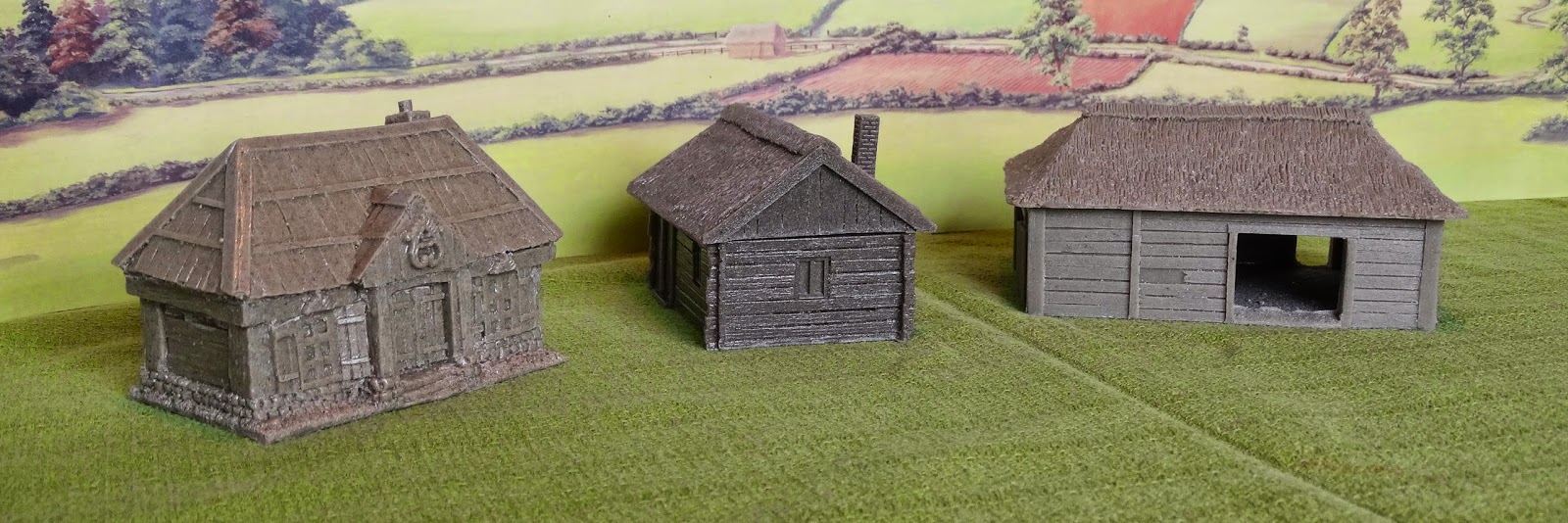
I picked up a couple of other models from Ironclad in the same purchase, plus what I hoped would be a compatible building from Hovels. I wanted to have the basis for a built up area that was of a more lightly-built and rustic nature than those I currently use, both for variety and also to have a village or small town that would provide a lower level of cover, and would therefore be easier to attack.

The buildings were the Small Log House and Eastern Front Barn from Ironclad, and the Regional Governor's House from Hovels, all in 15mm of course. Once again I was pleased with what I received. The Ironclad models come in a fairly large 15mm size, and you can see that their barn rather overshadows the supposedly grand residence of the 'regional governor', but this doesn't really worry me. The Ironclad models come with removable roofs and some detail on the inside. The barn measures around 110cm x 80cm x 55cm high, just for the record. The Hovels model is all in one piece, but standards of finish are just as high as Ironclad's. No annoying air bubbles present anywhere!

L to R, eastern front barn, small log house, regional governor's house.

Alternative aspects.
I find painting buildings so much more relaxing than painting figures - so much less fiddly, you understand. So you should see some of these buildings completed and gracing a game in the not too distant future.

And before I leave you, a reminder to SYW gamers - don't forget to visit:


Cheers for now.


Thursday, 24 April 2014

Wargames Magazines - The Road To Success

I have written previously in this blog about the positive role that the current 3 glossy magazines play in our hobby. I continue to hold to that position, yet I don't subscribe to any of these publications. Furthermore, the current issue of each one was checked out recently online (a great facility to have - thank you editors) and rejected for purchase. Why would that be? 

After some reflection I came to the personal conclusion that the problem could easily be summed up - too much diversity. Our hobby has become a very broad church and editors are sensitive to the criticism that they are leaving out one branch or other of the pastime. So we have modelling articles, painting articles, sci-fi articles, steam punk articles, articles about wars you've never heard of... you name it.

It's time to get back to basics. Every wargamer knows in his heart that playing battles with model soldiers has just three periods - ancients, horse and musket, and modern. Don't they? After all, this is what we learnt from Mssrs. Featherstone and Grant in the 60s and 70s. Come on, even my dog knows that wargaming is divided into three periods.

How much more proof do you need? Good boy Biffy!

So the lesson is obvious. Every issue of a wargames magazine should have at least one decent article dedicated to each one of these periods. And when I say decent article, I mean a good historical or fictional scenario with some solid background that can be adapted from one part of the period to another (say, from Napoleonics to Seven Years War), and including a nice little battle report. With a well drawn map or maps. And none of that skirmish nonsense or other diversification - I'm talking about solid, mainstream wargaming.

But what about sci-fi, fantasy, or steam punk fans? Perhaps they should get their own magazines going. For steam punk, you could call it Nutcase Monthly, or some such. Oops, sorry guys. Only joking. I appreciate that to most of the population we're all nutcases.

So there you have it. Gather in your traditional, core audience and all will be well. Our future lies in our past.

Editors, ignore me at your peril!