Followers

Saturday, 5 March 2022

Solo Rules Testing - 3

So, the old 4' x 4' table came out again for my last planned rules test. This time I wanted to remind myself of the ancients rules I'm currently using, Mantic Games' Kings of War Historical. Well, I say 'Mantic Games' but they don't actually sell or support these rules anymore! As usual I'm well behind the times and using old, long forgotten rule sets. But you can check the background to this decision at the posts linked below:

Post: Kings of War Historical

Post: Playing and Discussing KoWH

You can still get copies of the rules if you search around the net, from ebay and other sources. But it's worth pointing out that they differ very little from the original Kings of War fantasy rules, and these are still going strong and in their third edition. Even better, you can download the basic rules for free from the Mantic Games website. This really is the spirit of the hobby and Mantic should get a big thumbs up for this kind of offer. 

In fact, the free download gives you most of what you need to play - as far as I can tell the playing rules are all there, it's only the army lists and various bits of fluff that are absent, and as these are fantasy rules you don't need any of that. However, what turns the fantasy rules into a playable ancients set are the stats and special rules which give the various periods and units their flavour. For this a copy of Historical is really needed, unless you are feeling really creative and are ready for a bit of serious work.

The Game
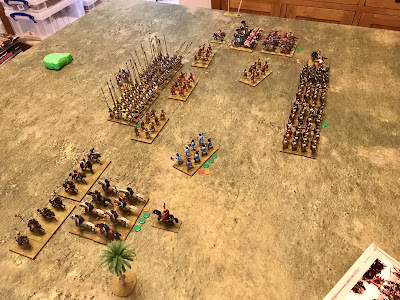
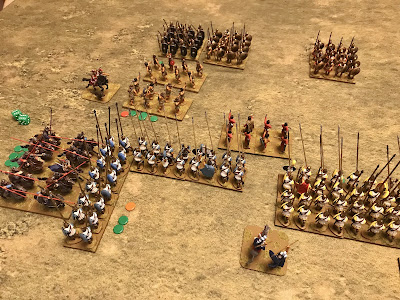
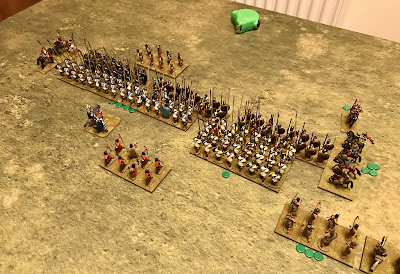
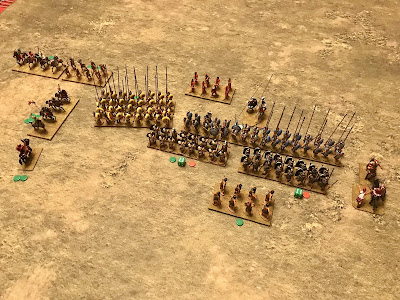
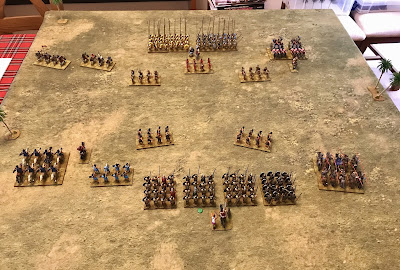
Anyway, a few captioned photos of the playtest. Sorry for the quality, but I snapped these in haste with an iPhone 7. Those are 28mm figures in use. You don't need a sketch map as the terrain was just a flat board with a terrain mat over it. The small forces involved are from my imagi-nations, the countries of Latium and Paphlagonia, and so you will see various units of hoplites, legionaries, cataphracts and chariots (and others) mixed up in both armies. Sadly my lovely Celts missed the cut.

End of the first move. Forces of Latium in the foreground.

The flanking cavalry come together whilst skirmishers and bowmen
on both sides try to weaken their opponents.

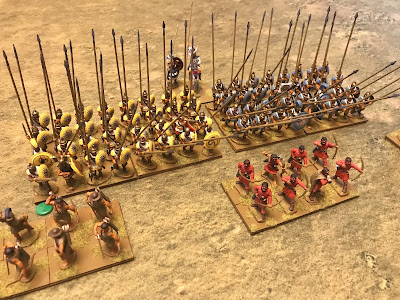
The Blue and Yellow Shields phalanx units of Paphlagonia.

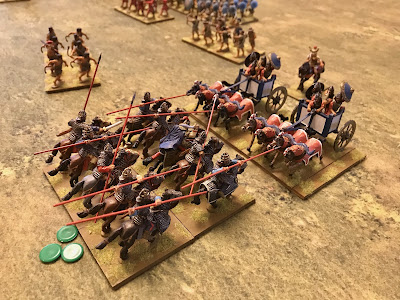
Cataphracts of Latium vs. Paphlagonian heavy chariots.
The chariots lost!

The cataphracts wheel around into the Blue Shields (top).
A gap in the Latium main line has been created by the Paphlagonian bowmen.

The cataphracts crash in but this was a melee too far for them,
resulting in their destruction by long pointy things.

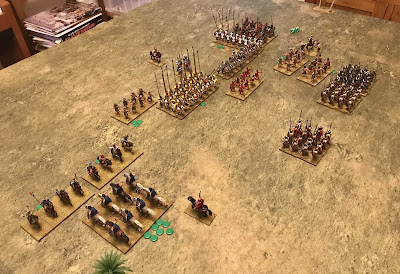
And finally the main lines come together...

...resulting in a Paphlagonian victory. Latium's left flank hoplite unit is destroyed
(helped by a flank attack from light cavalry), and the red markers show the
remaining two are 'wavering'. Game over.

Conclusion
This was a fun little action which reminded me how much I like these rules. They provide a fast moving game, and with a few tweaks they have all the period flavour I want. A great shame they never really seem to have taken off. Perhaps Mantic should try again. If you're listening guys...

This and the previous games in this series have also proved to me that a 4' x 4' table is no real barrier to having nice games, even in 28mm, without having to try those silly skirmish games that are all the rage these days. Skirmish games? Don Featherstone must be turning in his grave!

It feels like I've been through a period of preparation since Christmas, looking at new rules and rules not used for a while, and dusting off my model armies. I reckon I'm ready to go with some 'proper' gaming. Time to phone some friends and re-start the banter and dice rolling.

'Til next time!

Monday, 21 February 2022

Cotswold Wargaming Day 2022

I am pleased to announce that the Cotswold Wargaming Day is back:

COTSWOLD WARGAMING DAY 2022
SUNDAY 25th SEPTEMBER
WESTWOODS COMMUNITY CENTRE
NORTHLEACH GL54 3QJ
08.30 - 17.00

Last years 'Best Game' winner.

Not much to say that's new - the format this year will be the same as last year. An email has gone out to all on the mailing list. If you are new to this event and are interested, you can just turn up on the day to chat and join in, or contact me via the comments section if you want to put on a game. 

Last year was a great success despite Covid and a fuel 'crisis'. I reckon this year could be even more special. Hope to see you there!

Friday, 18 February 2022

Solo Rules Testing - 2

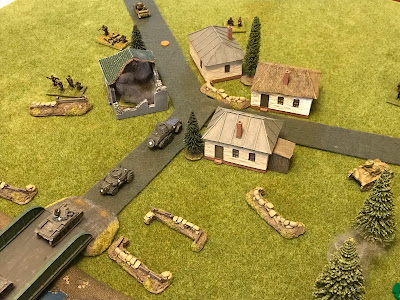
The second of my solo playtest series features the adaption of the WRG 1973 WW2 rules which I am currently working on. Once again this test game used a 4' x 4' table, but the scenario has the option to expand to 6' x 4', and would probably play better with this larger table size. The scenario sketch map is shown below with the full 6' x 4' terrain - the 4' x 4' table leaves out the western two feet containing the village of Strobin.

1' x 1' grid squares.

Scenario - The Action at Jarocin
3rd September 1939

German Forces – from 2nd Panzer Division (determined, attacking from the western baseline)

Force HQ - command base
Heavy Panzer Platoon: 2 x PzIV, 3 x PzII 
Light Panzer Platoon: 2 x PzII, 3 x PzI
Infantry platoon x 2: standard, 1 lorried
Recce section: Sdkfz231 (6-rad), Sdkfz 221
Recce section: Sdkfz222, motorcycle recce section
Weapons section: 2 x 37mm ATG and tows, command group
Mortars: 6 x 8cm, direct support, MFO (car, radio)
Artillery: 4 x 10.5cm, general support, AFO (car, radio)

Polish Forces – from 10th Mechanised Brigade (determined, defending Jarocin and the bridges)

Force HQ - command base
Tank Platoon: 3 x Vickers (single turret), 2 x Vickers (twin turret)
Infantry platoon: standard, + 37mm ATG and tow
Recce section: 1 x TKS (MG), 1 x TKS (20mm)
Weapons section: 37mm ATG and tow, MMG group, command group
Mortars: 2 x 8cm, direct support, MFO (telephone)

Any Polish infantry, infantry support or heavy weapons elements may be dug-in if required.

Scenario Conditions
The Germans must capture the 2 bridges and Jarocin by the end of turn 8 for a total victory. If both bridges are captured but not Jarocin, the game is drawn. Otherwise, the Poles win.
4' x 4' table – the Poles can deploy up to 3' from the eastern baseline. The Germans deploy from their table edge on turn 1.
6' x 4' table – the Poles deploy up to 4' from the eastern baseline. Germans may deploy recce units and up to 2 platoons (infantry or tank) up to 8" from their baseline. Other German units deploy from their base edge on turn 1.
Hills are gentle. Woods east of the river are open: to the west of the river they are dense.

Some Photos of the Game

German light tanks were quickly across the southern bridge.

Recce elements lead the way across the northern bridge.
The heavy tank platoon kept the advanced Polish positions occupied.

The Polish tanks engage the advancing German light tanks, but come off worse.
A Polish anti-tank gun covering the south bridge proves ineffective.

The leading German elements press on into Jarocin.
German infantry engage the Poles west of the river.

Overview - the German advance is going well.

The other Polish 37mm in Jarocin also had little luck.
The leading German armoured car knocked it out with close range 20mm cannon fire.

The Polish platoon in Jarocin had suffered steady casualties,
and was eventually forced to retreat following a morale test.
Jarocin could now be occupied by follow-up forces. The Germans had won with light casualties.

The Project
The 1973 rules have been out of print for decades now, and I'm guessing that few of you reading this are familiar with them. They were ahead of their time when published, and I remain convinced they could form the basis of a good, straightforward and compact set of rules for the whole of WW2. The core rules function very well - for an introduction to the project check out my first post on the subject here.

The basic infantry move is now up to a sensible 150mm (6"), whilst the vehicle moves remain mostly the same as in the original. I have tried to simplify the indirect fire rules and modernise the rules for air attacks. The morale rules are very old school with a long list of factors - I have overhauled these but kept the basic system as I found I had a soft spot for the old fashioned feel of them. I have added in some basic rules for troop quality (which were absent in the original), and I am trying to develop some simple rules that allow for hidden deployment and the odd surprise.

Also needed was a good deal of overall re-writing and re-arrangement to make the rules easier to understand. As I have said, they are basically a simple set but a typical 1970s lack of attention to clarity and exposition left them harder to fathom than needed. Overall, the possibility exists for a rule set covering the whole of WW2, suitable for 20mm down to 6mm size models, that could fit into an Osprey 'blue book'. But anything like publication is way in the future. And how Phil and Sue Barker might feel about publication is an unknown quantity.

This has been an absorbing and useful project so far. If anyone wants a copy of my present ideas, I have word documents of a set for 1939, one for 1944-45 Germans vs. Americans, and one for Germans vs. Russians 1943. These contain details of unit organisation as well as the rules. You would have to leave an email address in the comments, which I could delete once I've made a note of it (unless of course I have your email already). Feedback would be welcome.

In other WW2 news, I have recently bought a copy of the 'O' Group rules and I am working through the online videos made by the Too Fat Lardies. They seem like an original set with a number of quite challenging ideas and mechanics. Not sure how I feel about them at the moment.

Anyway, ancients next in this series. 'Til next time!

Friday, 11 February 2022

Solo Rules Testing - 1

This is the first in a series of three posts dealing with short and fairly simple play-tests of rule sets which I am presently interested in. All will use a 4' x 4' board and will be solo, in preparation (I hope) for some face-to-face gaming later in 2022.

First off is a test of the new Live Free or Die rules from Little Wars TV. Readers will know that I am a firm admirer of LWTV - besides being very watchable and well produced, their content is of the highest quality. It is solidly rooted in 'proper' historical wargaming, with plenty of historical background and a very creative approach. The Live Free or Die project exemplifies this. 

Looking for a set of simple rules for the AWI, Tom and Greg from LWTV used the old 1980s Loose Files and American Scramble rules from Andy Callan as inspiration. They then turned the development process into a 6-part podcast covering most aspects of rules design and publication, before producing a video of the culminating wargame of the Battle of Brandywine. As if that wasn't enough, they then made the rules available online as a full-colour PDF or print edition, with half the money going to the American Battlefields Trust. And then they produced a 'how to play' video, and then continued the theme with a refight of the Battle of Trenton, filmed on location at a museum in Trenton pretty much on the site of the original battle. Phew! If you can find me anyone else doing this kind of thing anywhere else in the wargaming world at the moment, I'd love to know about it. Oh, and did I mention the basic rules are just 4 pages long?

So, I bought the PDF (only $13) and set about making a few changes to suit the rules for the SYW and take into account one or two personal preferences. These included having brigade commanders for each brigade rather than just one or two subsidiary commanders, the inclusion of evade moves (offered as an optional rule in the PDF), some use of average dice rather than D6 where I thought it might help, and a minor tweak allowing for the possibility of double moves. The rules also use the concept of removing bases to represent casualties, which I don't personally like as I prefer to keep my figures on the table. Some markers to indicate lost bases work just as well.

Of particular interest was that the rules use a command points system, something I've never really liked as such rules seem to add an additional level of artificiality to wargames rules, which tend to be quite artificial enough in most cases. But I went with it. The scenario was quickly developed from a battle created by the Cirencester Wargames club which featured recently on the Shadow of the Eagles blog. I reduced the table size and trimmed down the number of units slightly - as you can see from the photos the Austrians are defending some high ground and are being attacked from two sides by superior Prussian forces. Figures are 28mm.

The Prussians struggle across the stream in the foreground and try to get to grips with the
Austrian position. Their cavalry is changing flanks to support their right.

A bit of a traffic jam results.
The cavalry of both sides get stuck in on the right of the picture.

Well, the cavalry are a bit thinned out, but the infantry firefight is well underway.

Close up as the Prussians try to break into the Austrian line.

Overall, the game was most interesting, and the rules turned out to be pretty well written, easy to understand, and easy to use. Despite the simplicity, there are a number of mechanics which seem quite original and add interest to the game - for example, units may use 'hasty fire' and use their full movement, or use 'volley fire' and remain stationary, with the latter using double the dice. The Andy Callan concept of deciding the result of a melee which then decides how many casualties are incurred to each side is another interesting mechanic. The charge process also seems quite original and produces some fun issues when charges fail to make contact.

The army and subsidiary commanders are very involved in the game, as they can help substantially with firing (which I have doubts about), and melee and morale (which is entirely appropriate). The commanders are also the source of the command points, with better commanders having more of them. This is a good way to represent commander quality. I found that my idea of creating brigade commanders, and thus increasing the number of subsidiary commanders, meant that too many command points were available. This led in particular to units being able to be shored up by attached commanders and becoming rather too resilient. So perhaps this is a change to abandon.

Another point to mention is that the rules are targeted at historical play, and require proper victory conditions for both sides. Actually destroying units seemed quite difficult to do - they tend to retire to the rear, ready to be rallied by their own officers or attached commanders. So rules dependent on losing a proportion of your forces to decide the result don't really work.

If you're a Horse & Musket wargamer, I would strongly suggest you look into these rules. They are not expensive to acquire, and make for an interesting and fresh gaming experience. And any rules you can fit onto 4 pages must be worth a look! Conversion to other periods would seem to be possible and could be a fascinating little project.

News Just In
Not satisfied with what they have already achieved, those LWTV boys now have the rules, along with various scenarios and supporting material, published in a wire-bound soft-back edition. Available from Caliver Books in the UK for £29.95. Honestly darlings, keeping up with these £30 rule books from Caliver is becoming quite a chore!

Tuesday, 4 January 2022

Miniature Wargaming - The Movie. A Review

Well, it seems this documentary film is now available in the UK, via the Sky Store at a price of £9.99. Check the link here. If you're not a Sky customer you have to download the Sky Store Player app, which is a bit of a hassle but no big deal. So I went ahead, bought the film, and watched it. And here's my review.


I would say that most of the criticisms I have read online, particularly in the review from Little Wars TV, are justified. I would also check out the reviews on IMDb.

First off, the opening scene of an air-soft engagement in progress is confusing and doesn't really work - whilst including the additional problem of having nothing to do with miniature wargaming. There follows a basic introduction to the hobby, which is OK, and then we start to meet the main protagonists around whom the film is anchored. Which is where the film really starts to fall down.

The blurb from the website gives things away - "the movie dives into the heart of the wargaming industry and reveals the impact it has on people's lives". 'The industry' is a term constantly used throughout the film, and much of the film is about this 'wargaming industry', not wargaming as a hobby. Two of the three personal stories told revolve around people running small wargaming businesses. As a result, an awful lot of the film feels like it is about the problems of running a small business, rather than being about the hobby itself. The brief section set in the U.S. also focusses on a (successful) wargaming business. 

Criticisms that the film is rather depressing also ring true. One of the main characters, Andy Bryant, is a war veteran suffering from PTSD who received a raw deal from the British Army and is now struggling with his personal life as well as his home-based terrain business. Another character, Chris Nicholls, is struggling to support his family with his wargaming business and is going under from stress. Even the two actual wargamers, who are followed to a wargaming competition in Norway, find the competition itself a bit disappointing, and furthermore one of them has (you guessed it) struggled with depression in the past and found his wargaming buddies helped him through it. Crikey.

Turning back to Chris Nicholls, the main part of his story is his struggle to get his boardgame ready for presentation at a major gaming show. He fails, as you might expect, but note he is developing a boardgame, not a miniature wargame. This again points to my main issue with the film - it signally fails to do what it says on the tin. Miniature wargaming as a hobby is absent from probably half the running time. The phrase 'playing with toy soldiers' (my own summary of what the hobby is) never even occurs in the film. Henry Hyde's brief canter through the history of wargaming is OK as far as it goes, but is so condensed and rapid that non-wargamers won't gain much from it. Not Henry's fault, but indicative of the film's priorities.

I also found the film frankly a bit dull in parts, and could easily have switched off, but I stuck with it and did find some interest in the personal stories being told. There is also interesting background here if you do indeed want to understand the miniature wargaming 'industry', with companies like Warlord Games receiving a good bit of time. We get to learn a bit about the advantages of Kickstarter campaigns. But the pleasures of playing with toy soldiers are often far in the background.

I felt the film-maker needed to reach out to more grass-roots players and examine their thoughts and experiences concerning the hobby, and give a greater idea of what the hobby actually is and what it means to people. Where were the visits to clubs and wargaming shows? Where were the fabulous games put on by dedicated gamers, such as I saw at Partizan this year? I guess this relates to my own feeling that our hobby is fundamentally a grass-roots one, and that the 'industry' usually feels peripheral to me, although the fact that the hobby does support an industry is an important point to make.

As a final point, the structure of the film can be rather confusing, as it jumps from theme to theme and situation to situation, particularly in the first hour.

So overall, not really a film I would recommend. I was disappointed with a movie which I was keen to enjoy. It would appear from the evidence in the film that most wargamers are dysfunctional, or failures in life, or both. Certainly, most wargamers would admit to being a bit geeky, at least as regards their hobby. But they also tend to be intelligent and sociable people who have fun with a hobby they enjoy and which they don't take too seriously, no matter how much historical research they do or how many hours they spend painting toy soldiers.

If you don't mind having a punt with a tenner, you may find some interest here, even if only in the fact that this is (and is likely to remain), the only film about the hobby. And it is very professionally made. But anyone wanting to know what miniature wargaming is really about would be best directed to Little Wars TV and their YouTube channel - where people actually seem to have fun with their toy soldiers.

Sunday, 26 December 2021

A Period of Restraint

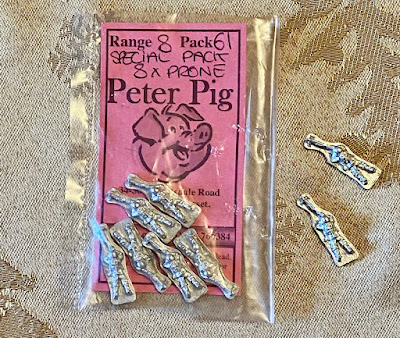
In the midst of what is sometimes a period of excess, it was interesting for me to reflect on how little money I have been spending on our hobby recently. For example, my Christmas wargaming binge-out consisted of that which you see below.


Yes, 8 prone BAR gunners. I needed some BAR gunners to reinforce my Polish 1939 infantry, but the availability of 15mm figures for this period is now very restricted. True North Miniatures seem to have disappeared, and Flames of War also seem to have discontinued their Polish stuff - so much for big manufacturers supporting the hobby. But at 15mm size an American BAR gunner will do fine - the helmets in particular are almost identical. The lovely people at Peter Pig do a bag of 8 BAR gunners, and they agreed to make up a special pack of 8 in the prone position at a small extra charge. Just over £8 including postage and they were with me in 48 hours. Now there's a company supporting the hobby - and they've been doing it for decades.

Not buying much has been a trend for me since I started work on Shadow of the Eagles. I thought maybe when the money from sales came in I would think about putting together a couple of Napoleonic armies, but the enthusiasm doesn't seem to be there. I did end up ordering a 'brigade box' of the new Warlord Games 'Epic' figures, just to see what all the fuss was about, but then cancelled the order the next day. (I got an immediate refund at around 8 o'clock at night, another bit of good service from a wargames seller). I really couldn't see myself painting 80 figure units. Or even halving the units and painting 40 figures at a time.

Broadly speaking, it would seem 3 collections is the most I can cope with. I haven't touched my ancients in months, for example, and I would like to get some games in with them in the New Year. Starting a new collection would just be a distraction from enjoying what I already have.

So at Partizan in October, when I did the Shadow of the Eagles demo, I came away with  single Osprey book (on War Elephants). And that was it. I've spent out on a couple of military history books since then, but no specific wargaming stuff. Until my monster purchase with Peter Pig!

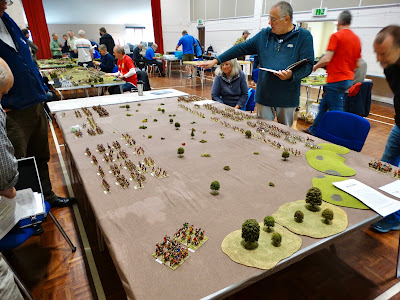
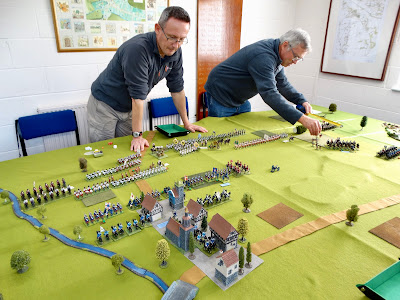
This I find very satisfying. Coming back to my existing periods after a deep dive into Napoleonics has been a great pleasure, an example being the large Battle of Chotusitz game I played with some old friends back in November. You can find an excellent report on that game on the Wargaming Addict blog. The photo below shows the game in progress, using a 10' x 6' table and a rented room at my local community centre.

Steve and Paul played the Austrians. They pulled off a famous victory
when Frederick arrived too late to save his advanced guard and cavalry. 

So my New Year starts not with plans for adventurous new projects, but a hope that Omicron will allow me to get back into the swing of playing my SYW, Ancients and WW2 Poland games with friends, just as in the past. Well, there is the matter of continuing to develop my revised edition of the WRG 1973 WW2 rules. There will be more of this in another post.

Happy New Year everyone. See you in 2022!

Saturday, 23 October 2021

'Miniature Wargaming The Movie' - Whatever Happened?

One or two of you may remember a post from February this year which I called 'Why We Wargame'. The post had some interesting responses, but its inspiration was a documentary film called Miniature Wargaming - The Movie'.


I was fascinated by the concept of the film as soon as I learnt about it. Like many wargamers, my first reaction was - you must be joking. Closely followed by - I bet that will be a heap of crap. But I have learnt during this year that what resulted looks like a thoroughly professional, eye-catching film that really sets out to say something about the hobby. 

Fortunately, it wasn't the film a lot of gamers seemed to want - a history of the hobby along with details of how miniature wargames are played, a film that would have been of interest mostly to people who are already wargamers. Instead it seemed to focus on what the hobby (and by extension all hobbies) meant to people and how it affected their lives. We all spend a fair amount of time thinking about and participating in our hobby, so why not take a bit of time to think through why we do it?

The film clearly concentrated on British gamers and the British hobby. The main problem is, the film was released in 2019, won some awards, was released to the public in the U.S, but remains unreleased in this country. As far as I'm aware, the only Brits who have seen it are those who participated in the crowd-funding which got the film made.

From what I hear and have found online, the other surprising thing about the movie is how little real interest it seemed to generate amongst UK wargamers. Here was a professional movie that was worth watching, made about our hobby, and no one seemed to care much.

So I very much hope it will be released soon in this country. In fact, I emailed director Joe Piddington via the film's website to ask what was going on. He was kind enough to send a pretty full reply, and in short he is waiting on the film's distributor's in the UK to complete negotiations with people like Sky and Amazon - a process that is entirely beyond his control. Lockdown was apparently part of the problem, and reading between the lines I could sense Joe's frustration at the film remaining unavailable in the country of its birth. This exchange was in August, and Joe mentioned that the intention was to get the film out this year. Well, nothing yet. I can only say that as an ordinary punter it all feels a bit weird.

Anyway, my fingers remain crossed. It is sad that this film seems to have been forgotten in the UK before it even became available to watch. I hope the situation may be resolved soon, and I wish Joe all the luck in the world. Meanwhile, see this review on Little Wars TV for a bit more info and an interview with Joe.

'Til next time!