Followers

Showing posts with label Napoleonic. Show all posts

Friday, 10 October 2025

The Crimea With 'Shadow of the Eagles'

My wargaming friend Roy Boss has an astonishing collection of toy soldiers, collected over about 60 years. Every now and then he surprises me by producing yet another army (or armies) from his Alladin's cave of a wargaming room. Most recently, he revealed the existence of a rather lovely collection of figures for the Crimea. He also asked if I fancied adapting SotE for the period and playing a game. Dear readers, how could I refuse?

I soon found that the required rule adaptions were minimal. In fact, there were just two. Rifled muskets were awarded a range of 18", twice the range of smooth-bore muskets as used in the original rules. Firing at over 9" range with rifled muskets would get a -1 modifier. The other change was to dispense with the rules for skirmish screens, i.e. those skirmishers provided by the light companies of a given infantry battalion. Skirmishing cover would be provided by battalions of suitably trained soldiers, operating with the whole battalion in skirmishing order. This both simplified the rules and seemed to give a more Crimean feel to the fairly large scale battle we were envisaging.

Roy had invited four of us over. On arrival we found a delightfully large battle laid out, on a 10' x 4' table. The Russians were intending to attack a combined British/French force, moving down from their ridge position. There were 26 Russian infantry battalions with a standard 24 figures per battalion, with 17 similar sized battalions on the Allied side. The Allies were outnumbered 12 to 8 in cavalry regiments (12 figures per unit), and 8 to 6 in artillery batteries. On the other hand, the Russians had no rifled muskets (apart from a couple of rifle battalions), and they were likely to have inferior brigade commanders, though this would be subject to dice rolls. And they had the burden of attacking.

A typical Russian 'brigade', formed from a regiment of 3 battalions.

Paul commanded the Russian right. 
He seemed confident of success.

The figures in use were classic Hinton Hunts, of 25mm size. The perfect figures for gaming this kind of battle. The stream was a linear obstacle and so not too much of an issue for the Russians. The dice rolls for commanders gave the Russians all regular brigadiers - not an inferior commander amongst them! The Allied commanders (which included me) swallowed hard and braced ourselves for a tough fight.

And so the game gets underway.
Classic pointing action from veteran gamer Roy.

My opponent on the Allied right was Adam.
I can't say I was very keen on his apparent grim determination.

Well, it was a tough fight, and as the turns went by the Allied defence got increasingly desperate, particularly on my side of the table. There were just too many damned Russians, well supported by 4 deadly batteries firing from the ridge. The first line of Russian columns was turned back, but they retired through their second line which then resumed the assault. This was just too much for the already damaged British units and they broke away one by one. My partner Matt caused some alarm and despondency by doing well in the initial cavalry combats on his (French) flank, but in the end the luck turned against these troops. However, honours were much more even on this flank. 

Here they come.
The Russian infantry was only allowed to attack in assault/company column.

The French flank was rather more open,
as both sides had most of their cavalry here.

My screen of rifleman fell back behind the main line.

The Allied centre under extreme pressure. In the background
you can see the Allied right wing is already folding.

Oh dear me. The Russians are in amongst the British in the centre,
forcing flank combats which even guard units are unlikely to win.

Paul played aggressively against my French allies. Stop enjoying yourself man!

And so it's all over. A conclusive victory for the Russians.
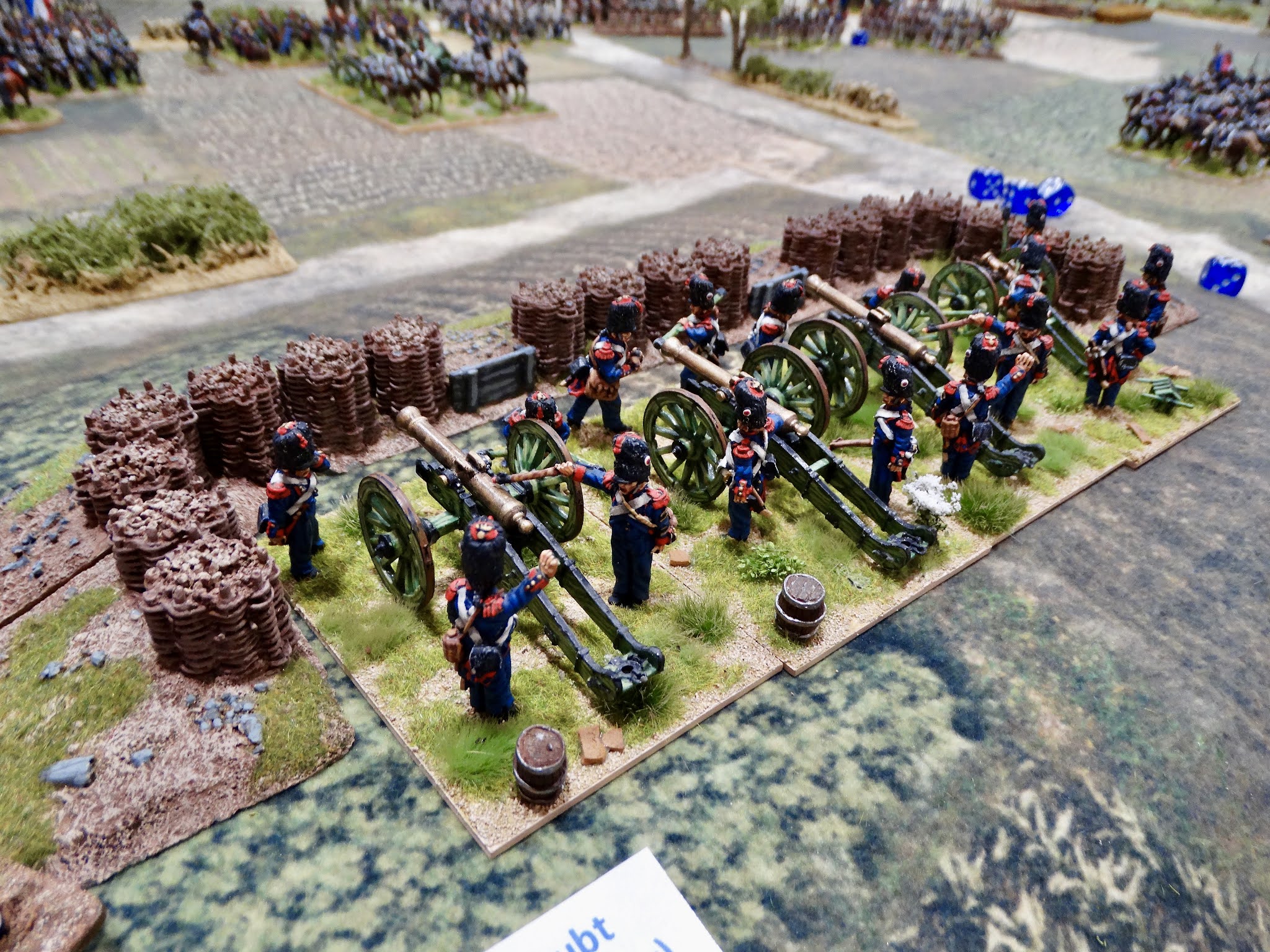
The very effective Russian batteries are seen in the foreground.

Yes, I have to say that the Allies got their butts well and truly kicked. A whole bunch of my infantry units routed off the table and the right flank was broken, with lots of Russian units ready to exploit. The French flank wasn't in as bad a state, but even here we were definitely on the back foot. Time to assess what went wrong for the Allies and how the scenario worked out.

Learning Points
Were there just too many Russian units? Maybe not. They were lucky with their initial command rolls - statistically a third of their brigadiers should have been 'inferior', which would have slowed down their attacks. And Allied tactics were at fault - we failed to move forward from our initial dispositions, which meant that we were cramped against our baseline. This gave us restricted room to fall back and rally, and units were lost by leaving the table when they should have had the chance to reform. And perhaps a redoubt or two (or three) might have been granted to the Allies. After all, what is a Crimean wargame without redoubts?

Some rules needed changing. All the British forces should have been superior for training, making their fire more effective. Making the Russians superior for motivation is a mistake - their performance in the Crimea makes 'regular' a better option. We also failed to use the British counter-charge rule, which means they are the only infantry able to counter-charge, representing their 'volley then charge' tactics. On the other hand, we gave all the French infantry rifled muskets, which I believe was wrong. Rifled muskets were not generally issued until after the Crimean War was over.

The main problem in moving SotE to the Crimean theatre is assessing how the main 4 nations (Russia, France, Britain and Turkey) should be classed for the various rule mechanisms. Books on the Crimea giving the kind of detail that wargamers want are much rarer than for the Napoleonic period, and it was difficult to make some of the assessments. 

Nevertheless, a fine time was had by all. Thanks to Roy for setting it all up and letting us use his marvellous collection of figures. I look forward to more Crimean action in the future.

Those wishing to check out the extra Crimean rules and the various National Characteristics can find free downloads on my Facebook page:


'Til next time!

Tuesday, 26 March 2024

In Which I Try Out Valour & Fortitude

The Perry Twin's Valour & Fortitude rules are a set I have been interested in since they first came out about 18 months ago. The basic idea is excellent, and impressed me straight away - a set of Napoleonic rules created by some very well known wargamers (mainly Jervis Johnson), designed to be short and relatively simple, available for entirely free download and supported by regular updates as they improve and develop. I think that's what is sometimes called 'the spirit of wargaming'. The shame is, it has taken me so long to get around to a playtest. I finally got around to it recently following an invitation from a friend at the Cirencester Wargames Club (many thanks Nigel). 

For our game, Nigel set up a fictional Prussians vs. French battle from 1806. Each side had 3 infantry brigades and a cavalry brigade, plus an artillery battery in each brigade - around 20 units a side. Nigel has a wonderful collection of 20mm plastic figures, including Airfix figures going back to when he was a teenager, and we were using a 6' x 4' table, with the ranges and distances in the rules reduced by one third. Here was my first lesson in V&F - as with Black Powder, the big games and large units they were apparently designed for can easily be reduced for the collections and tables of mere mortals.

The French 'come on in the same old way...'

After the game, both of us had some comments about the detail of the rules, but the overall conclusion was straightforward enough - we had both enjoyed ourselves, and we were keen to play the rules again and further our understanding of how they worked. Simply writing a decent set of Napoleonic rules within a limit of 4 pages is a remarkable achievement in itself, and this is certainly a very decent set of rules. Any modest criticisms given below should be seen in this light.

Just a few words about the game. Firstly, both of us were new to V&F. The version we were using was v.2.3. In order to give the rules a good wring out, Nigel flung his French forces into a headlong attack against my Prussians, who adopted a defensive posture. Under these circumstances, the Prussians managed to see off the French assaulting columns relatively easily, and the battle ended (if I remember correctly) with 2 French brigades destroyed and a third approaching destruction, whilst all Prussian brigades were still functioning. A few photos are given below, mainly to enable readers to admire Nigel's lovely figures.


Impressions of the Rules
Most people interested in V&F have had plenty of time to check them out and will be familiar with their basics - so this post won't attempt any summary or overall description of the rules. I just wanted to record the thoughts of a couple of experienced wargamers following their first game.

Myself
One interesting thing I've never seen mentioned is that the rules don't actually say what period they are for. "Designed for fighting battles using the Perry Miniatures range of figures" is the nearest the rules get, but as Perry Miniatures cover periods from Medieval to WW2 this isn't much help. It's the kind of thing one expects on a title page - but there we are, everyone seems to know they are primarily for Napoleonics but can be adapted for other Horse and Musket periods, so let's leave it at that.

Now then - the Fate Cards. Personally I could do without them. Their presence was one reason I left the rules alone for a while. The idea of such cards is as old as the hills (as I'm sure Jervis would admit), being something I remember reading about in Donald Featherstone's earliest books. In V&F you draw a card at the beginning of each turn and add it to your store of surprises (i.e. previously drawn Fate Cards) which you can spring whenever you want. You know the kind of thing - that unit that's about to be destroyed or retreat can re-roll its last dice throw and be saved. For me, this just adds an extra layer that detracts from the game - the rules themselves, especially with the special rules for particular nations, provide all the period character you might need. The rest is just fluff, IMHO. Yes, you guessed it, I don't like cards in wargames. I'm pleased to see that V&F isn't one of those 'card driven systems' that are all the rage these days.

A particular mechanism I retain some doubts about is the use of supporting units for both fire and melee - only one unit attacks in both these processes, whilst others offer support. This seemed to be one reason that the Prussians saw off the French so well in our game - perhaps rather too well, as the rules seemed to prevent the French columns from developing their full potential. However, more games are needed to see the rule in action before I get too dismissive!

The various army lists currently offered are a fundamental part of playing a 'proper' Napoleonic game, and a solid attempt has been made to give each nation a bit of historical character. The 'stat line' system defining the characteristics of each type of unit is carried over from Black Powder, and is very useful in creating period flavour whilst keeping the core rules simple. The 'elan' rule for the French is a good example of a national special rule that seems to work well, but the 'drilled' special rule for the Prussians had both Nigel and I scratching our heads over whether it was really justified, particularly in 1806. 

The compressed nature of the rules does make for the occasional difficulty in understanding what is intended, and overlooking a short sentence buried in a particular section can make a big difference in a game - so if you're new to the rules, some careful reading is advised. I was unsure what the 'reform' action was all about until I read the Designer's Comments and twigged that it was all about formation changes - but the phrase 'formation change' is entirely absent in the main rules. A minor point, but the sort of thing you need to look out for.

The rules for skirmishers (i.e. skirmish screens in front of a formed unit) are commendably simple, but I'm not sure if they really provide the flavour of the real thing - in particular the unit deploying them doesn't seem to get any protection from their presence. Rule 8.1.2 gives line a significant advantage vs. column in melee (as far as I can tell after one game). This was great for me in this battle, but whether it is justified? Who knows. Maybe more experienced players can put me straight.

Finally, as the reviewers on Little Wars TV have noted, the QRS has the look of a sheet of A4 where the rules were fitted on...well, where they would fit on, rather than in any particular order. The LWTV QRS is much better, but note it is a bit out of date now and will need amending for the latest rule changes.

Nigel
Nigel was fully in favour of the Fate Cards idea, maintaining that they added some colour to the game without adversely affecting play. Overall, he reckoned (as I did) that the rules gave a game that flowed well without getting bogged down in too much detail. He also liked the system for working out who had won, based on the accumulation of Defeat Tokens, again something I liked as well. It is a nifty and easy to use mechanic. Nigel also liked the command and control system - perhaps 'system' is too strong a word, but the rules are simple and have the required effect.

On the down side he noted that you need to have decent sized armies for the system to work well - even using smaller units and smaller size figures, you still need a handful of brigades to get a worthwhile game. This is fine, and it is what the rules are written for, but players of Sharpe Practice and Dan Mersey-style rules should beware. Nigel also thought the sudden death of units (the Valour Test), reliant on a 50/50 dice roll when they reached the appropriate level of damage, was a bit too harsh and too dependent on a single D6. I could certainly see what he meant, although at this level of game I do tend to like a set of rules that are reasonably bloody. 

Over and Out
And that's just about that. If you're holding back from giving these rules a run out, wait no longer. I seem to have concentrated in my comments on things I had some doubts about - but overall I found the rules interesting and original, and fun to play. They're well worth trying and have much to recommend them. For myself, I need to look in particular at the special rules for each nation and see how they fit in with my own thoughts. But that's just me.

'Til next time!

Sunday, 28 January 2024

Ah Yes...Facebook

I have never really thought Facebook was a good place for wargaming sites. The Facebook pages or groups I visited seemed to lack focus and looked to me like a jumble of messages and posts with little order or organisation. So I set up 'proper' websites for Honours of War and Shadow of the Eagles, with forums, download sections, author content etc. 

Well, the Honours of War site has worked pretty well for about 9 years, but activity is now limited to a few stalwart members. These guys post some great content, but for a set of rules published in 2015 a website was beginning to look like a luxury I couldn't afford.

The Shadow of the Eagles site had some interest at first, but this has faded recently and there is currently very little activity. The simple fact is that SotE sold less copies than HoW. This is pretty easy to explain - the Napoleonic rules market is much more competitive than the SYW one, and Osprey have a much higher profile than Partizan Press - particularly with their 'Blue Books'. With the annual renewal of the site coming up, at much increased cost, renewal just didn't seem worth it for a site generating almost zero posts on the forum. (As an aside, check out the Little Wars TV review of the Blue Book series HERE).

On the other hand, people kept telling me Facebook and Instagram were the places to be if one wanted to generate interest in your rules. Once you joined Facebook and your page or group got going, you became part of a significant online conversation, where people joined and posted on your little group, and you joined and posted on their groups. Interest might therefore flourish. This is the problem for small-time rules authors - once the initial publicity has faded, there is the danger that your rules will just sink without trace amongst all the other rule sets.

So there we are - I want to keep interest in my rules alive, and Facebook seems to be a good place to help that along. At least, that's the case according to my kids - and my wife. And a number of fellow gamers. And Dave Ryan at Partizan Press, who always wanted me to have a Facebook page. And recently, well-known military historian and Osprey author Angus Konstam also encouraged me along this route.

So, in a month or so, I will be saying goodbye to the HoW and SotE sites. To anyone who ever posted on those sites, or just joined to download free stuff, my sincere appreciation and thanks. I learned a lot from the questions asked and comments made, and this resulted in some rule amendments and errata corrections. All the errata and new or amended rules will continue to be available on Facebook, free to download. 

The Facebook group is set up, and you can apply to join via the group page:


As for Startline, the discussion group on groups.io will continue (see the Startline Discussion Group). After all, this group has only just started and I want to keep the momentum going. Anyone interested in Startline should keep an eye on both groups. 

For the record, where Startline is going remains uncertain, but I'm enjoying working on the rules immensely. I'll just keep plugging away and time will provide an answer as to what to do with them. The secret to success (as the Buddhists and mindfulness experts tell us) is to love the process, not crave an outcome. That works for me!

So, I hope to see you on the new platform. 'Til next time!

Friday, 15 July 2022

Waterloo 2022 with 'Shadow of the Eagles'

Last Sunday I had the great pleasure of organising and presenting a re-fight of Waterloo at my local community centre. I won't say much here, but a very enjoyable day was had. For a full report, see my post on the Shadow of the Eagles blog:


Hougomont under attack. The chateau and orchard are held by British Guards battalions,
whilst Brunswick reinforcements arrive via the famous North Gate.

I hope you enjoy the account! 

Monday, 6 June 2022

Control The River - A 'Shadow Of The Eagles' Scenario

Just a quick post to flag up a recent SotE game I had with my old buddy Steve. Of particular interest as it uses a table just 4' x 3', and really distinctive 10mm MDF figures. The game in question is scenario 2 from the rulebook itself.


Steve has put out a fine post detailing the action, so I won't tread on his toes by doing the same here. However, there is a supporting post on the SotE blog which adds a few points on the rules and how they functioned.

Angus Konstam
Angus is of course a prolific and highly respected military history author, as well as a well-known wargamer.  I can't resist flagging up Angus's Orkney Wargames blog, as Angus has been trying out SotE recently and seems to be enjoying them. Well worth a visit for the wide variety of games played in all periods.

Hope to see you soon with a bigger post about something really interesting! If I can work out what that might be.

'Til next time!

Friday, 11 February 2022

Solo Rules Testing - 1

This is the first in a series of three posts dealing with short and fairly simple play-tests of rule sets which I am presently interested in. All will use a 4' x 4' board and will be solo, in preparation (I hope) for some face-to-face gaming later in 2022.

First off is a test of the new Live Free or Die rules from Little Wars TV. Readers will know that I am a firm admirer of LWTV - besides being very watchable and well produced, their content is of the highest quality. It is solidly rooted in 'proper' historical wargaming, with plenty of historical background and a very creative approach. The Live Free or Die project exemplifies this. 

Looking for a set of simple rules for the AWI, Tom and Greg from LWTV used the old 1980s Loose Files and American Scramble rules from Andy Callan as inspiration. They then turned the development process into a 6-part podcast covering most aspects of rules design and publication, before producing a video of the culminating wargame of the Battle of Brandywine. As if that wasn't enough, they then made the rules available online as a full-colour PDF or print edition, with half the money going to the American Battlefields Trust. And then they produced a 'how to play' video, and then continued the theme with a refight of the Battle of Trenton, filmed on location at a museum in Trenton pretty much on the site of the original battle. Phew! If you can find me anyone else doing this kind of thing anywhere else in the wargaming world at the moment, I'd love to know about it. Oh, and did I mention the basic rules are just 4 pages long?

So, I bought the PDF (only $13) and set about making a few changes to suit the rules for the SYW and take into account one or two personal preferences. These included having brigade commanders for each brigade rather than just one or two subsidiary commanders, the inclusion of evade moves (offered as an optional rule in the PDF), some use of average dice rather than D6 where I thought it might help, and a minor tweak allowing for the possibility of double moves. The rules also use the concept of removing bases to represent casualties, which I don't personally like as I prefer to keep my figures on the table. Some markers to indicate lost bases work just as well.

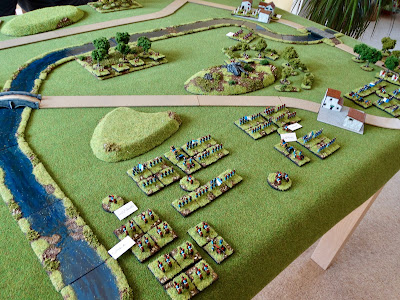
Of particular interest was that the rules use a command points system, something I've never really liked as such rules seem to add an additional level of artificiality to wargames rules, which tend to be quite artificial enough in most cases. But I went with it. The scenario was quickly developed from a battle created by the Cirencester Wargames club which featured recently on the Shadow of the Eagles blog. I reduced the table size and trimmed down the number of units slightly - as you can see from the photos the Austrians are defending some high ground and are being attacked from two sides by superior Prussian forces. Figures are 28mm.

The Prussians struggle across the stream in the foreground and try to get to grips with the
Austrian position. Their cavalry is changing flanks to support their right.

A bit of a traffic jam results.
The cavalry of both sides get stuck in on the right of the picture.

Well, the cavalry are a bit thinned out, but the infantry firefight is well underway.

Close up as the Prussians try to break into the Austrian line.

Overall, the game was most interesting, and the rules turned out to be pretty well written, easy to understand, and easy to use. Despite the simplicity, there are a number of mechanics which seem quite original and add interest to the game - for example, units may use 'hasty fire' and use their full movement, or use 'volley fire' and remain stationary, with the latter using double the dice. The Andy Callan concept of deciding the result of a melee which then decides how many casualties are incurred to each side is another interesting mechanic. The charge process also seems quite original and produces some fun issues when charges fail to make contact.

The army and subsidiary commanders are very involved in the game, as they can help substantially with firing (which I have doubts about), and melee and morale (which is entirely appropriate). The commanders are also the source of the command points, with better commanders having more of them. This is a good way to represent commander quality. I found that my idea of creating brigade commanders, and thus increasing the number of subsidiary commanders, meant that too many command points were available. This led in particular to units being able to be shored up by attached commanders and becoming rather too resilient. So perhaps this is a change to abandon.

Another point to mention is that the rules are targeted at historical play, and require proper victory conditions for both sides. Actually destroying units seemed quite difficult to do - they tend to retire to the rear, ready to be rallied by their own officers or attached commanders. So rules dependent on losing a proportion of your forces to decide the result don't really work.

If you're a Horse & Musket wargamer, I would strongly suggest you look into these rules. They are not expensive to acquire, and make for an interesting and fresh gaming experience. And any rules you can fit onto 4 pages must be worth a look! Conversion to other periods would seem to be possible and could be a fascinating little project.

News Just In
Not satisfied with what they have already achieved, those LWTV boys now have the rules, along with various scenarios and supporting material, published in a wire-bound soft-back edition. Available from Caliver Books in the UK for £29.95. Honestly darlings, keeping up with these £30 rule books from Caliver is becoming quite a chore!

Monday, 11 October 2021

Shadow of the Eagles - On The Road At Partizan 2021

Thanks to Dave Ryan at Caliver Books/Partizan Press, I had the opportunity to put on a demo game of Shadow of the Eagles at the re-scheduled Partizan Show on Sunday 10th October.

Well, I and the four other gamers involved had a great day, the Caliver Books stand was busy all day, and the show itself was very well attended and had a large number of fantastic games to enjoy and inspire. I decided to put the main report on the 'Shadow' blog, which seemed the right thing to do, so follow the link to see that. Just a couple of photos below to whet your appetite.

For those interested in the wider show and the fabulous games being demonstrated, as well as a fine report on our own game, I can do no better than direct you to Steve's Wargaming Addict blog. Well done as usual Steve in creating an informative and nicely photographed record of the day.

"I heartily endorse this product".
The man himself, Dave Ryan.

Steve and Jon contemplate the task ahead
for their Russian forces.

So head over to the Shadow of the Eagles blog for my take on the day. Thanks to Steve, Jon, Paul and Roland for making the day so enjoyable and the game so easy to run. 

Might be time for a brief rest from Napoleonics, so look forward to posts coming up on SYW battles and maybe some WW2 or even ancients. Could take a while though!

Go well 'til next time.

Tuesday, 5 October 2021

Cotswold Wargaming Day - Full Story and Pictures

So the day finally came, two years after the last event. 

Thanks to the very co-operative caretaker of the hall, I had been able to get all the tables set up the evening before, and so arriving at the hall around 08.15 to make the finishing touches was much less stressful. By about 10.30 we had 29 people in the hall, and there were two or three visitors who popped in later, so overall numbers were the same as in 2019. 

There were 8 games, 6 in the main hall and 2 in the side room. It was interesting to have 4 big games present, all using 12 foot long tables. There was still room for a couple of extra games of average size, so there is room to expand the event in 2022. Unfortunately, three games were cancelled before the event (all for very good reasons), so we could have had an even busier day this year. However, I also concluded that expansion beyond about 10 games and maybe 40 people would make things too crowded and intense.

Overall, the day couldn't have gone any better. Everyone seemed to be relaxed and enjoying their gaming, and everyone found time to chat to old friends and new acquaintances. It was a lovely atmosphere and I thank all the participants for coming, especially during a fuel shortage! 

The Scene
Evidently I was getting a bit over-excited, as my photos weren't really up to scratch. Particular apologies for the photos of prize winners which look like they were taken on a 1970s Instamatic (if you remember those). We can start with a basic trip around the hall.

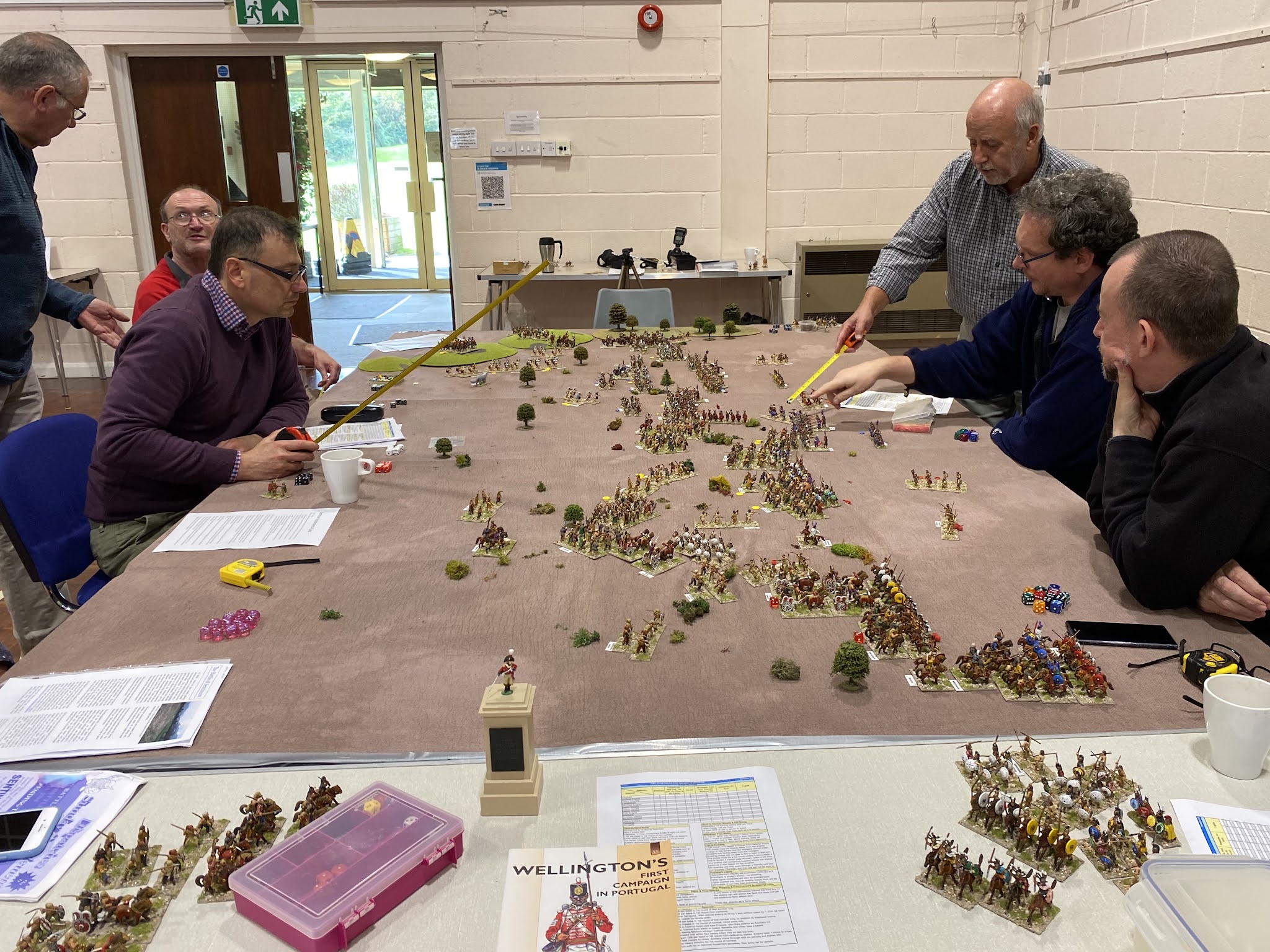
Tim Cull and members of the Farnborough Wargames Club presented The Battle of Sentium (295 BCE). 12' x 6' table with 6 well-briefed players.

At the other end of the scale was Steve Johnson's Napoleonic battle,
using a scenario from Grant and Asquith's Scenarios For All Ages. 3' x 2' table.

Stuart C and the Cirencester Wargames Club brought a Renaissance game,
with Poles against an Ottoman army. 12' x 4' table

This is JP's great-looking Napoleonic game, The Battle of Dollitz, using General d'Armee.
Another biggie on a 12' x 6' table.

Equally lovely was this ACW game led by Keith McWilliam.
Another 12' x 4' game. 

Couldn't miss out the train. Nice!

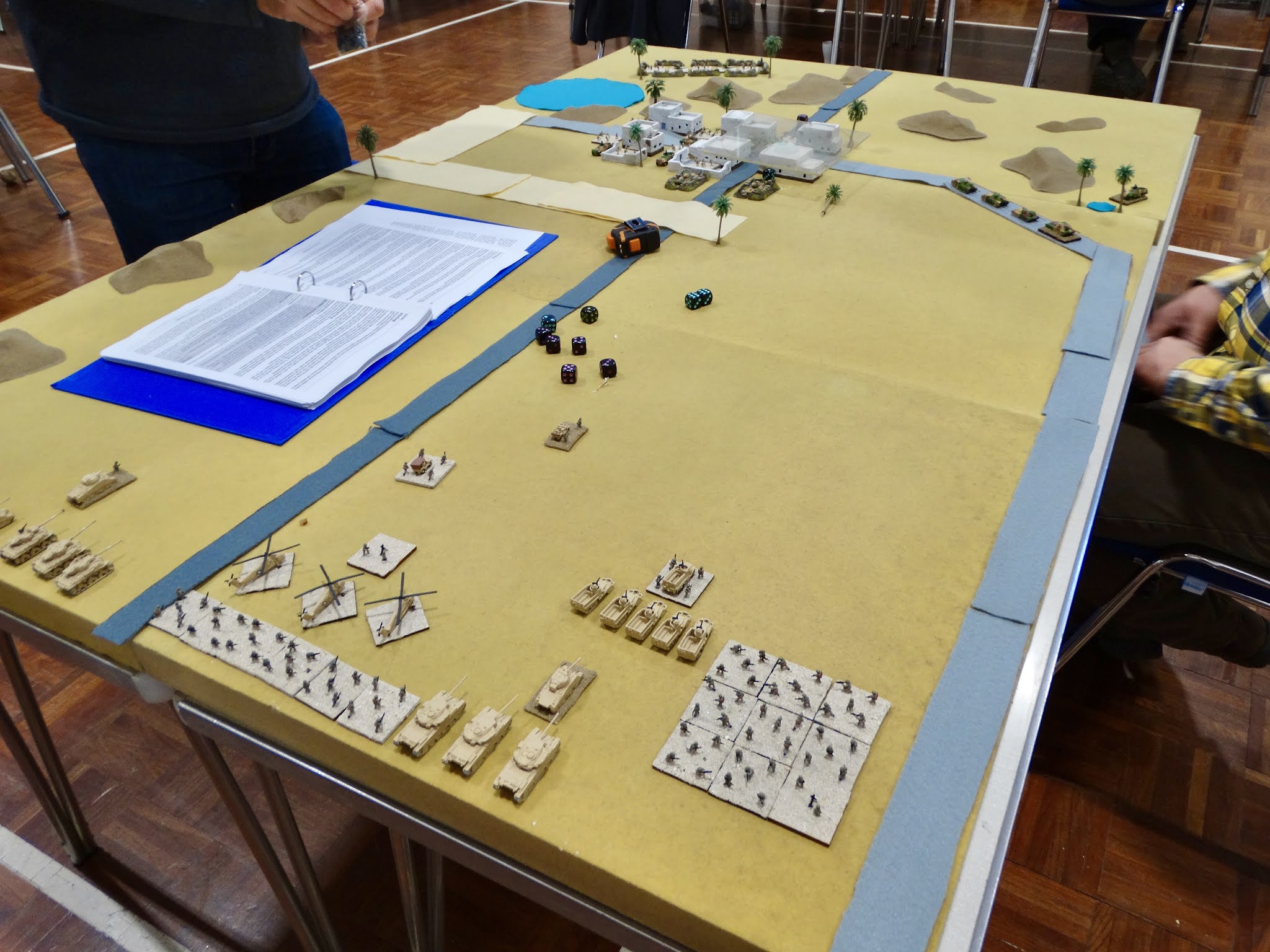
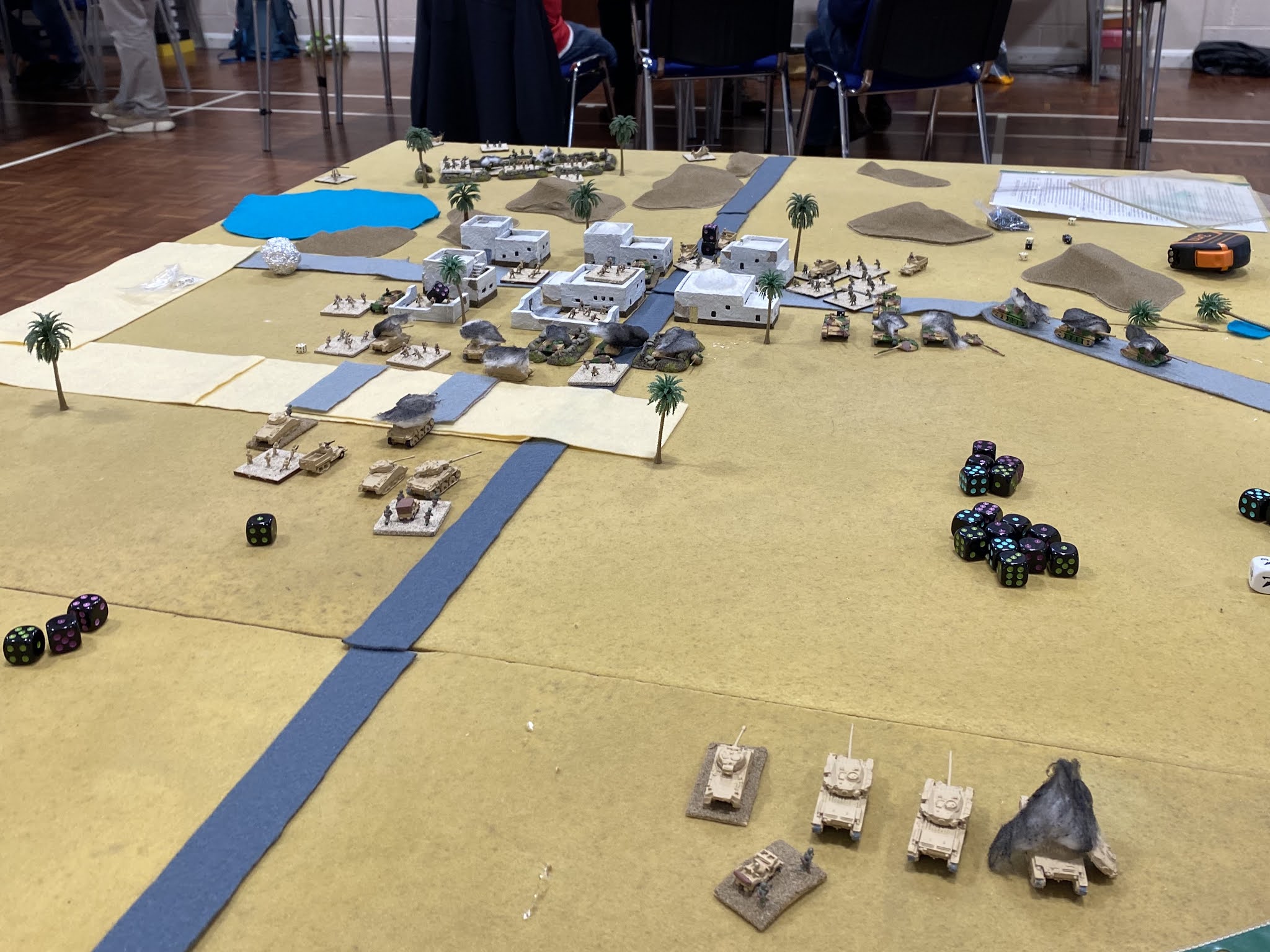
My old buddy Paul put together a Cold War Commander game
featuring a battle from the 1967 'Six Day War'. 

No wargames show would be complete without someone using a plastic beaten zone.

In the side room Dave Kenyon and friends had set up a 6' x 4' table
with a Sharp Practice game set in the French-Indian War.

Game 8 was Jon Billington's WW2 game using the old
Battlegroup Panzergrenadier rules from 2002.

The Winners
I think everyone was a winner on the day, but I like to have a light-hearted prize giving to say thanks to those who take so much trouble to put on games. I have kept in touch with Stuart Asquith's son Tom, and was delighted when he agreed to come along and present the prizes, as his father had done 2 years ago. Tom also judged the prizes in conjunction with myself and Jon Billington. Thank you so much Tom.

Best Game and the Stuart Asquith Trophy went to Tim Cull. An impressive game,
with a lot of effort put into historical background and player briefing.
Plus some very high quality figures.

Best Figures - Steve Johnson. Tom was very taken by the 10mm MDF figures
Steve was using, and felt Stuart would have loved them.

Best terrain went to JP. A really attractive game which drew you in with its visual appeal.

Honourable mentions to the other 5 gamers who braved the fuel shortage
to put on games we could all enjoy. Thank you gentlemen.

Eye Candy
Pictures of rather better quality are available at a couple of other blogs, Wargaming Addict and Battlefields and Warriors. Below are a few close ups of some of the action, and pictures of gamers enjoying themselves. Which is always good.

Cavalry clash at the Battle of Dollwitz.

Crazy-good figures and models.

Dollwitz again. A fine spectacle.

The ACW game gets going.

Steve's now-famous MDF figures are from Commision Figurines.

More terrific figures in Dave's FIW game.

Gamers having fun. 

The Arab-Israeli game from the Israeli side.

More gamers having fun.

Did I mention the terrific figures?

'Best Game'. 

Oh, for goodness sake stop enjoying yourselves.

Jon's game used the 'Pont de la Croix' scenario from
Gavin Lyall's 1976 classic, Operation Warboard. Very high nostalgia value.

A man and his game. Dave Kenyon with his FIW skirmish set up.

The day flew by, and I loved every minute. So many people came up to me to say thanks and what a great day it had been that it started to get embarrassing. I think this is something clubs and groups of gamers all over the country should consider - hire a hall and invite local gamers to showcase what they're doing. It makes a great halfway house between everyday gaming and the big shows. 

Partizan on Sunday. Phew! Hope to see you there!