Followers

Wednesday, 21 September 2022

In Which I Actually Play A Couple Of Games

Yes comrades, a lot of my time recently has been spent in front of my laptop trying to develop an updated version of the 1973 WRG Armour and Infantry rules. These efforts are now bearing some wothwhile fruit, but it was good last week to be able to indulge in two real wargames with real opponents. We all have our own individual ways of enjoying our hobby, and for me in the last few months this has meant too much time researching and writing, and insufficient time actually wargaming. I needed to remind myself why all this research and writing was taking place.

Game 1 - The Battle of... erm... Roy's Wargaming Room.
It was way past time for me to return the remaining figures that Roy had lent me for my Waterloo game in early August. So it made sense to arrange a game at the same time. Eager for a change of scene from WW2, I took up Roy's suggestion of a game of Armati, one of Roy's favourite ancients rule sets and one in which he is well practised. We used Armati 2, an update of the original rules dating from 2004, and although to gamers of my age this seems like a fairly recent publication date, in the rapidly changing world of wargaming rules Armati 2 is out of print and quite hard to get hold of.

This is a shame, as the games I have played under Roy's guidance have revealed a basically straightforward set which requires players to use historical tactics and which plays quite briskly. This particular battle pitted late Romans against a Goth army in the mid-4th century C.E. This was a battle quickly set up 'on the hoof', and I'm afraid I can't give details of all the units in use, but the Gothic army was, of course, larger, a bit lower in quality, and had lots of cavalry. The figures used were 20mm in size and mostly Newline Designs - a very impressive collection indeed.

We each set up behind a blind lowered across the centre of the table (a lovely old school touch which is part of Roy's very fancy wargames room). We found we needed a table extending to 8 feet wide to fit in the armies in use (particularly the Goths), with their very linear deployments, but depth was kept to 4 feet. The terrain was simple, but a sketch map is given below. Two gentle hills, two woods, and a road that was basically decorative:


A close-up of a Goth infantry base, just to demonstrate the quality of Roy's figures.

The Goth's (under my uncertain control) charged down off their hill.

The long, thin Goth 'divisions' made manoeuvre awkward - as doubtless it was in real life.

Goth left wing cavalry meets Roman right wing cavalry.

Roy niftily detached some light cavalry and caught me in the flank.

The infantry slogging match gets underway.

You can see that the Goths had a second line of infantry, but under the standard Armati victory conditions my army buckled before they could be engaged. So, I lost the battle but had a couple of very entertaining hours gaming. I am currently wondering whether some of the approach of these rules (mostly regarding movement restrictions) should be incorporated into house rules for Kings of War Historical, the ancient set I am currently using. KoWH is good on playability, but its roots in fantasy gaming mean that historical flavour is sometimes lacking. 

Game 2 - Poland, early September 1939
Game 1 was Monday, and Friday saw me heading up to Birmingham for a WW2 game with Paul. It was time to test out the latest version of my WRG amendments. 

I chose to use a scenario from the Battlegroup Blitzkrieg rule book, entitled 'Forward The Uhlans'. This pits Poles from the 10th Mechanised Brigade against Germans from the 2nd Panzer Division. The terrain was as per the book, whilst the OOB was amended for the WRG rules - basically, this was an encounter battle with each side having 2 platoons of motorised infantry, 2 platoons of tanks, and some fairly light off-table fire support. Oh, and a couple of recce units out in front for the first couple of moves before the main forces entered the table. For a change, the baselines are the short edges of a 6' x 4' table. I brought over my 15mm Poles, whilst Paul provided (and commanded) the Germans.

Table set-up. Objectives were the church on the left,
the road junction, and the farm seen on the right.

Well into the game, and the Poles have gained the junction and farm.
The church is firmly in German hands.

Polish tanks and infantry around the village and road junction.

The German right flank battlegroup sets up to attack the farm.

In the village, both sides struggled to advance across open ground.
A fierce firefight ensued with tanks supporting infantry sheltering in the houses.

Tankettes and infantry advance in the Polish centre, attempting to
threaten the impending German advance against the farm.

The Polish left flank tank platoon takes casualties at the farm.

German light tanks providing fire support in the village.

In the end, the engagement turned into a bit of a slugging match, particularly in the village, which the Germans won. The German attack against the farm succeeded, with many Polish tanks lost. Both Polish tank platoons ended up under half strength, whilst their German opponents only lost a couple of vehicles. It was time for me to head home, and I had no choice but to concede to Paul.

This was a very valuable playtest, which showed up issues in the amended morale rules and in one or two other areas. But the basic moving and fighting rules seemed solid enough, and work quickly and simply - a tribute to Mr Barker's original work.

Gaming is Good
As usual, it was good to get playing again. Sometimes I find it strangely easy to lose sight of the fact that playing games is the core of the hobby! I was fortunate to have two excellent opponents, both knowledgeable but relaxed in their approach. Just what I needed.

Well, the Cotswold Wargaming Day beckons on Sunday next. Should be a blast - a report will surely follow in the not-too-distant future.

'Til then comrades!

Sunday, 11 September 2022

New Figure Ranges

It is of course many decades since 6mm figure ranges started being produced, with their advantages of easy storage and large batttles on smaller tables. Recently 3mm and 2mm ranges have also been developed, taking the concept further. Now some new figure ranges from Iron Bollocks Miniatures are making a bit of a splash.

You may have heard elsewhere about IBM's 0mm figures, but I wanted to flag them up here as, for me at least, they seem like a great new concept with many advantages. But first a few photos of some sample figures and models I ordered recently:

From IBM's 0mm Napoleonics range. Imperial Guard infantry with skirmishers in front.

These Roman Legionaries show the incredible detail that IBM
have managed to include in these small figures.

A close up of a Sherman Firefly troop.

Besides the possibility of creating really big battles on a small table, there are many other benefits. Perhaps most significantly, the figures look just as good unpainted as painted, as the photo below shows:

The difference from the fully painted figures is practically unnoticeable at 'wargaming ranges'.

But let me assure you, painting these figures is not the chore that some might have you believe, even if you're one of those with the highest standards. I managed to produce the results you see in the photos in no time at all, using absolutely no paint whatsoever. Picking out the detail really is no problem. That could be quite a significant selling point. 

Basing is also made really simple. Some gamers have actually started using these figures unbased:

A Spartan pike phalanx left unbased - still looking good!

Even if you're a traditionalist and take the time to base these babies up, you'll quickly appreciate another ground-breaking advantage - storage. Storage immediately ceases to be an issue, as the bases can be stacked on top of one another without damaging the figures. Even more interestingly, gamers taking the 'unbased' option have found that no storage space at all is required. Existing cupboards already full of clothes and other household items can be used with ease.

I think the images above also demonstrate that you don't have to always use close-ups to create good photos, as some have claimed. Photographing these models is a breeze. The above are only quick snaps, but they compare well with the professional efforts on the IBM site and recent magazine articles. Another advantage for both bloggers and magazine editors!

Finally, what about the 'big army look' that small scale gamers claim for their models? The photo below gives you an idea of how this can be achieved. Having been impressed by the samples, I decided to splash out on opposing Austrian and Prussian SYW armies, each of about 500 figures. The painting process went by in a flash, and (being a bit lazy), I decided to leave them unbased.  Nevertheless, I was really impressed by the results:

Over a thousand figures on a 3' x 3' table - and still plenty of room for manoeuvre.
Quite a sight!

Personally, I reckon these figures could be something of a revolution in gaming. There are, of course, some stick-in-the-muds who are making much of issues around how to tell units apart at this small scale. Admittedly, it can be tricky to tell a 6pdr anti-tank gun from a ballista without closely inspecting the models, but attaching labels or writing underneath the bases easily solves this. How to measure ranges and moves using unbased figures can be an issue, but as always, good basing is needed anyway to really show off your armies.

Is 0mm the 'one true scale' gamers have been looking for all these years? I guess we'll see how sales go. Certainly something to look out for as the show season gets under way.

'Til next time comrades!

Tuesday, 6 September 2022

More 3D Printed Vehicles

This will be the last post on this subject for  the forseeable future - promise! I think I've filled in all the gaps that need to be filled in my 1939 collection.

Firstly, I obtained a couple of FT-17s from a French guy who sells on Etsy, mainly doing French WW1 vehicles. Follow this link. As I have come to expect, top quality models at a reasonable price.

FT-17 in standard Polish 1939 camo.

A rare colour photo gives an idea of the original camouflage look.

Secondly, Garry at Paint and Glue provided a couple of Polish armoured cars to upgrade my recce options.

Wz.34 on the left, Wz.39 Ursus on the right.
Painting only just started!

And finally, I tried out Battlefield 3D for an Sdkfz 221 model.

221 on the left, compared with a Zvezda Sdkfz 222.

I'm very happy with all these purchases and can recommend all the sellers concerned. This journey into 3D printed models has been a delight. At last, accurate, freely available and reasonably-priced models can be purchased for what remains a bit of a niche period for WW2 gaming.

I'm hoping  a real, actual game report will follow in a week or two and some of these models can be seen in action.

'Til next time!

Tuesday, 26 July 2022

The 3D Printing Revolution

From The Particular...
In a post from April I wrote about how the unavailability of vehicle models for the 1939 Polish campaign was being solved by the growth of 3D printing. Since then I've managed to locate other sources of tanks and soft skins for this era, and this post is here to pass on links to some great 3D printing sources, and show you how I've been getting on with expanding my collection.

Vickers 6 ton tank, single turret version, in Polish service 1939.

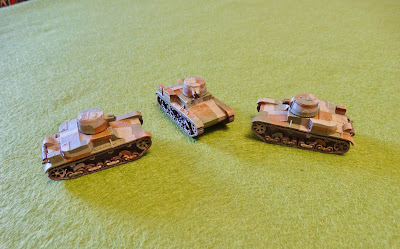
In April I got some great 7tp tank models from 3D Printing Valley (also check out their eBay store), and was lucky enough to get a tip regarding Paint And Glue Miniatures. Garry at Paint and Glue has a great range of Polish-campaign models, and I was able to order Vickers 6-ton tanks in both single and twin turret versions, as well as some rare soft skins and a model of the very rare TKS-D tank hunter.

'Standard' platoon of 3 single turret Vickers tanks and 2 twin turret.
This is how they arrived, straight out of the packaging.

Close-up of the single turret tank (or 'Type B' to be more accurate).

'Type A' twin turret vehicle after a light sand base coat.

Three finished Type B models.

As you can see, these are all very nice models indeed. Garry has twin turret tanks with both the wz.25 air-cooled mgs or the wz.30 water-cooled guns. The models match the 7tp models from 3D Printing perfectly.

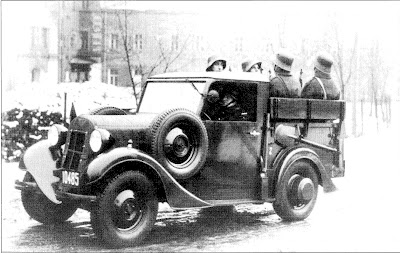
Paint and Glue also do a number of versions of the Polski-Fiat PF508 'jeep', or light truck. I went for a couple each of the pick-up and radio vehicle versions.

PF508 Furgon pick-up, with a standard load of a 4-man squad.

PF508 Furgon in Polish service.

PF508 pick-up with the radio van version (in undercoat only).

Comparison with the old True North Miniatures Lazik jeep, a vehicle which used
the same chassis. True North seem to be another extinct trader.

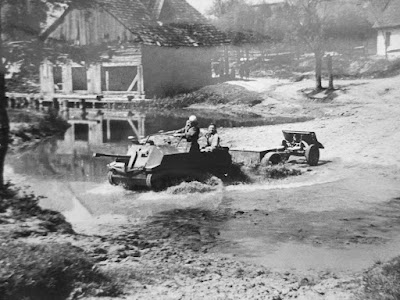
And so to the pièce de résistance - the TKS-D. This was a TKS tankette with the superstructure cut down to take a 37mm anti-tank gun. Only 2 were converted, but they appear to have seen service with the Polish 'Black Brigade' in September 1939.

TKS-D on manoeuvres. This shows the design concept of either towing a 37mm gun,
or mounting the gun itself in the vehicle, whilst still towing the gun chassis (as here).

The Jagdtiger of its day! Not. TKS-D looking menacing.

The Paint and Glue model. The crew figures need to be added.

Paint and Glue also do the TKD, a self-propelled 47mm gun version of the TKS tankette, of which only one was made but which may have seen service. Models of a couple of experimental SP-tankette prototypes are also available. Plus motorcycles and other stuff. All great fun.  

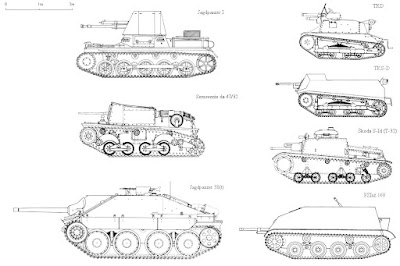
Side view comparisons of light tank-hunters, for the geek in you!

All TKS-D images and the Vickers 6 ton side-view were found on the excellent PIBWL Military Site, run by Michal Derela. Re-produced by permission. There is no better source (online or in print) for Polish tanks and armoured forces in 1939.

...To The General
3D printing seems to be a great new addition to our hobby. Many of you will be way ahead of me here - a Google search for '3D printing wargaming' creates access to a whole new world for a rather ill-informed grognard such as myself. 

Getting into 3D printing for wargaming is really a hobby in itself, as this gentleman explains. The creation of the files required for the printers, from drawings or hand made models, is a highly technical and skilled process requiring considerable knowledge (especially of CAD techniques), and much practice. The process of printing is also far from straightforward and requires much trial and error, as any number of online 'how to' videos will demonstrate. The kit required for all this can also be pretty expensive. However, this fascinating video on creating an entire fantasy army with 3D printing indicates what can be achieved. Or check out the possiblities offered by Wargaming 3D

Given the many difficulties of the process, I am actually quite surprised at the availabilty, accuracy and reasonable pricing of the finished models I have encountered. The quality is also improving all the time - the rather off-putting models I first encountered a year ago with their stepped surfaces seem to have all but disappeared.

For most of us, 3D printing means we now have access to a whole new world of top quality military vehicle models and model figures. The 'cottage industry' world of the 70s and 80s has returned, and our reliance on what the bigger companies will produce is dramatically reduced. Hobby enthusiasts can have a sideline that makes them a bit of money, working out of a garage or hobby room, and they can provide us with models that are usually superior to the cast metal or resin models that we have been buying for the past few decades. In this respect, the balance of power has shifted back to the grass roots, which I think is a very good thing. No doubt the bigger companies will be on to this technology shortly, but hopefully the access to smaller retailers and rare models will continue.

I have mentioned only a few sources for models in this post - many of you will know of others. Let me know via a comment if you have other traders to recommend. The most regularly publicised source I know of is Butlers Printed Models (who at the moment don't do any Polish 1939 models). I have also recently discovered Battlefield 3D with their extensive product range.

All we need now is the arrival of colour-printed 3D models. Then all that tedious painting will no longer be needed, and the hobby could really find a new lease of life. Who knows how long that will be?

'Til next time!

EDIT 14th August 2022
Check out this video from Paint and Glue Miniatures which shows how the models get produced. Certainly an eye-opener for me.

Saturday, 23 July 2022

Cotswold Wargaming Day 2022 - update

Just a quick shout out that the Cotswold Wargaming Day is still on, as advertised:

Sunday 25th September 2022
Westwoods Community Centre
Bassett Road
Northleach
Cheltenham
Gloucestershire
GL54 3QJ
08.30 - 17.00


An email has just gone out to all on the mailing list - check your inboxes guys! If you're interested in putting on a game and haven't been in touch, just leave a comment. There may still be space. If you're interested in just attending - no further action required. Just come along and say hello.

It looks like attendance for 2022 should be either as good as last year or better. I'll see you on the beach!

Friday, 15 July 2022

Waterloo 2022 with 'Shadow of the Eagles'

Last Sunday I had the great pleasure of organising and presenting a re-fight of Waterloo at my local community centre. I won't say much here, but a very enjoyable day was had. For a full report, see my post on the Shadow of the Eagles blog:


Hougomont under attack. The chateau and orchard are held by British Guards battalions,
whilst Brunswick reinforcements arrive via the famous North Gate.

I hope you enjoy the account! 

Monday, 6 June 2022

Control The River - A 'Shadow Of The Eagles' Scenario

Just a quick post to flag up a recent SotE game I had with my old buddy Steve. Of particular interest as it uses a table just 4' x 3', and really distinctive 10mm MDF figures. The game in question is scenario 2 from the rulebook itself.


Steve has put out a fine post detailing the action, so I won't tread on his toes by doing the same here. However, there is a supporting post on the SotE blog which adds a few points on the rules and how they functioned.

Angus Konstam
Angus is of course a prolific and highly respected military history author, as well as a well-known wargamer.  I can't resist flagging up Angus's Orkney Wargames blog, as Angus has been trying out SotE recently and seems to be enjoying them. Well worth a visit for the wide variety of games played in all periods.

Hope to see you soon with a bigger post about something really interesting! If I can work out what that might be.

'Til next time!